
- Current location: Home > Spring Fling > Treasure Island
Treasure Island
Published:2026-07-30 06:59:32 Source: engineering kits for 11 year olds under 30 dollars Author: Stress Relief Toys
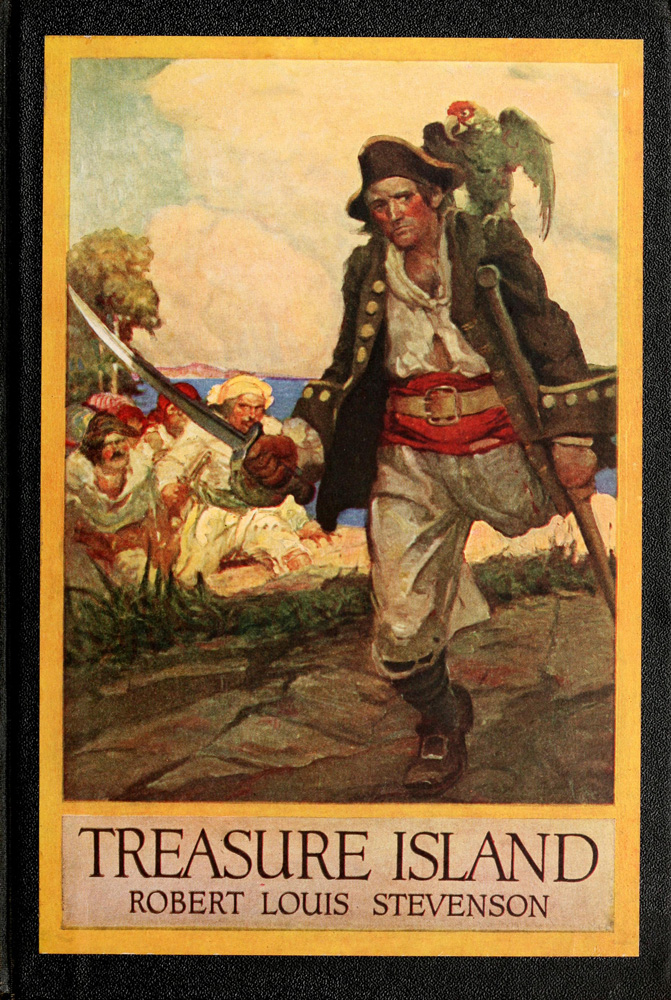
TREASURE ISLAND
by Robert Louis Stevenson
Illustrated by Louis Rhead
| TREASURE ISLAND |
| PART ONE—The best robot figures for 4 year olds under 20 dollarsOld Buccaneer |
| I. The Old Sea-dog at the “Admiral Benbow” |
| II. Black Dog Appears and Disappears |
| III. The Black Spot |
| IV. The Sea-chest |
| V. The Last of the Blind Man |
| VI. The Captain’s Papers |
| PART TWO—The Sea-cook |
| VII. I Go to Bristol |
| VIII. At the Sign of the Spy-glass |
| IX. Powder and Arms |
| X. The Voyage |
| XI. What I Heard in the Apple-Barrel |
| XII. Council of War |
| PART THREE—My Shore Adventure |
| XIII. How I Began My Shore Adventure |
| XIV. The First Blow |
| XV. The Man of the Island |
| PART FOUR—The Stockade |
| XVI. Narrative Continued by the Doctor: How the Ship Was Abandoned |
| XVII. Narrative Continued by the Doctor: The Jolly-boat’s Last Trip |
| XVIII. Narrative Continued by the Doctor: End of the First Day’s Fighting |
| XIX. Narrative Resumed by Jim Hawkins: The Garrison in the Stockade |
| XX. Silver’s Embassy |
| XXI. The Attack |
| PART FIVE—My Sea Adventure |
| XXII. How I Began My Sea Adventure |
| XXIII. The Ebb-tide Runs |
| XXIV. The Cruise of the Coracle |
| XXV. I Strike the Jolly Roger |
| XXVI. Israel Hands |
| XXVII. “Pieces of Eight” |
| PART SIX—Captain Silver |
| XXVIII. In the Enemy’s Camp |
| XXIX. The Black Spot Again |
| XXX. On Parole |
| XXXI. The Treasure-hunt—Flint’s Pointer |
| XXXII. The Treasure-hunt—The Voice Among the Trees |
| XXXIII. The Fall of a Chieftain |
| XXXIV. And Last |
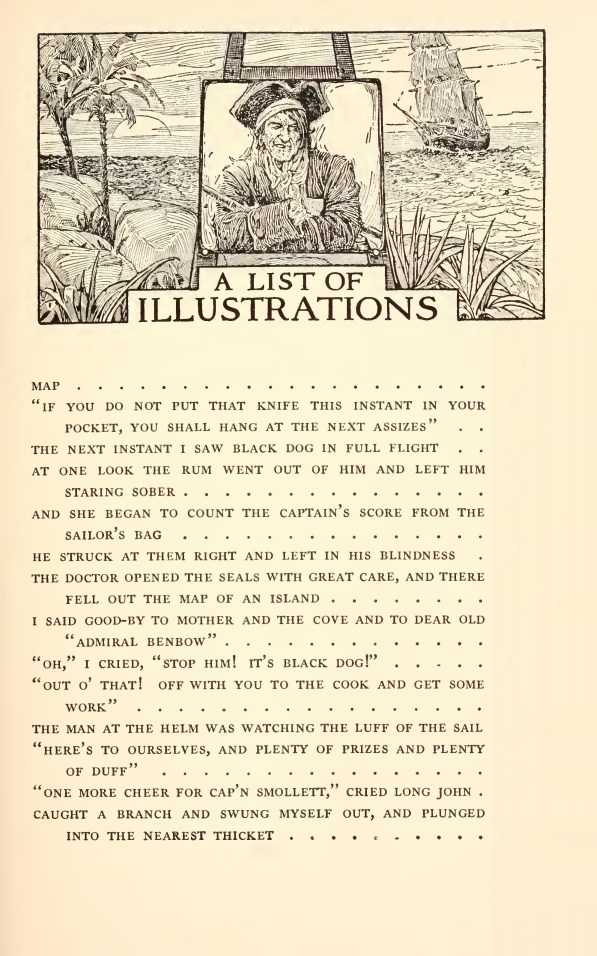
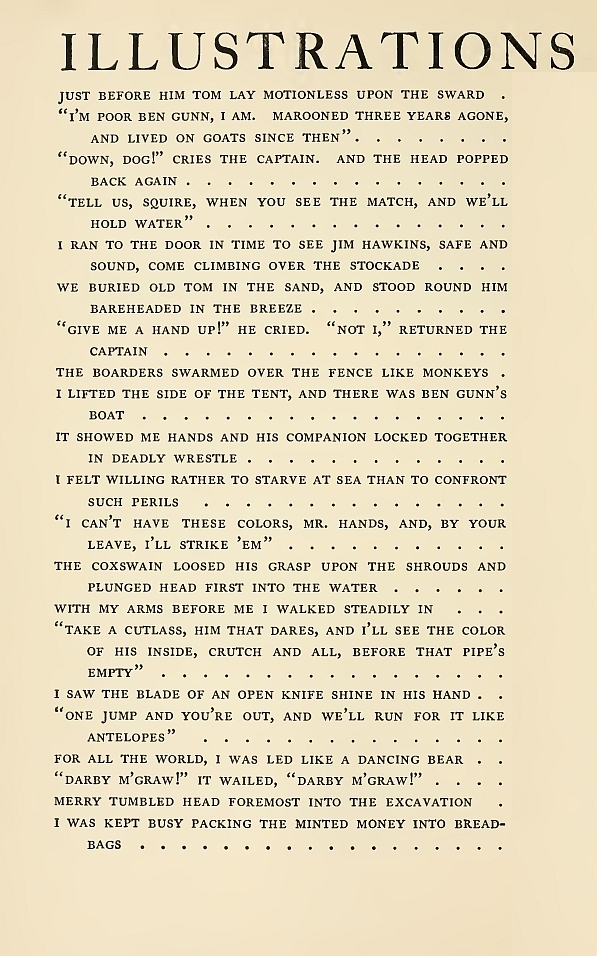
TREASURE ISLAND
To S.L.O., an American gentleman in accordance with whose classic taste thefollowing narrative has been designed, it is now, in return for numerousdelightful hours, and with the kindest wishes, dedicated by his affectionatefriend,
the author.
TO THE HESITATING PURCHASER
If sailor tales to sailor tunes,
Storm and adventure, heat and cold,
If schooners, islands, and maroons,
And buccaneers, and buried gold,
And all the old romance, retold
Exactly in the ancient way,
Can please, as me they pleased of old,
The wiser youngsters of today:
—So be it, and fall on! If not,
If studious youth no longer crave,
His ancient appetites forgot,
Kingston, or Ballantyne the brave,
Or Cooper of the wood and wave:
So be it, also! And may I
And all my pirates share the grave
Where these and their creations lie!

TREASURE ISLAND
PART ONE—The Old Buccaneer
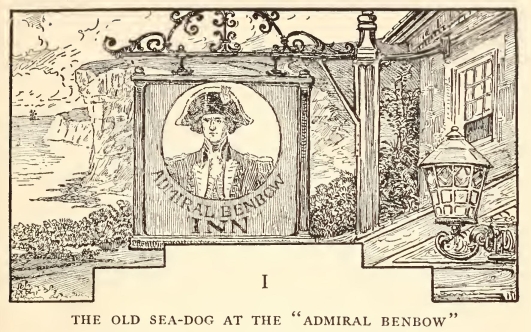
I
The Old Sea-dog at the “Admiral Benbow”
quire Trelawney, Dr. Livesey, and the rest of these gentlemen having asked meto write down the whole particulars about Treasure Island, from the beginningto the end, keeping nothing back but the bearings of the island, and that onlybecause there is still treasure not yet lifted, I take up my pen in the year ofgrace 17—, and go back to the time when my father kept the Admiral Benbow innand the brown old seaman with the sabre cut first took up his lodging under ourroof.
I remember him as if it were yesterday, as he came plodding to the inn door,his sea-chest following behind him in a hand-barrow—a tall, strong, heavy,nut-brown man, his tarry pigtail falling over the shoulder of his soiled bluecoat, his hands ragged and scarred, with black, broken nails, and the sabre cutacross one cheek, a dirty, livid white. I remember him looking round the coveand whistling to himself as he did so, and then breaking out in that oldsea-song that he sang so often afterwards:
“Fifteen men on the dead man’s chest—
Yo-ho-ho, and a bottle of rum!”
in the high, old tottering voice that seemed to have been tuned and broken atthe capstan bars. Then he rapped on the door with a bit of stick like ahandspike that he carried, and when my father appeared, called roughly for aglass of rum. This, when it was brought to him, he drank slowly, like aconnoisseur, lingering on the taste and still looking about him at the cliffsand up at our signboard.
“This is a handy cove,” says he at length; “and a pleasant sittyated grog-shop.Much company, mate?”
My father told him no, very little company, the more was the pity.
“Well, then,” said he, “this is the berth for me. Here you, matey,” he cried tothe man who trundled the barrow; “bring up alongside and help up my chest. I’llstay here a bit,” he continued. “I’m a plain man; rum and bacon and eggs iswhat I want, and that head up there for to watch ships off. What you moughtcall me? You mought call me captain. Oh, I see what you’re at—there”; and hethrew down three or four gold pieces on the threshold. “You can tell me whenI’ve worked through that,” says he, looking as fierce as a commander.
And indeed bad as his clothes were and coarsely as he spoke, he had none of theappearance of a man who sailed before the mast, but seemed like a mate orskipper accustomed to be obeyed or to strike. The man who came with the barrowtold us the mail had set him down the morning before at the Royal George, thathe had inquired what inns there were along the coast, and hearing ours wellspoken of, I suppose, and described as lonely, had chosen it from the othersfor his place of residence. And that was all we could learn of our guest.
He was a very silent man by custom. All day he hung round the cove or upon thecliffs with a brass telescope; all evening he sat in a corner of the parlournext the fire and drank rum and water very strong. Mostly he would not speakwhen spoken to, only look up sudden and fierce and blow through his nose like afog-horn; and we and the people who came about our house soon learned to lethim be. Every day when he came back from his stroll he would ask if anyseafaring men had gone by along the road. At first we thought it was the wantof company of his own kind that made him ask this question, but at last webegan to see he was desirous to avoid them. When a seaman did put up at theAdmiral Benbow (as now and then some did, making by the coast road for Bristol)he would look in at him through the curtained door before he entered theparlour; and he was always sure to be as silent as a mouse when any such waspresent. For me, at least, there was no secret about the matter, for I was, ina way, a sharer in his alarms. He had taken me aside one day and promised me asilver fourpenny on the first of every month if I would only keep my“weather-eye open for a seafaring man with one leg” and let him know the momenthe appeared. Often enough when the first of the month came round and I appliedto him for my wage, he would only blow through his nose at me and stare medown, but before the week was out he was sure to think better of it, bring memy four-penny piece, and repeat his orders to look out for “the seafaring manwith one leg.”
How that personage haunted my dreams, I need scarcely tell you. On stormynights, when the wind shook the four corners of the house and the surf roaredalong the cove and up the cliffs, I would see him in a thousand forms, and witha thousand diabolical expressions. Now the leg would be cut off at the knee,now at the hip; now he was a monstrous kind of a creature who had never had butthe one leg, and that in the middle of his body. To see him leap and run andpursue me over hedge and ditch was the worst of nightmares. And altogether Ipaid pretty dear for my monthly fourpenny piece, in the shape of theseabominable fancies.
But though I was so terrified by the idea of the seafaring man with one leg, Iwas far less afraid of the captain himself than anybody else who knew him.There were nights when he took a deal more rum and water than his head wouldcarry; and then he would sometimes sit and sing his wicked, old, wildsea-songs, minding nobody; but sometimes he would call for glasses round andforce all the trembling company to listen to his stories or bear a chorus tohis singing. Often I have heard the house shaking with “Yo-ho-ho, and a bottleof rum,” all the neighbours joining in for dear life, with the fear of deathupon them, and each singing louder than the other to avoid remark. For in thesefits he was the most overriding companion ever known; he would slap his hand onthe table for silence all round; he would fly up in a passion of anger at aquestion, or sometimes because none was put, and so he judged the company wasnot following his story. Nor would he allow anyone to leave the inn till he haddrunk himself sleepy and reeled off to bed.
His stories were what frightened people worst of all. Dreadful stories theywere—about hanging, and walking the plank, and storms at sea, and the DryTortugas, and wild deeds and places on the Spanish Main. By his own account hemust have lived his life among some of the wickedest men that God ever allowedupon the sea, and the language in which he told these stories shocked our plaincountry people almost as much as the crimes that he described. My father wasalways saying the inn would be ruined, for people would soon cease coming thereto be tyrannized over and put down, and sent shivering to their beds; but Ireally believe his presence did us good. People were frightened at the time,but on looking back they rather liked it; it was a fine excitement in a quietcountry life, and there was even a party of the younger men who pretended toadmire him, calling him a “true sea-dog” and a “real old salt” and such likenames, and saying there was the sort of man that made England terrible at sea.
In one way, indeed, he bade fair to ruin us, for he kept on staying week afterweek, and at last month after month, so that all the money had been longexhausted, and still my father never plucked up the heart to insist on havingmore. If ever he mentioned it, the captain blew through his nose so loudly thatyou might say he roared, and stared my poor father out of the room. I have seenhim wringing his hands after such a rebuff, and I am sure the annoyance and theterror he lived in must have greatly hastened his early and unhappy death.
All the time he lived with us the captain made no change whatever in his dressbut to buy some stockings from a hawker. One of the cocks of his hat havingfallen down, he let it hang from that day forth, though it was a greatannoyance when it blew. I remember the appearance of his coat, which he patchedhimself upstairs in his room, and which, before the end, was nothing butpatches. He never wrote or received a letter, and he never spoke with any butthe neighbours, and with these, for the most part, only when drunk on rum. Thegreat sea-chest none of us had ever seen open.
He was only once crossed, and that was towards the end, when my poor father wasfar gone in a decline that took him off. Dr. Livesey came late one afternoon tosee the patient, took a bit of dinner from my mother, and went into the parlourto smoke a pipe until his horse should come down from the hamlet, for we had nostabling at the old Benbow. I followed him in, and I remember observing thecontrast the neat, bright doctor, with his powder as white as snow and hisbright, black eyes and pleasant manners, made with the coltish country folk,and above all, with that filthy, heavy, bleared scarecrow of a pirate of ours,sitting, far gone in rum, with his arms on the table. Suddenly he—the captain,that is—began to pipe up his eternal song:
“Fifteen men on the dead man’s chest—
Yo-ho-ho, and a bottle of rum!
Drink and the devil had done for the rest—
Yo-ho-ho, and a bottle of rum!”
At first I had supposed “the dead man’s chest” to be that identical big box ofhis upstairs in the front room, and the thought had been mingled in mynightmares with that of the one-legged seafaring man. But by this time we hadall long ceased to pay any particular notice to the song; it was new, thatnight, to nobody but Dr. Livesey, and on him I observed it did not produce anagreeable effect, for he looked up for a moment quite angrily before he went onwith his talk to old Taylor, the gardener, on a new cure for the rheumatics. Inthe meantime, the captain gradually brightened up at his own music, and at lastflapped his hand upon the table before him in a way we all knew to meansilence. The voices stopped at once, all but Dr. Livesey’s; he went on asbefore speaking clear and kind and drawing briskly at his pipe between everyword or two. The captain glared at him for a while, flapped his hand again,glared still harder, and at last broke out with a villainous, low oath,“Silence, there, between decks!”
“Were you addressing me, sir?” says the doctor; and when the ruffian had toldhim, with another oath, that this was so, “I have only one thing to say to you,sir,” replies the doctor, “that if you keep on drinking rum, the world willsoon be quit of a very dirty scoundrel!”
The old fellow’s fury was awful. He sprang to his feet, drew and opened asailor’s clasp-knife, and balancing it open on the palm of his hand, threatenedto pin the doctor to the wall.
The doctor never so much as moved. He spoke to him as before, over his shoulderand in the same tone of voice, rather high, so that all the room might hear,but perfectly calm and steady: “If you do not put that knife this instant inyour pocket, I promise, upon my honour, you shall hang at the next assizes.”
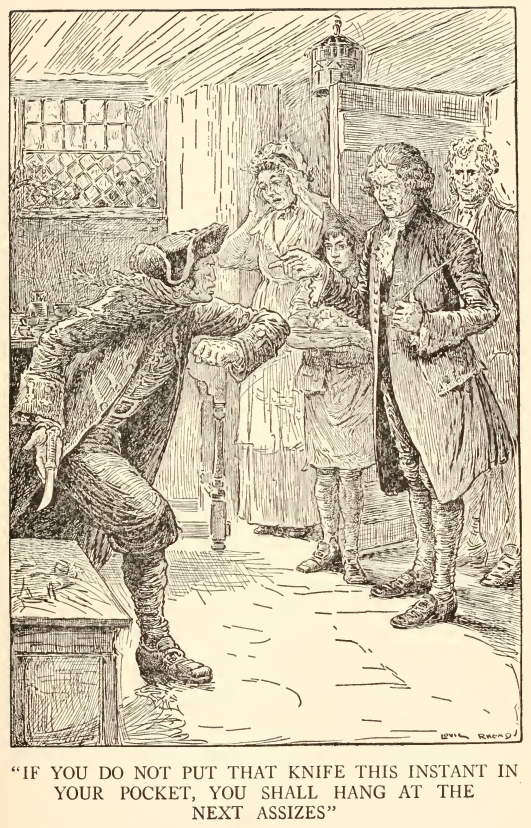
Then followed a battle of looks between them, but the captain soon knuckledunder, put up his weapon, and resumed his seat, grumbling like a beaten dog.
“And now, sir,” continued the doctor, “since I now know there’s such a fellowin my district, you may count I’ll have an eye upon you day and night. I’m nota doctor only; I’m a magistrate; and if I catch a breath of complaint againstyou, if it’s only for a piece of incivility like tonight’s, I’ll take effectualmeans to have you hunted down and routed out of this. Let that suffice.”
Soon after, Dr. Livesey’s horse came to the door and he rode away, but thecaptain held his peace that evening, and for many evenings to come.
II
Black Dog Appears and Disappears
t was not very long after this that there occurred the first of the mysteriousevents that rid us at last of the captain, though not, as you will see, of hisaffairs. It was a bitter cold winter, with long, hard frosts and heavy gales;and it was plain from the first that my poor father was little likely to seethe spring. He sank daily, and my mother and I had all the inn upon our hands,and were kept busy enough without paying much regard to our unpleasant guest.
It was one January morning, very early—a pinching, frosty morning—the cove allgrey with hoar-frost, the ripple lapping softly on the stones, the sun stilllow and only touching the hilltops and shining far to seaward. The captain hadrisen earlier than usual and set out down the beach, his cutlass swinging underthe broad skirts of the old blue coat, his brass telescope under his arm, hishat tilted back upon his head. I remember his breath hanging like smoke in hiswake as he strode off, and the last sound I heard of him as he turned the bigrock was a loud snort of indignation, as though his mind was still running uponDr. Livesey.
Well, mother was upstairs with father and I was laying the breakfast-tableagainst the captain’s return when the parlour door opened and a man stepped inon whom I had never set my eyes before. He was a pale, tallowy creature,wanting two fingers of the left hand, and though he wore a cutlass, he did notlook much like a fighter. I had always my eye open for seafaring men, with oneleg or two, and I remember this one puzzled me. He was not sailorly, and yet hehad a smack of the sea about him too.
I asked him what was for his service, and he said he would take rum; but as Iwas going out of the room to fetch it, he sat down upon a table and motioned meto draw near. I paused where I was, with my napkin in my hand.
“Come here, sonny,” says he. “Come nearer here.”
I took a step nearer.
“Is this here table for my mate Bill?” he asked with a kind of leer.
I told him I did not know his mate Bill, and this was for a person who stayedin our house whom we called the captain.
“Well,” said he, “my mate Bill would be called the captain, as like as not. Hehas a cut on one cheek and a mighty pleasant way with him, particularly indrink, has my mate Bill. We’ll put it, for argument like, that your captain hasa cut on one cheek—and we’ll put it, if you like, that that cheek’s the rightone. Ah, well! I told you. Now, is my mate Bill in this here house?”
I told him he was out walking.
“Which way, sonny? Which way is he gone?”
And when I had pointed out the rock and told him how the captain was likely toreturn, and how soon, and answered a few other questions, “Ah,” said he,“this’ll be as good as drink to my mate Bill.”
The expression of his face as he said these words was not at all pleasant, andI had my own reasons for thinking that the stranger was mistaken, evensupposing he meant what he said. But it was no affair of mine, I thought; andbesides, it was difficult to know what to do. The stranger kept hanging aboutjust inside the inn door, peering round the corner like a cat waiting for amouse. Once I stepped out myself into the road, but he immediately called meback, and as I did not obey quick enough for his fancy, a most horrible changecame over his tallowy face, and he ordered me in with an oath that made mejump. As soon as I was back again he returned to his former manner, halffawning, half sneering, patted me on the shoulder, told me I was a good boy andhe had taken quite a fancy to me. “I have a son of my own,” said he, “as likeyou as two blocks, and he’s all the pride of my ’art. But the great thing forboys is discipline, sonny—discipline. Now, if you had sailed along of Bill, youwouldn’t have stood there to be spoke to twice—not you. That was never Bill’sway, nor the way of sich as sailed with him. And here, sure enough, is my mateBill, with a spy-glass under his arm, bless his old ’art, to be sure. You andme’ll just go back into the parlour, sonny, and get behind the door, and we’llgive Bill a little surprise—bless his ’art, I say again.”
So saying, the stranger backed along with me into the parlour and put me behindhim in the corner so that we were both hidden by the open door. I was veryuneasy and alarmed, as you may fancy, and it rather added to my fears toobserve that the stranger was certainly frightened himself. He cleared the hiltof his cutlass and loosened the blade in the sheath; and all the time we werewaiting there he kept swallowing as if he felt what we used to call a lump inthe throat.
At last in strode the captain, slammed the door behind him, without looking tothe right or left, and marched straight across the room to where his breakfastawaited him.
“Bill,” said the stranger in a voice that I thought he had tried to make boldand big.
The captain spun round on his heel and fronted us; all the brown had gone outof his face, and even his nose was blue; he had the look of a man who sees aghost, or the evil one, or something worse, if anything can be; and upon myword, I felt sorry to see him all in a moment turn so old and sick.
“Come, Bill, you know me; you know an old shipmate, Bill, surely,” said thestranger.
The captain made a sort of gasp.
“Black Dog!” said he.
“And who else?” returned the other, getting more at his ease. “Black Dog asever was, come for to see his old shipmate Billy, at the Admiral Benbow inn.Ah, Bill, Bill, we have seen a sight of times, us two, since I lost them twotalons,” holding up his mutilated hand.
“Now, look here,” said the captain; “you’ve run me down; here I am; well, then,speak up; what is it?”
“That’s you, Bill,” returned Black Dog, “you’re in the right of it, Billy. I’llhave a glass of rum from this dear child here, as I’ve took such a liking to;and we’ll sit down, if you please, and talk square, like old shipmates.”
When I returned with the rum, they were already seated on either side of thecaptain’s breakfast-table—Black Dog next to the door and sitting sideways so asto have one eye on his old shipmate and one, as I thought, on his retreat.
He bade me go and leave the door wide open. “None of your keyholes for me,sonny,” he said; and I left them together and retired into the bar.
For a long time, though I certainly did my best to listen, I could hear nothingbut a low gattling; but at last the voices began to grow higher, and I couldpick up a word or two, mostly oaths, from the captain.
“No, no, no, no; and an end of it!” he cried once. And again, “If it comes toswinging, swing all, say I.”
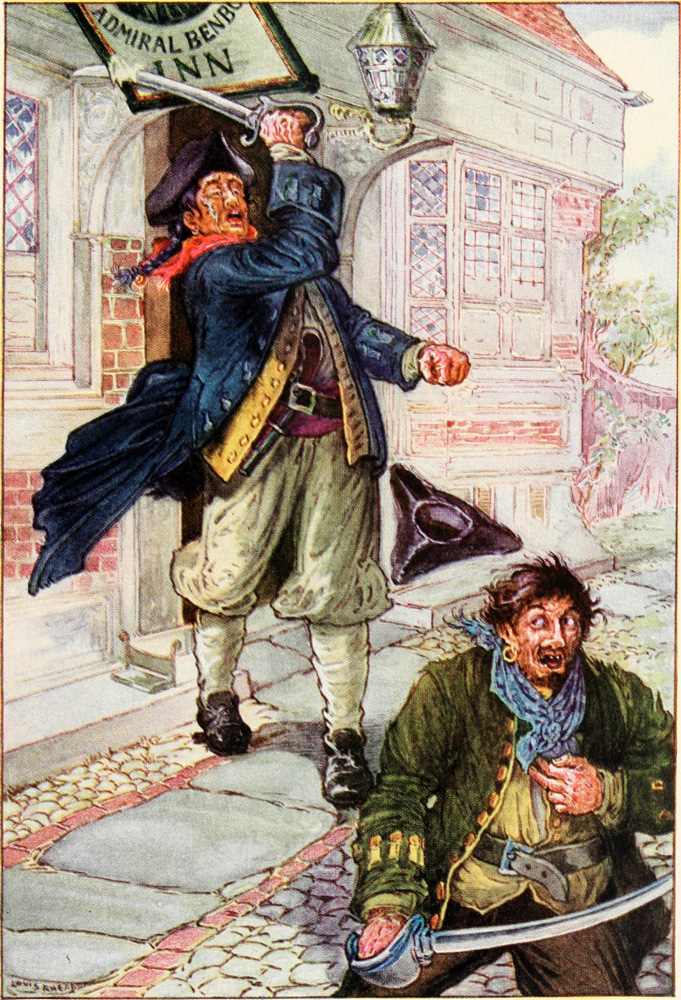
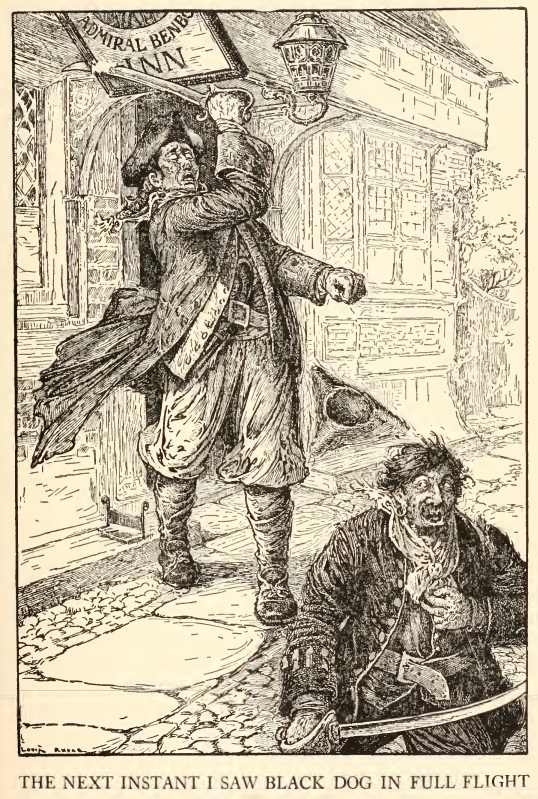
Then all of a sudden there was a tremendous explosion of oaths and othernoises—the chair and table went over in a lump, a clash of steel followed, andthen a cry of pain, and the next instant I saw Black Dog in full flight, andthe captain hotly pursuing, both with drawn cutlasses, and the former streamingblood from the left shoulder. Just at the door the captain aimed at thefugitive one last tremendous cut, which would certainly have split him to thechine had it not been intercepted by our big signboard of Admiral Benbow. Youmay see the notch on the lower side of the frame to this day.
That blow was the last of the battle. Once out upon the road, Black Dog, inspite of his wound, showed a wonderful clean pair of heels and disappeared overthe edge of the hill in half a minute. The captain, for his part, stood staringat the signboard like a bewildered man. Then he passed his hand over his eyesseveral times and at last turned back into the house.
“Jim,” says he, “rum”; and as he spoke, he reeled a little, and caught himselfwith one hand against the wall.
“Are you hurt?” cried I.
“Rum,” he repeated. “I must get away from here. Rum! Rum!”
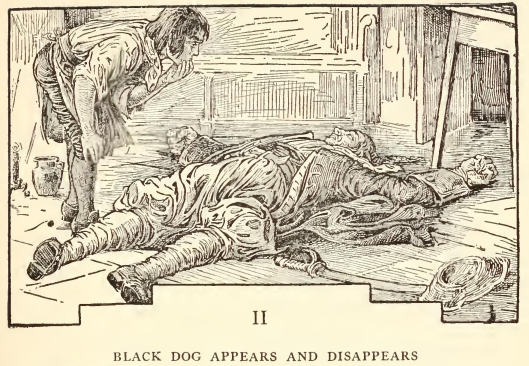
I ran to fetch it, but I was quite unsteadied by all that had fallen out, and Ibroke one glass and fouled the tap, and while I was still getting in my ownway, I heard a loud fall in the parlour, and running in, beheld the captainlying full length upon the floor. At the same instant my mother, alarmed by thecries and fighting, came running downstairs to help me. Between us we raisedhis head. He was breathing very loud and hard, but his eyes were closed and hisface a horrible colour.
“Dear, deary me,” cried my mother, “what a disgrace upon the house! And yourpoor father sick!”
In the meantime, we had no idea what to do to help the captain, nor any otherthought but that he had got his death-hurt in the scuffle with the stranger. Igot the rum, to be sure, and tried to put it down his throat, but his teethwere tightly shut and his jaws as strong as iron. It was a happy relief for uswhen the door opened and Doctor Livesey came in, on his visit to my father.
“Oh, doctor,” we cried, “what shall we do? Where is he wounded?”
“Wounded? A fiddle-stick’s end!” said the doctor. “No more wounded than you orI. The man has had a stroke, as I warned him. Now, Mrs. Hawkins, just you runupstairs to your husband and tell him, if possible, nothing about it. For mypart, I must do my best to save this fellow’s trebly worthless life; Jim, youget me a basin.”
When I got back with the basin, the doctor had already ripped up the captain’ssleeve and exposed his great sinewy arm. It was tattooed in several places.“Here’s luck,” “A fair wind,” and “Billy Bones his fancy,” were very neatly andclearly executed on the forearm; and up near the shoulder there was a sketch ofa gallows and a man hanging from it—done, as I thought, with great spirit.
“Prophetic,” said the doctor, touching this picture with his finger. “And now,Master Billy Bones, if that be your name, we’ll have a look at the colour ofyour blood. Jim,” he said, “are you afraid of blood?”
“No, sir,” said I.
“Well, then,” said he, “you hold the basin”; and with that he took his lancetand opened a vein.
A great deal of blood was taken before the captain opened his eyes and lookedmistily about him. First he recognized the doctor with an unmistakable frown;then his glance fell upon me, and he looked relieved. But suddenly his colourchanged, and he tried to raise himself, crying, “Where’s Black Dog?”
“There is no Black Dog here,” said the doctor, “except what you have on yourown back. You have been drinking rum; you have had a stroke, precisely as Itold you; and I have just, very much against my own will, dragged youheadforemost out of the grave. Now, Mr. Bones—”
“That’s not my name,” he interrupted.
“Much I care,” returned the doctor. “It’s the name of a buccaneer of myacquaintance; and I call you by it for the sake of shortness, and what I haveto say to you is this; one glass of rum won’t kill you, but if you take oneyou’ll take another and another, and I stake my wig if you don’t break offshort, you’ll die—do you understand that?—die, and go to your own place, likethe man in the Bible. Come, now, make an effort. I’ll help you to your bed foronce.”
Between us, with much trouble, we managed to hoist him upstairs, and laid himon his bed, where his head fell back on the pillow as if he were almostfainting.
“Now, mind you,” said the doctor, “I clear my conscience—the name of rum foryou is death.”
And with that he went off to see my father, taking me with him by the arm.
“This is nothing,” he said as soon as he had closed the door. “I have drawnblood enough to keep him quiet awhile; he should lie for a week where heis—that is the best thing for him and you; but another stroke would settlehim.”
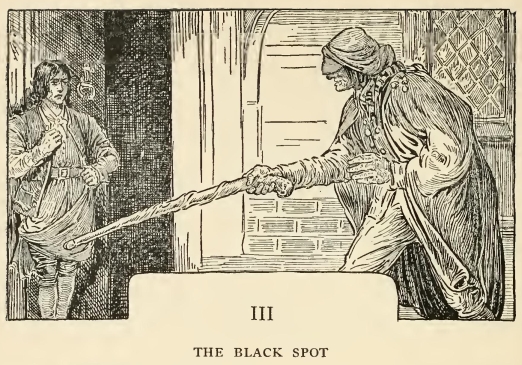
III
The Black Spot
bout noon I stopped at the captain’s door with some cooling drinks andmedicines. He was lying very much as we had left him, only a little higher, andhe seemed both weak and excited.
“Jim,” he said, “you’re the only one here that’s worth anything, and you knowI’ve been always good to you. Never a month but I’ve given you a silverfourpenny for yourself. And now you see, mate, I’m pretty low, and deserted byall; and Jim, you’ll bring me one noggin of rum, now, won’t you, matey?”
“The doctor—” I began.
But he broke in cursing the doctor, in a feeble voice but heartily. “Doctors isall swabs,” he said; “and that doctor there, why, what do he know aboutseafaring men? I been in places hot as pitch, and mates dropping round withYellow Jack, and the blessed land a-heaving like the sea with earthquakes—whatdo the doctor know of lands like that?—and I lived on rum, I tell you. It’sbeen meat and drink, and man and wife, to me; and if I’m not to have my rum nowI’m a poor old hulk on a lee shore, my blood’ll be on you, Jim, and that doctorswab”; and he ran on again for a while with curses. “Look, Jim, how my fingersfidges,” he continued in the pleading tone. “I can’t keep ’em still, not I. Ihaven’t had a drop this blessed day. That doctor’s a fool, I tell you. If Idon’t have a dram o’ rum, Jim, I’ll have the horrors; I seen some on ’emalready. I seen old Flint in the corner there, behind you; as plain as print, Iseen him; and if I get the horrors, I’m a man that has lived rough, and I’llraise Cain. Your doctor hisself said one glass wouldn’t hurt me. I’ll give youa golden guinea for a noggin, Jim.”
He was growing more and more excited, and this alarmed me for my father, whowas very low that day and needed quiet; besides, I was reassured by thedoctor’s words, now quoted to me, and rather offended by the offer of a bribe.
“I want none of your money,” said I, “but what you owe my father. I’ll get youone glass, and no more.”
When I brought it to him, he seized it greedily and drank it out.
“Aye, aye,” said he, “that’s some better, sure enough. And now, matey, did thatdoctor say how long I was to lie here in this old berth?”
“A week at least,” said I.
“Thunder!” he cried. “A week! I can’t do that; they’d have the black spot on meby then. The lubbers is going about to get the wind of me this blessed moment;lubbers as couldn’t keep what they got, and want to nail what is another’s. Isthat seamanly behaviour, now, I want to know? But I’m a saving soul. I neverwasted good money of mine, nor lost it neither; and I’ll trick ’em again. I’mnot afraid on ’em. I’ll shake out another reef, matey, and daddle ’em again.”
As he was thus speaking, he had risen from bed with great difficulty, holdingto my shoulder with a grip that almost made me cry out, and moving his legslike so much dead weight. His words, spirited as they were in meaning,contrasted sadly with the weakness of the voice in which they were uttered. Hepaused when he had got into a sitting position on the edge.
“That doctor’s done me,” he murmured. “My ears is singing. Lay me back.”
Before I could do much to help him he had fallen back again to his formerplace, where he lay for a while silent.
“Jim,” he said at length, “you saw that seafaring man today?”
“Black Dog?” I asked.
“Ah! Black Dog,” says he. “He’sa bad ’un; but there’s worse that puthim on. Now, if I can’t get away nohow, and they tip me the black spot, mindyou, it’s my old sea-chest they’re after; you get on a horse—you can, can’tyou? Well, then, you get on a horse, and go to—well, yes, I will!—to thateternal doctor swab, and tell him to pipe all hands—magistrates and sich—andhe’ll lay ’em aboard at the Admiral Benbow—all old Flint’s crew, man and boy,all on ’em that’s left. I was first mate, I was, old Flint’s first mate, andI’m the on’y one as knows the place. He gave it me at Savannah, when he laya-dying, like as if I was to now, you see. But you won’t peach unless they getthe black spot on me, or unless you see that Black Dog again or a seafaring manwith one leg, Jim—him above all.”
“But what is the black spot, captain?” I asked.
“That’s a summons, mate. I’ll tell you if they get that. But you keep yourweather-eye open, Jim, and I’ll share with you equals, upon my honour.”
He wandered a little longer, his voice growing weaker; but soon after I hadgiven him his medicine, which he took like a child, with the remark, “If ever aseaman wanted drugs, it’s me,” he fell at last into a heavy, swoon-like sleep,in which I left him. What I should have done had all gone well I do not know.Probably I should have told the whole story to the doctor, for I was in mortalfear lest the captain should repent of his confessions and make an end of me.But as things fell out, my poor father died quite suddenly that evening, whichput all other matters on one side. Our natural distress, the visits of theneighbours, the arranging of the funeral, and all the work of the inn to becarried on in the meanwhile kept me so busy that I had scarcely time to thinkof the captain, far less to be afraid of him.
He got downstairs next morning, to be sure, and had his meals as usual, thoughhe ate little and had more, I am afraid, than his usual supply of rum, for hehelped himself out of the bar, scowling and blowing through his nose, and noone dared to cross him. On the night before the funeral he was as drunk asever; and it was shocking, in that house of mourning, to hear him singing awayat his ugly old sea-song; but weak as he was, we were all in the fear of deathfor him, and the doctor was suddenly taken up with a case many miles away andwas never near the house after my father’s death. I have said the captain wasweak, and indeed he seemed rather to grow weaker than regain his strength. Heclambered up and down stairs, and went from the parlour to the bar and backagain, and sometimes put his nose out of doors to smell the sea, holding on tothe walls as he went for support and breathing hard and fast like a man on asteep mountain. He never particularly addressed me, and it is my belief he hadas good as forgotten his confidences; but his temper was more flighty, andallowing for his bodily weakness, more violent than ever. He had an alarmingway now when he was drunk of drawing his cutlass and laying it bare before himon the table. But with all that, he minded people less and seemed shut up inhis own thoughts and rather wandering. Once, for instance, to our extremewonder, he piped up to a different air, a kind of country love-song that hemust have learned in his youth before he had begun to follow the sea.
So things passed until, the day after the funeral, and about three o’clock of abitter, foggy, frosty afternoon, I was standing at the door for a moment, fullof sad thoughts about my father, when I saw someone drawing slowly near alongthe road. He was plainly blind, for he tapped before him with a stick and worea great green shade over his eyes and nose; and he was hunched, as if with ageor weakness, and wore a huge old tattered sea-cloak with a hood that made himappear positively deformed. I never saw in my life a more dreadful-lookingfigure. He stopped a little from the inn, and raising his voice in an oddsing-song, addressed the air in front of him, “Will any kind friend inform apoor blind man, who has lost the precious sight of his eyes in the graciousdefence of his native country, England—and God bless King George!—where or inwhat part of this country he may now be?”
“You are at the Admiral Benbow, Black Hill Cove, my good man,” said I.
“I hear a voice,” said he, “a young voice. Will you give me your hand, my kindyoung friend, and lead me in?”
I held out my hand, and the horrible, soft-spoken, eyeless creature gripped itin a moment like a vise. I was so much startled that I struggled to withdraw,but the blind man pulled me close up to him with a single action of his arm.
“Now, boy,” he said, “take me in to the captain.”
“Sir,” said I, “upon my word I dare not.”
“Oh,” he sneered, “that’s it! Take me in straight or I’ll break your arm.”
And he gave it, as he spoke, a wrench that made me cry out.
“Sir,” said I, “it is for yourself I mean. The captain is not what he used tobe. He sits with a drawn cutlass. Another gentleman—”
“Come, now, march,” interrupted he; and I never heard a voice so cruel, andcold, and ugly as that blind man’s. It cowed me more than the pain, and I beganto obey him at once, walking straight in at the door and towards the parlour,where our sick old buccaneer was sitting, dazed with rum. The blind man clungclose to me, holding me in one iron fist and leaning almost more of his weighton me than I could carry. “Lead me straight up to him, and when I’m in view,cry out, ‘Here’s a friend for you, Bill.’ If you don’t, I’ll do this,” and withthat he gave me a twitch that I thought would have made me faint. Between thisand that, I was so utterly terrified of the blind beggar that I forgot myterror of the captain, and as I opened the parlour door, cried out the words hehad ordered in a trembling voice.
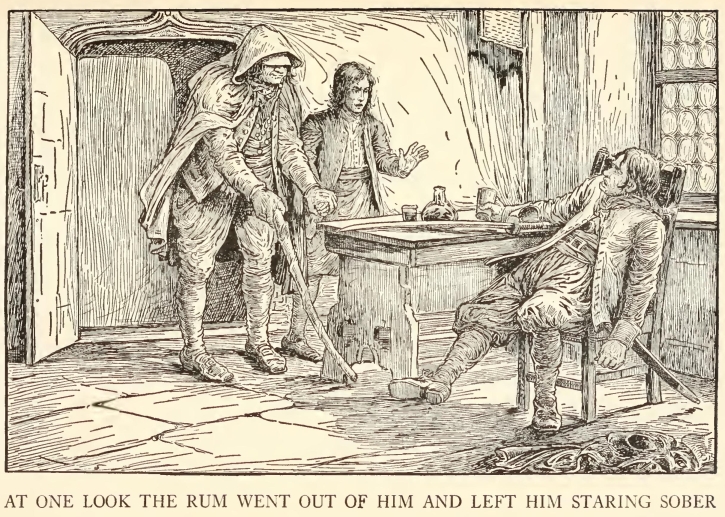
The poor captain raised his eyes, and at one look the rum went out of him andleft him staring sober. The expression of his face was not so much of terror asof mortal sickness. He made a movement to rise, but I do not believe he hadenough force left in his body.
“Now, Bill, sit where you are,” said the beggar. “If I can’t see, I can hear afinger stirring. Business is business. Hold out your left hand. Boy, take hisleft hand by the wrist and bring it near to my right.”
We both obeyed him to the letter, and I saw him pass something from the hollowof the hand that held his stick into the palm of the captain’s, which closedupon it instantly.
“And now that’s done,” said the blind man; and at the words he suddenly lefthold of me, and with incredible accuracy and nimbleness, skipped out of theparlour and into the road, where, as I still stood motionless, I could hear hisstick go tap-tap-tapping into the distance.
It was some time before either I or the captain seemed to gather our senses,but at length, and about at the same moment, I released his wrist, which I wasstill holding, and he drew in his hand and looked sharply into the palm.
“Ten o’clock!” he cried. “Six hours. We’ll do them yet,” and he sprang to hisfeet.
Even as he did so, he reeled, put his hand to his throat, stood swaying for amoment, and then, with a peculiar sound, fell from his whole height faceforemost to the floor.
I ran to him at once, calling to my mother. But haste was all in vain. Thecaptain had been struck dead by thundering apoplexy. It is a curious thing tounderstand, for I had certainly never liked the man, though of late I had begunto pity him, but as soon as I saw that he was dead, I burst into a flood oftears. It was the second death I had known, and the sorrow of the first wasstill fresh in my heart.
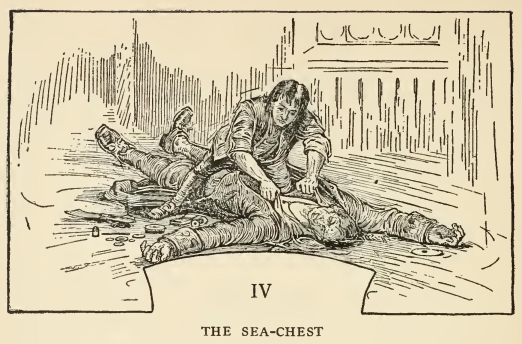
IV
The Sea-chest
lost no time, of course, in telling my mother all that I knew, and perhapsshould have told her long before, and we saw ourselves at once in a difficultand dangerous position. Some of the man’s money—if he had any—was certainly dueto us, but it was not likely that our captain’s shipmates, above all the twospecimens seen by me, Black Dog and the blind beggar, would be inclined to giveup their booty in payment of the dead man’s debts. The captain’s order to mountat once and ride for Doctor Livesey would have left my mother alone andunprotected, which was not to be thought of. Indeed, it seemed impossible foreither of us to remain much longer in the house; the fall of coals in thekitchen grate, the very ticking of the clock, filled us with alarms. Theneighbourhood, to our ears, seemed haunted by approaching footsteps; and whatbetween the dead body of the captain on the parlour floor and the thought ofthat detestable blind beggar hovering near at hand and ready to return, therewere moments when, as the saying goes, I jumped in my skin for terror.Something must speedily be resolved upon, and it occurred to us at last to goforth together and seek help in the neighbouring hamlet. No sooner said thandone. Bare-headed as we were, we ran out at once in the gathering evening andthe frosty fog.
The hamlet lay not many hundred yards away, though out of view, on the otherside of the next cove; and what greatly encouraged me, it was in an oppositedirection from that whence the blind man had made his appearance and whither hehad presumably returned. We were not many minutes on the road, though wesometimes stopped to lay hold of each other and hearken. But there was nounusual sound—nothing but the low wash of the ripple and the croaking of theinmates of the wood.
It was already candle-light when we reached the hamlet, and I shall neverforget how much I was cheered to see the yellow shine in doors and windows; butthat, as it proved, was the best of the help we were likely to get in thatquarter. For—you would have thought men would have been ashamed ofthemselves—no soul would consent to return with us to the Admiral Benbow. Themore we told of our troubles, the more—man, woman, and child—they clung to theshelter of their houses. The name of Captain Flint, though it was strange tome, was well enough known to some there and carried a great weight of terror.Some of the men who had been to field-work on the far side of the AdmiralBenbow remembered, besides, to have seen several strangers on the road, andtaking them to be smugglers, to have bolted away; and one at least had seen alittle lugger in what we called Kitt’s Hole. For that matter, anyone who was acomrade of the captain’s was enough to frighten them to death. And the shortand the long of the matter was, that while we could get several who werewilling enough to ride to Dr. Livesey’s, which lay in another direction, notone would help us to defend the inn.
They say cowardice is infectious; but then argument is, on the other hand, agreat emboldener; and so when each had said his say, my mother made them aspeech. She would not, she declared, lose money that belonged to her fatherlessboy; “If none of the rest of you dare,” she said, “Jim and I dare. Back we willgo, the way we came, and small thanks to you big, hulking, chicken-hearted men.We’ll have that chest open, if we die for it. And I’ll thank you for that bag,Mrs. Crossley, to bring back our lawful money in.”
Of course I said I would go with my mother, and of course they all cried out atour foolhardiness, but even then not a man would go along with us. All theywould do was to give me a loaded pistol lest we were attacked, and to promiseto have horses ready saddled in case we were pursued on our return, while onelad was to ride forward to the doctor’s in search of armed assistance.
My heart was beating finely when we two set forth in the cold night upon thisdangerous venture. A full moon was beginning to rise and peered redly throughthe upper edges of the fog, and this increased our haste, for it was plain,before we came forth again, that all would be as bright as day, and ourdeparture exposed to the eyes of any watchers. We slipped along the hedges,noiseless and swift, nor did we see or hear anything to increase our terrors,till, to our relief, the door of the Admiral Benbow had closed behind us.
I slipped the bolt at once, and we stood and panted for a moment in the dark,alone in the house with the dead captain’s body. Then my mother got a candle inthe bar, and holding each other’s hands, we advanced into the parlour. He layas we had left him, on his back, with his eyes open and one arm stretched out.
“Draw down the blind, Jim,” whispered my mother; “they might come and watchoutside. And now,” said she when I had done so, “we have to get the key offthat;and who’s to touch it, I should like to know!” and she gave a kindof sob as she said the words.
I went down on my knees at once. On the floor close to his hand there was alittle round of paper, blackened on the one side. I could not doubt that thiswas the black spot;and taking it up, I found written on the other side,in a very good, clear hand, this short message: “You have till ten tonight.”
“He had till ten, Mother,” said I; and just as I said it, our old clock beganstriking. This sudden noise startled us shockingly; but the news was good, forit was only six.
“Now, Jim,” she said, “that key.”
I felt in his pockets, one after another. A few small coins, a thimble, andsome thread and big needles, a piece of pigtail tobacco bitten away at the end,his gully with the crooked handle, a pocket compass, and a tinder box were allthat they contained, and I began to despair.
“Perhaps it’s round his neck,” suggested my mother.
Overcoming a strong repugnance, I tore open his shirt at the neck, and there,sure enough, hanging to a bit of tarry string, which I cut with his own gully,we found the key. At this triumph we were filled with hope and hurried upstairswithout delay to the little room where he had slept so long and where his boxhad stood since the day of his arrival.
It was like any other seaman’s chest on the outside, the initial “B” burned onthe top of it with a hot iron, and the corners somewhat smashed and broken asby long, rough usage.
“Give me the key,” said my mother; and though the lock was very stiff, she hadturned it and thrown back the lid in a twinkling.
A strong smell of tobacco and tar rose from the interior, but nothing was to beseen on the top except a suit of very good clothes, carefully brushed andfolded. They had never been worn, my mother said. Under that, the miscellanybegan—a quadrant, a tin canikin, several sticks of tobacco, two brace of veryhandsome pistols, a piece of bar silver, an old Spanish watch and some othertrinkets of little value and mostly of foreign make, a pair of compassesmounted with brass, and five or six curious West Indian shells. I have oftenwondered since why he should have carried about these shells with him in hiswandering, guilty, and hunted life.
In the meantime, we had found nothing of any value but the silver and thetrinkets, and neither of these were in our way. Underneath there was an oldboat-cloak, whitened with sea-salt on many a harbour-bar. My mother pulled itup with impatience, and there lay before us, the last things in the chest, abundle tied up in oilcloth, and looking like papers, and a canvas bag that gaveforth, at a touch, the jingle of gold.
“I’ll show these rogues that I’m an honest woman,” said my mother. “I’ll havemy dues, and not a farthing over. Hold Mrs. Crossley’s bag.” And she began tocount over the amount of the captain’s score from the sailor’s bag into the onethat I was holding.
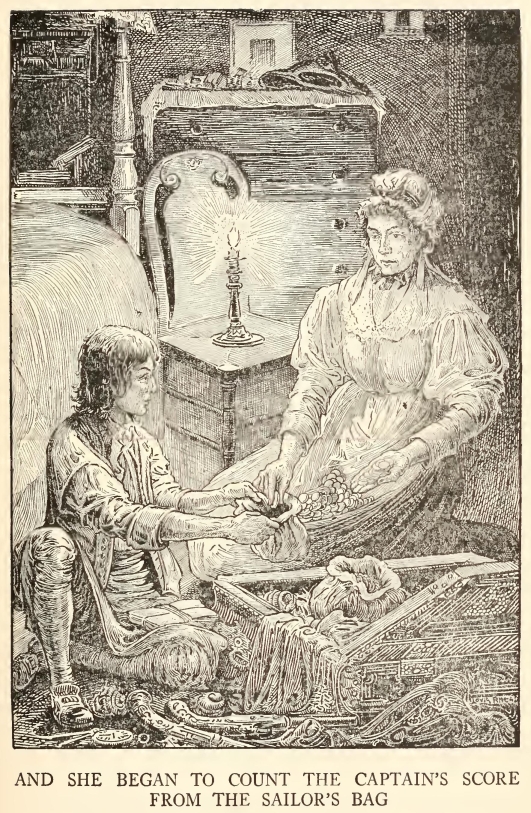
It was a long, difficult business, for the coins were of all countries andsizes—doubloons, and louis d’ors, and guineas, and pieces of eight, and I knownot what besides, all shaken together at random. The guineas, too, were aboutthe scarcest, and it was with these only that my mother knew how to make hercount.
When we were about half-way through, I suddenly put my hand upon her arm, for Ihad heard in the silent frosty air a sound that brought my heart into mymouth—the tap-tapping of the blind man’s stick upon the frozen road. It drewnearer and nearer, while we sat holding our breath. Then it struck sharp on theinn door, and then we could hear the handle being turned and the bolt rattlingas the wretched being tried to enter; and then there was a long time of silenceboth within and without. At last the tapping recommenced, and, to ourindescribable joy and gratitude, died slowly away again until it ceased to beheard.
“Mother,” said I, “take the whole and let’s be going,” for I was sure thebolted door must have seemed suspicious and would bring the whole hornet’s nestabout our ears, though how thankful I was that I had bolted it, none could tellwho had never met that terrible blind man.
But my mother, frightened as she was, would not consent to take a fraction morethan was due to her and was obstinately unwilling to be content with less. Itwas not yet seven, she said, by a long way; she knew her rights and she wouldhave them; and she was still arguing with me when a little low whistle soundeda good way off upon the hill. That was enough, and more than enough, for bothof us.
“I’ll take what I have,” she said, jumping to her feet.
“And I’ll take this to square the count,” said I, picking up the oilskinpacket.
Next moment we were both groping downstairs, leaving the candle by the emptychest; and the next we had opened the door and were in full retreat. We had notstarted a moment too soon. The fog was rapidly dispersing; already the moonshone quite clear on the high ground on either side; and it was only in theexact bottom of the dell and round the tavern door that a thin veil still hungunbroken to conceal the first steps of our escape. Far less than half-way tothe hamlet, very little beyond the bottom of the hill, we must come forth intothe moonlight. Nor was this all, for the sound of several footsteps runningcame already to our ears, and as we looked back in their direction, a lighttossing to and fro and still rapidly advancing showed that one of the newcomerscarried a lantern.
“My dear,” said my mother suddenly, “take the money and run on. I am going tofaint.”
This was certainly the end for both of us, I thought. How I cursed thecowardice of the neighbours; how I blamed my poor mother for her honesty andher greed, for her past foolhardiness and present weakness! We were just at thelittle bridge, by good fortune; and I helped her, tottering as she was, to theedge of the bank, where, sure enough, she gave a sigh and fell on my shoulder.I do not know how I found the strength to do it at all, and I am afraid it wasroughly done, but I managed to drag her down the bank and a little way underthe arch. Farther I could not move her, for the bridge was too low to let me domore than crawl below it. So there we had to stay—my mother almost entirelyexposed and both of us within earshot of the inn.
V
The Last of the Blind Man

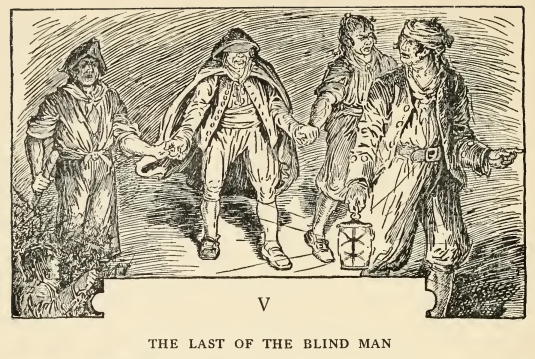
y curiosity, in a sense, was stronger than my fear, for I could not remainwhere I was, but crept back to the bank again, whence, sheltering my headbehind a bush of broom, I might command the road before our door. I wasscarcely in position ere my enemies began to arrive, seven or eight of them,running hard, their feet beating out of time along the road and the man withthe lantern some paces in front. Three men ran together, hand in hand; and Imade out, even through the mist, that the middle man of this trio was the blindbeggar. The next moment his voice showed me that I was right.
“Down with the door!” he cried.
“Aye, aye, sir!” answered two or three; and a rush was made upon the AdmiralBenbow, the lantern-bearer following; and then I could see them pause, and hearspeeches passed in a lower key, as if they were surprised to find the dooropen. But the pause was brief, for the blind man again issued his commands. Hisvoice sounded louder and higher, as if he were afire with eagerness and rage.
“In, in, in!” he shouted, and cursed them for their delay.
Four or five of them obeyed at once, two remaining on the road with theformidable beggar. There was a pause, then a cry of surprise, and then a voiceshouting from the house, “Bill’s dead.”
But the blind man swore at them again for their delay.
“Search him, some of you shirking lubbers, and the rest of you aloft and getthe chest,” he cried.
I could hear their feet rattling up our old stairs, so that the house must haveshook with it. Promptly afterwards, fresh sounds of astonishment arose; thewindow of the captain’s room was thrown open with a slam and a jingle of brokenglass, and a man leaned out into the moonlight, head and shoulders, andaddressed the blind beggar on the road below him.
“Pew,” he cried, “they’ve been before us. Someone’s turned the chest out alowand aloft.”
“Is it there?” roared Pew.
“The money’s there.”
The blind man cursed the money.
“Flint’s fist, I mean,” he cried.
“We don’t see it here nohow,” returned the man.
“Here, you below there, is it on Bill?” cried the blind man again.
At that another fellow, probably him who had remained below to search thecaptain’s body, came to the door of the inn. “Bill’s been overhauled a’ready,”said he; “nothin’ left.”
“It’s these people of the inn—it’s that boy. I wish I had put his eyes out!”cried the blind man, Pew. “There were no time ago—they had the door bolted whenI tried it. Scatter, lads, and find ’em.”
“Sure enough, they left their glim here,” said the fellow from the window.
“Scatter and find ’em! Rout the house out!” reiterated Pew, striking with hisstick upon the road.
Then there followed a great to-do through all our old inn, heavy feet poundingto and fro, furniture thrown over, doors kicked in, until the very rocksre-echoed and the men came out again, one after another, on the road anddeclared that we were nowhere to be found. And just the same whistle that hadalarmed my mother and myself over the dead captain’s money was once moreclearly audible through the night, but this time twice repeated. I had thoughtit to be the blind man’s trumpet, so to speak, summoning his crew to theassault, but I now found that it was a signal from the hillside towards thehamlet, and from its effect upon the buccaneers, a signal to warn them ofapproaching danger.
“There’s Dirk again,” said one. “Twice! We’ll have to budge, mates.”
“Budge, you skulk!” cried Pew. “Dirk was a fool and a coward from the first—youwouldn’t mind him. They must be close by; they can’t be far; you have yourhands on it. Scatter and look for them, dogs! Oh, shiver my soul,” he cried,“if I had eyes!”
This appeal seemed to produce some effect, for two of the fellows began to lookhere and there among the lumber, but half-heartedly, I thought, and with halfan eye to their own danger all the time, while the rest stood irresolute on theroad.
“You have your hands on thousands, you fools, and you hang a leg! You’d be asrich as kings if you could find it, and you know it’s here, and you stand thereskulking. There wasn’t one of you dared face Bill, and I did it—a blind man!And I’m to lose my chance for you! I’m to be a poor, crawling beggar, spongingfor rum, when I might be rolling in a coach! If you had the pluck of a weevilin a biscuit you would catch them still.”
“Hang it, Pew, we’ve got the doubloons!” grumbled one.
“They might have hid the blessed thing,” said another. “Take the Georges, Pew,and don’t stand here squalling.”
Squalling was the word for it; Pew’s anger rose so high at these objectionstill at last, his passion completely taking the upper hand, he struck at themright and left in his blindness and his stick sounded heavily on more than one.
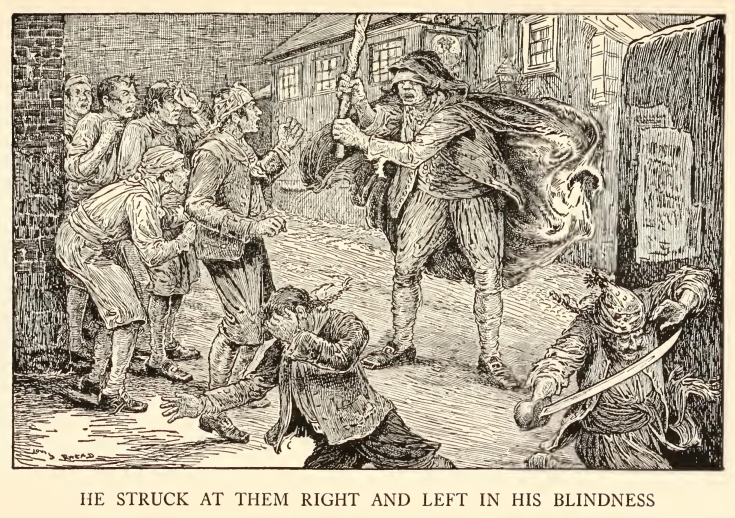
These, in their turn, cursed back at the blind miscreant, threatened him inhorrid terms, and tried in vain to catch the stick and wrest it from his grasp.
This quarrel was the saving of us, for while it was still raging, another soundcame from the top of the hill on the side of the hamlet—the tramp of horsesgalloping. Almost at the same time a pistol-shot, flash and report, came fromthe hedge side. And that was plainly the last signal of danger, for thebuccaneers turned at once and ran, separating in every direction, one seawardalong the cove, one slant across the hill, and so on, so that in half a minutenot a sign of them remained but Pew. Him they had deserted, whether in sheerpanic or out of revenge for his ill words and blows I know not; but there heremained behind, tapping up and down the road in a frenzy, and groping andcalling for his comrades. Finally he took a wrong turn and ran a few steps pastme, towards the hamlet, crying, “Johnny, Black Dog, Dirk,” and other names,“you won’t leave old Pew, mates—not old Pew!”
Just then the noise of horses topped the rise, and four or five riders came insight in the moonlight and swept at full gallop down the slope.
At this Pew saw his error, turned with a scream, and ran straight for theditch, into which he rolled. But he was on his feet again in a second and madeanother dash, now utterly bewildered, right under the nearest of the cominghorses.
The rider tried to save him, but in vain. Down went Pew with a cry that ranghigh into the night; and the four hoofs trampled and spurned him and passed by.He fell on his side, then gently collapsed upon his face and moved no more.
I leaped to my feet and hailed the riders. They were pulling up, at any rate,horrified at the accident; and I soon saw what they were. One, tailing outbehind the rest, was a lad that had gone from the hamlet to Dr. Livesey’s; therest were revenue officers, whom he had met by the way, and with whom he hadhad the intelligence to return at once. Some news of the lugger in Kitt’s Holehad found its way to Supervisor Dance and set him forth that night in ourdirection, and to that circumstance my mother and I owed our preservation fromdeath.
Pew was dead, stone dead. As for my mother, when we had carried her up to thehamlet, a little cold water and salts and that soon brought her back again, andshe was none the worse for her terror, though she still continued to deplorethe balance of the money. In the meantime the supervisor rode on, as fast as hecould, to Kitt’s Hole; but his men had to dismount and grope down the dingle,leading, and sometimes supporting, their horses, and in continual fear ofambushes; so it was no great matter for surprise that when they got down to theHole the lugger was already under way, though still close in. He hailed her. Avoice replied, telling him to keep out of the moonlight or he would get somelead in him, and at the same time a bullet whistled close by his arm. Soonafter, the lugger doubled the point and disappeared. Mr. Dance stood there, ashe said, “like a fish out of water,” and all he could do was to dispatch a manto B—— to warn the cutter. “And that,” said he, “is just about as good asnothing. They’ve got off clean, and there’s an end. Only,” he added, “I’m gladI trod on Master Pew’s corns,” for by this time he had heard my story.
I went back with him to the Admiral Benbow, and you cannot imagine a house insuch a state of smash; the very clock had been thrown down by these fellows intheir furious hunt after my mother and myself; and though nothing had actuallybeen taken away except the captain’s money-bag and a little silver from thetill, I could see at once that we were ruined. Mr. Dance could make nothing ofthe scene.
“They got the money, you say? Well, then, Hawkins, what in fortune were theyafter? More money, I suppose?”
“No, sir; not money, I think,” replied I. “In fact, sir, I believe I have thething in my breast pocket; and to tell you the truth, I should like to get itput in safety.”
“To be sure, boy; quite right,” said he. “I’ll take it, if you like.”
“I thought perhaps Dr. Livesey—” I began.
“Perfectly right,” he interrupted very cheerily, “perfectly right—a gentlemanand a magistrate. And, now I come to think of it, I might as well ride roundthere myself and report to him or squire. Master Pew’s dead, when all’s done;not that I regret it, but he’s dead, you see, and people will make it outagainst an officer of his Majesty’s revenue, if make it out they can. Now, I’lltell you, Hawkins, if you like, I’ll take you along.”
I thanked him heartily for the offer, and we walked back to the hamlet wherethe horses were. By the time I had told mother of my purpose they were all inthe saddle.
“Dogger,” said Mr. Dance, “you have a good horse; take up this lad behind you.”
As soon as I was mounted, holding on to Dogger’s belt, the supervisor gave theword, and the party struck out at a bouncing trot on the road to Dr. Livesey’shouse.
VI
The Captain’s Papers
e rode hard all the way till we drew up before Dr. Livesey’s door. The housewas all dark to the front.
Mr. Dance told me to jump down and knock, and Dogger gave me a stirrup todescend by. The door was opened almost at once by the maid.
“Is Dr. Livesey in?” I asked.
No, she said, he had come home in the afternoon but had gone up to the hall todine and pass the evening with the squire.
“So there we go, boys,” said Mr. Dance.
This time, as the distance was short, I did not mount, but ran with Dogger’sstirrup-leather to the lodge gates and up the long, leafless, moonlit avenue towhere the white line of the hall buildings looked on either hand on great oldgardens. Here Mr. Dance dismounted, and taking me along with him, was admittedat a word into the house.
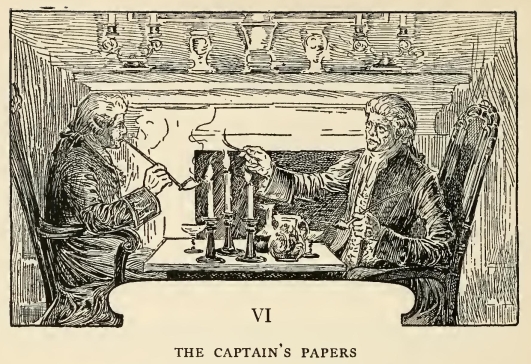
The servant led us down a matted passage and showed us at the end into a greatlibrary, all lined with bookcases and busts upon the top of them, where thesquire and Dr. Livesey sat, pipe in hand, on either side of a bright fire.
I had never seen the squire so near at hand. He was a tall man, over six feethigh, and broad in proportion, and he had a bluff, rough-and-ready face, allroughened and reddened and lined in his long travels. His eyebrows were veryblack, and moved readily, and this gave him a look of some temper, not bad, youwould say, but quick and high.
“Come in, Mr. Dance,” says he, very stately and condescending.
“Good evening, Dance,” says the doctor with a nod. “And good evening to you,friend Jim. What good wind brings you here?”
The supervisor stood up straight and stiff and told his story like a lesson;and you should have seen how the two gentlemen leaned forward and looked ateach other, and forgot to smoke in their surprise and interest. When they heardhow my mother went back to the inn, Dr. Livesey fairly slapped his thigh, andthe squire cried “Bravo!” and broke his long pipe against the grate. Longbefore it was done, Mr. Trelawney (that, you will remember, was the squire’sname) had got up from his seat and was striding about the room, and the doctor,as if to hear the better, had taken off his powdered wig and sat there lookingvery strange indeed with his own close-cropped black poll.
At last Mr. Dance finished the story.
“Mr. Dance,” said the squire, “you are a very noble fellow. And as for ridingdown that black, atrocious miscreant, I regard it as an act of virtue, sir,like stamping on a cockroach. This lad Hawkins is a trump, I perceive. Hawkins,will you ring that bell? Mr. Dance must have some ale.”
“And so, Jim,” said the doctor, “you have the thing that they were after, haveyou?”
“Here it is, sir,” said I, and gave him the oilskin packet.
The doctor looked it all over, as if his fingers were itching to open it; butinstead of doing that, he put it quietly in the pocket of his coat.
“Squire,” said he, “when Dance has had his ale he must, of course, be off onhis Majesty’s service; but I mean to keep Jim Hawkins here to sleep at myhouse, and with your permission, I propose we should have up the cold pie andlet him sup.”
“As you will, Livesey,” said the squire; “Hawkins has earned better than coldpie.”
So a big pigeon pie was brought in and put on a sidetable, and I made a heartysupper, for I was as hungry as a hawk, while Mr. Dance was further complimentedand at last dismissed.
“And now, squire,” said the doctor.
“And now, Livesey,” said the squire in the same breath.
“One at a time, one at a time,” laughed Dr. Livesey. “You have heard of thisFlint, I suppose?”
“Heard of him!” cried the squire. “Heard of him, you say! He was thebloodthirstiest buccaneer that sailed. Blackbeard was a child to Flint. TheSpaniards were so prodigiously afraid of him that, I tell you, sir, I wassometimes proud he was an Englishman. I’ve seen his top-sails with these eyes,off Trinidad, and the cowardly son of a rum-puncheon that I sailed with putback—put back, sir, into Port of Spain.”
“Well, I’ve heard of him myself, in England,” said the doctor. “But the pointis, had he money?”
“Money!” cried the squire. “Have you heard the story? What were these villainsafter but money? What do they care for but money? For what would they risktheir rascal carcasses but money?”
“That we shall soon know,” replied the doctor. “But you are so confoundedlyhot-headed and exclamatory that I cannot get a word in. What I want to know isthis: Supposing that I have here in my pocket some clue to where Flint buriedhis treasure, will that treasure amount to much?”
“Amount, sir!” cried the squire. “It will amount to this: If we have the clueyou talk about, I fit out a ship in Bristol dock, and take you and Hawkins herealong, and I’ll have that treasure if I search a year.”
“Very well,” said the doctor. “Now, then, if Jim is agreeable, we’ll open thepacket”; and he laid it before him on the table.
The bundle was sewn together, and the doctor had to get out his instrument caseand cut the stitches with his medical scissors. It contained two things—a bookand a sealed paper.
“First of all we’ll try the book,” observed the doctor.
The squire and I were both peering over his shoulder as he opened it, for Dr.Livesey had kindly motioned me to come round from the side-table, where I hadbeen eating, to enjoy the sport of the search. On the first page there wereonly some scraps of writing, such as a man with a pen in his hand might makefor idleness or practice. One was the same as the tattoo mark, “Billy Bones hisfancy”; then there was “Mr. W. Bones, mate,” “No more rum,” “Off Palm Key hegot itt,” and some other snatches, mostly single words and unintelligible. Icould not help wondering who it was that had “got itt,” and what “itt” was thathe got. A knife in his back as like as not.
“Not much instruction there,” said Dr. Livesey as he passed on.
The next ten or twelve pages were filled with a curious series of entries.There was a date at one end of the line and at the other a sum of money, as incommon account-books, but instead of explanatory writing, only a varying numberof crosses between the two. On the 12th of June, 1745, for instance, a sum ofseventy pounds had plainly become due to someone, and there was nothing but sixcrosses to explain the cause. In a few cases, to be sure, the name of a placewould be added, as “Offe Caraccas,” or a mere entry of latitude and longitude,as “62° 17′ 20″, 19° 2′ 40″.”
The record lasted over nearly twenty years, the amount of the separate entriesgrowing larger as time went on, and at the end a grand total had been made outafter five or six wrong additions, and these words appended, “Bones, his pile.”
“I can’t make head or tail of this,” said Dr. Livesey.
“The thing is as clear as noonday,” cried the squire. “This is theblack-hearted hound’s account-book. These crosses stand for the names of shipsor towns that they sank or plundered. The sums are the scoundrel’s share, andwhere he feared an ambiguity, you see he added something clearer. ‘OffeCaraccas,’ now; you see, here was some unhappy vessel boarded off that coast.God help the poor souls that manned her—coral long ago.”
“Right!” said the doctor. “See what it is to be a traveller. Right! And theamounts increase, you see, as he rose in rank.”
There was little else in the volume but a few bearings of places noted in theblank leaves towards the end and a table for reducing French, English, andSpanish moneys to a common value.
“Thrifty man!” cried the doctor. “He wasn’t the one to be cheated.”
“And now,” said the squire, “for the other.”
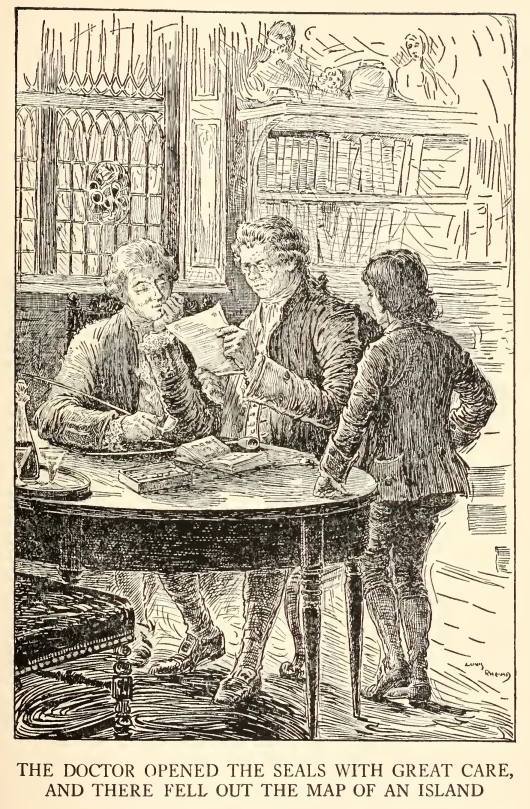
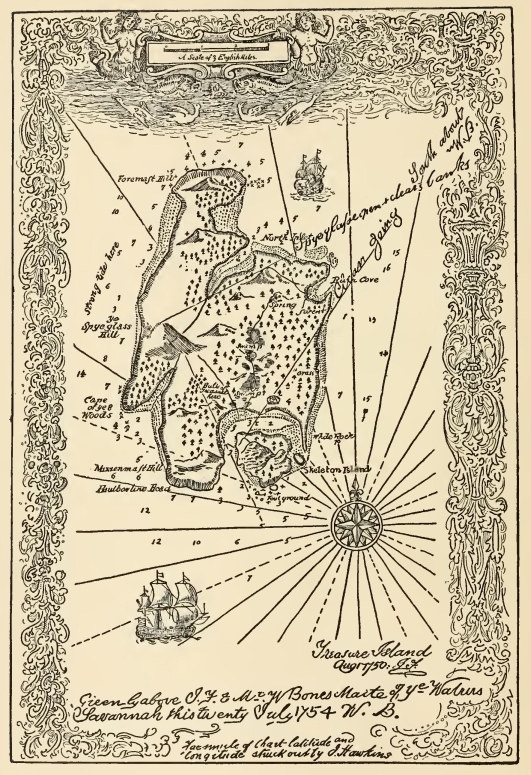
The paper had been sealed in several places with a thimble by way of seal; thevery thimble, perhaps, that I had found in the captain’s pocket. The doctoropened the seals with great care, and there fell out the map of an island, withlatitude and longitude, soundings, names of hills and bays and inlets, andevery particular that would be needed to bring a ship to a safe anchorage uponits shores. It was about nine miles long and five across, shaped, you mightsay, like a fat dragon standing up, and had two fine land-locked harbours, anda hill in the centre part marked “The Spy-glass.” There were several additionsof a later date, but above all, three crosses of red ink—two on the north partof the island, one in the southwest—and beside this last, in the same red ink,and in a small, neat hand, very different from the captain’s totterycharacters, these words: “Bulk of treasure here.”
Over on the back the same hand had written this further information:
Tall tree, Spy-glass shoulder, bearing a point to the N. of N.N.E.
Skeleton Island E.S.E. and by E.
Ten feet.
The bar silver is in the north cache; you can find it by the trend of the easthummock, ten fathoms south of the black crag with the face on it.
The arms are easy found, in the sand-hill, N. point of north inlet cape,bearing E. and a quarter N.
J.F.
That was all; but brief as it was, and to me incomprehensible, it filled thesquire and Dr. Livesey with delight.
“Livesey,” said the squire, “you will give up this wretched practice at once.Tomorrow I start for Bristol. In three weeks’ time—three weeks!—two weeks—tendays—we’ll have the best ship, sir, and the choicest crew in England. Hawkinsshall come as cabin-boy. You’ll make a famous cabin-boy, Hawkins. You, Livesey,are ship’s doctor; I am admiral. We’ll take Redruth, Joyce, and Hunter. We’llhave favourable winds, a quick passage, and not the least difficulty in findingthe spot, and money to eat, to roll in, to play duck and drake with everafter.”
“Trelawney,” said the doctor, “I’ll go with you; and I’ll go bail for it, sowill Jim, and be a credit to the undertaking. There’s only one man I’m afraidof.”
“And who’s that?” cried the squire. “Name the dog, sir!”
“You,” replied the doctor; “for you cannot hold your tongue. We are not theonly men who know of this paper. These fellows who attacked the inntonight—bold, desperate blades, for sure—and the rest who stayed aboard thatlugger, and more, I dare say, not far off, are, one and all, through thick andthin, bound that they’ll get that money. We must none of us go alone till weget to sea. Jim and I shall stick together in the meanwhile; you’ll take Joyceand Hunter when you ride to Bristol, and from first to last, not one of us mustbreathe a word of what we’ve found.”
“Livesey,” returned the squire, “you are always in the right of it. I’ll be assilent as the grave.”
PART TWO—The Sea-cook
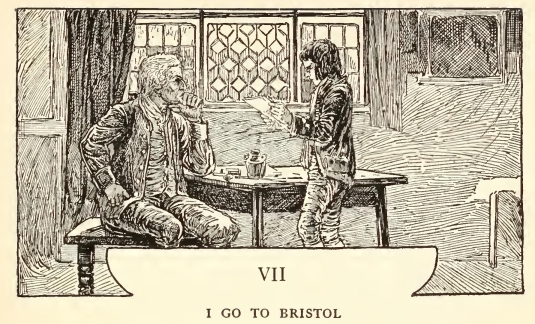
VII
I Go to Bristol
t was longer than the squire imagined ere we were ready for the sea, and noneof our first plans—not even Dr. Livesey’s, of keeping me beside him—could becarried out as we intended. The doctor had to go to London for a physician totake charge of his practice; the squire was hard at work at Bristol; and Ilived on at the hall under the charge of old Redruth, the gamekeeper, almost aprisoner, but full of sea-dreams and the most charming anticipations of strangeislands and adventures. I brooded by the hour together over the map, all thedetails of which I well remembered. Sitting by the fire in the housekeeper’sroom, I approached that island in my fancy from every possible direction; Iexplored every acre of its surface; I climbed a thousand times to that tallhill they call the Spy-glass, and from the top enjoyed the most wonderful andchanging prospects. Sometimes the isle was thick with savages, with whom wefought, sometimes full of dangerous animals that hunted us, but in all myfancies nothing occurred to me so strange and tragic as our actual adventures.
So the weeks passed on, till one fine day there came a letter addressed to Dr.Livesey, with this addition, “To be opened, in the case of his absence, by TomRedruth or young Hawkins.” Obeying this order, we found, or rather I found—forthe gamekeeper was a poor hand at reading anything but print—the followingimportant news:
Old Anchor Inn, Bristol, March 1, 17—.
Dear Livesey—As I do not know whether you are at the hall or still in London, Isend this in double to both places.
The ship is bought and fitted. She lies at anchor, ready for sea. You neverimagined a sweeter schooner—a child might sail her—two hundred tons; name,Hispaniola.
I got her through my old friend, Blandly, who has proved himself throughout themost surprising trump. The admirable fellow literally slaved in my interest,and so, I may say, did everyone in Bristol, as soon as they got wind of theport we sailed for—treasure, I mean.
“Redruth,” said I, interrupting the letter, “Dr. Livesey will not like that.The squire has been talking, after all.”
“Well, who’s a better right?” growled the gamekeeper. “A pretty rum go ifsquire ain’t to talk for Dr. Livesey, I should think.”
At that I gave up all attempts at commentary and read straight on:
Blandly himself found the Hispaniola, and by the most admirablemanagement got her for the merest trifle. There is a class of men in Bristolmonstrously prejudiced against Blandly. They go the length of declaring thatthis honest creature would do anything for money, that the Hispaniolabelonged to him, and that he sold it me absurdly high—the most transparentcalumnies. None of them dare, however, to deny the merits of the ship.
So far there was not a hitch. The workpeople, to be sure—riggers and whatnot—were most annoyingly slow; but time cured that. It was the crew thattroubled me.
I wished a round score of men—in case of natives, buccaneers, or the odiousFrench—and I had the worry of the deuce itself to find so much as half a dozen,till the most remarkable stroke of fortune brought me the very man that Irequired.
I was standing on the dock, when, by the merest accident, I fell in talk withhim. I found he was an old sailor, kept a public-house, knew all the seafaringmen in Bristol, had lost his health ashore, and wanted a good berth as cook toget to sea again. He had hobbled down there that morning, he said, to get asmell of the salt.
I was monstrously touched—so would you have been—and, out of pure pity, Iengaged him on the spot to be ship’s cook. Long John Silver, he is called, andhas lost a leg; but that I regarded as a recommendation, since he lost it inhis country’s service, under the immortal Hawke. He has no pension, Livesey.Imagine the abominable age we live in!
Well, sir, I thought I had only found a cook, but it was a crew I haddiscovered. Between Silver and myself we got together in a few days a companyof the toughest old salts imaginable—not pretty to look at, but fellows, bytheir faces, of the most indomitable spirit. I declare we could fight afrigate.
Long John even got rid of two out of the six or seven I had already engaged.He showed me in a moment that they were just the sort of fresh-water swabs wehad to fear in an adventure of importance.
I am in the most magnificent health and spirits, eating like a bull, sleepinglike a tree, yet I shall not enjoy a moment till I hear my old tarpaulinstramping round the capstan. Seaward, ho! Hang the treasure! It’s the gloryof the sea that has turned my head. So now, Livesey, come post; do not lose anhour, if you respect me.
Let young Hawkins go at once to see his mother, with Redruth for a guard; andthen both come full speed to Bristol.
John Trelawney
Postscript.—I did not tell you that Blandly, who, by the way, is tosend a consort after us if we don’t turn up by the end of August, had found anadmirable fellow for sailing master—a stiff man, which I regret, but in allother respects a treasure. Long John Silver unearthed a very competent man fora mate, a man named Arrow. I have a boatswain who pipes, Livesey; so thingsshall go man-o’-war fashion on board the good ship Hispaniola.
I forgot to tell you that Silver is a man of substance; I know of my ownknowledge that he has a banker’s account, which has never been overdrawn. Heleaves his wife to manage the inn; and as she is a woman of colour, a pair ofold bachelors like you and I may be excused for guessing that it is the wife,quite as much as the health, that sends him back to roving.
J. T.
P.P.S.—Hawkins may stay one night with his mother.
J. T.
You can fancy the excitement into which that letter put me. I was half besidemyself with glee; and if ever I despised a man, it was old Tom Redruth, whocould do nothing but grumble and lament. Any of the under-gamekeepers wouldgladly have changed places with him; but such was not the squire’s pleasure,and the squire’s pleasure was like law among them all. Nobody but old Redruthwould have dared so much as even to grumble.
The next morning he and I set out on foot for the Admiral Benbow, and there Ifound my mother in good health and spirits. The captain, who had so long been acause of so much discomfort, was gone where the wicked cease from troubling.The squire had had everything repaired, and the public rooms and the signrepainted, and had added some furniture—above all a beautiful armchair formother in the bar. He had found her a boy as an apprentice also so that sheshould not want help while I was gone.
It was on seeing that boy that I understood, for the first time, my situation.I had thought up to that moment of the adventures before me, not at all of thehome that I was leaving; and now, at sight of this clumsy stranger, who was tostay here in my place beside my mother, I had my first attack of tears. I amafraid I led that boy a dog’s life, for as he was new to the work, I had ahundred opportunities of setting him right and putting him down, and I was notslow to profit by them.
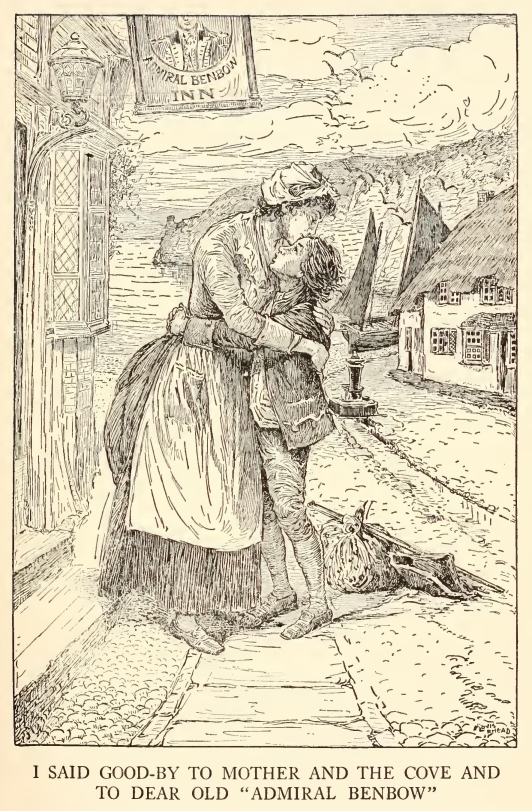
The night passed, and the next day, after dinner, Redruth and I were afootagain and on the road. I said good-bye to Mother and the cove where I had livedsince I was born, and the dear old Admiral Benbow—since he was repainted, nolonger quite so dear. One of my last thoughts was of the captain, who had sooften strode along the beach with his cocked hat, his sabre-cut cheek, and hisold brass telescope. Next moment we had turned the corner and my home was outof sight.
The mail picked us up about dusk at the Royal George on the heath. I was wedgedin between Redruth and a stout old gentleman, and in spite of the swift motionand the cold night air, I must have dozed a great deal from the very first, andthen slept like a log up hill and down dale through stage after stage, for whenI was awakened at last it was by a punch in the ribs, and I opened my eyes tofind that we were standing still before a large building in a city street andthat the day had already broken a long time.
“Where are we?” I asked.
“Bristol,” said Tom. “Get down.”
Mr. Trelawney had taken up his residence at an inn far down the docks tosuperintend the work upon the schooner. Thither we had now to walk, and ourway, to my great delight, lay along the quays and beside the great multitude ofships of all sizes and rigs and nations. In one, sailors were singing at theirwork, in another there were men aloft, high over my head, hanging to threadsthat seemed no thicker than a spider’s. Though I had lived by the shore all mylife, I seemed never to have been near the sea till then. The smell of tar andsalt was something new. I saw the most wonderful figureheads, that had all beenfar over the ocean. I saw, besides, many old sailors, with rings in their ears,and whiskers curled in ringlets, and tarry pigtails, and their swaggering,clumsy sea-walk; and if I had seen as many kings or archbishops I could nothave been more delighted.
And I was going to sea myself, to sea in a schooner, with a piping boatswainand pig-tailed singing seamen, to sea, bound for an unknown island, and to seekfor buried treasure!
While I was still in this delightful dream, we came suddenly in front of alarge inn and met Squire Trelawney, all dressed out like a sea-officer, instout blue cloth, coming out of the door with a smile on his face and a capitalimitation of a sailor’s walk.
“Here you are,” he cried, “and the doctor came last night from London. Bravo!The ship’s company complete!”
“Oh, sir,” cried I, “when do we sail?”
“Sail!” says he. “We sail tomorrow!”
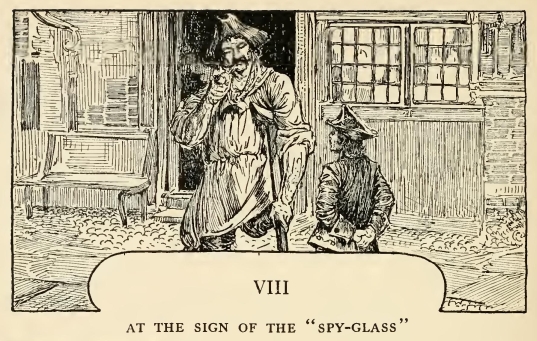
VIII
At the Sign of the Spy-glass
hen I had done breakfasting the squire gave me a note addressed to John Silver,at the sign of the Spy-glass, and told me I should easily find the place byfollowing the line of the docks and keeping a bright lookout for a littletavern with a large brass telescope for sign. I set off, overjoyed at thisopportunity to see some more of the ships and seamen, and picked my way among agreat crowd of people and carts and bales, for the dock was now at its busiest,until I found the tavern in question.
It was a bright enough little place of entertainment. The sign was newlypainted; the windows had neat red curtains; the floor was cleanly sanded. Therewas a street on each side and an open door on both, which made the large, lowroom pretty clear to see in, in spite of clouds of tobacco smoke.
The customers were mostly seafaring men, and they talked so loudly that I hungat the door, almost afraid to enter.
As I was waiting, a man came out of a side room, and at a glance I was sure hemust be Long John. His left leg was cut off close by the hip, and under theleft shoulder he carried a crutch, which he managed with wonderful dexterity,hopping about upon it like a bird. He was very tall and strong, with a face asbig as a ham—plain and pale, but intelligent and smiling. Indeed, he seemed inthe most cheerful spirits, whistling as he moved about among the tables, with amerry word or a slap on the shoulder for the more favoured of his guests.
Now, to tell you the truth, from the very first mention of Long John in SquireTrelawney’s letter I had taken a fear in my mind that he might prove to be thevery one-legged sailor whom I had watched for so long at the old Benbow. Butone look at the man before me was enough. I had seen the captain, and BlackDog, and the blind man, Pew, and I thought I knew what a buccaneer was like—avery different creature, according to me, from this clean and pleasant-temperedlandlord.
I plucked up courage at once, crossed the threshold, and walked right up to theman where he stood, propped on his crutch, talking to a customer.
“Mr. Silver, sir?” I asked, holding out the note.
“Yes, my lad,” said he; “such is my name, to be sure. And who may you be?” Andthen as he saw the squire’s letter, he seemed to me to give something almostlike a start.
“Oh!” said he, quite loud, and offering his hand. “I see. You are our newcabin-boy; pleased I am to see you.”
And he took my hand in his large firm grasp.
Just then one of the customers at the far side rose suddenly and made for thedoor. It was close by him, and he was out in the street in a moment. But hishurry had attracted my notice, and I recognized him at glance. It was thetallow-faced man, wanting two fingers, who had come first to the AdmiralBenbow.
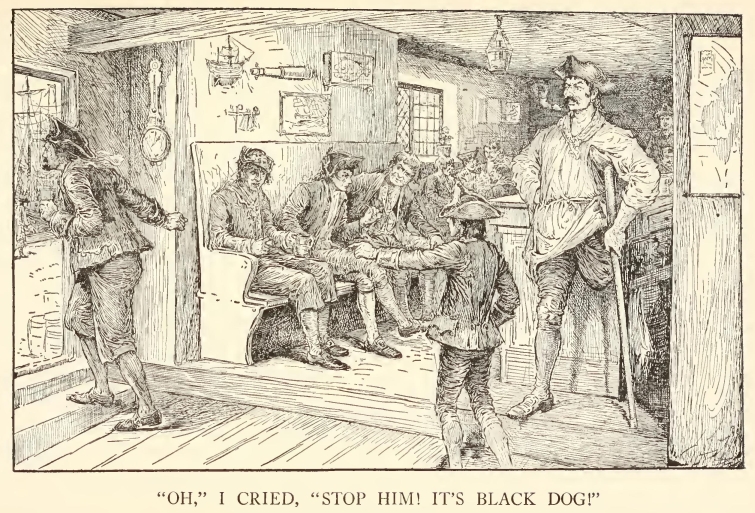
“Oh,” I cried, “stop him! It’s Black Dog!”
“I don’t care two coppers who he is,” cried Silver. “But he hasn’t paid hisscore. Harry, run and catch him.”
One of the others who was nearest the door leaped up and started in pursuit.
“If he were Admiral Hawke he shall pay his score,” cried Silver; and then,relinquishing my hand, “Who did you say he was?” he asked. “Black what?”
“Dog, sir,” said I. “Has Mr. Trelawney not told you of the buccaneers? He wasone of them.”
“So?” cried Silver. “In my house! Ben, run and help Harry. One of those swabs,was he? Was that you drinking with him, Morgan? Step up here.”
The man whom he called Morgan—an old, grey-haired, mahogany-faced sailor—cameforward pretty sheepishly, rolling his quid.
“Now, Morgan,” said Long John very sternly, “you never clapped your eyes onthat Black—Black Dog before, did you, now?”
“Not I, sir,” said Morgan with a salute.
“You didn’t know his name, did you?”
“No, sir.”
“By the powers, Tom Morgan, it’s as good for you!” exclaimed the landlord. “Ifyou had been mixed up with the like of that, you would never have put anotherfoot in my house, you may lay to that. And what was he saying to you?”
“I don’t rightly know, sir,” answered Morgan.
“Do you call that a head on your shoulders, or a blessed dead-eye?” cried LongJohn. “Don’t rightly know, don’t you! Perhaps you don’t happen to rightly knowwho you was speaking to, perhaps? Come, now, what was he jawing—v’yages,cap’ns, ships? Pipe up! What was it?”
“We was a-talkin’ of keel-hauling,” answered Morgan.
“Keel-hauling, was you? And a mighty suitable thing, too, and you may lay tothat. Get back to your place for a lubber, Tom.”
And then, as Morgan rolled back to his seat, Silver added to me in aconfidential whisper that was very flattering, as I thought, “He’s quite anhonest man, Tom Morgan, on’y stupid. And now,” he ran on again, aloud, “let’ssee—Black Dog? No, I don’t know the name, not I. Yet I kind of think I’ve—yes,I’ve seen the swab. He used to come here with a blind beggar, he used.”
“That he did, you may be sure,” said I. “I knew that blind man too. His namewas Pew.”
“It was!” cried Silver, now quite excited. “Pew! That were his name forcertain. Ah, he looked a shark, he did! If we run down this Black Dog, now,there’ll be news for Cap’n Trelawney! Ben’s a good runner; few seamen runbetter than Ben. He should run him down, hand over hand, by the powers! Hetalked o’ keel-hauling, did he? I’llkeel-haul him!”
All the time he was jerking out these phrases he was stumping up and down thetavern on his crutch, slapping tables with his hand, and giving such a show ofexcitement as would have convinced an Old Bailey judge or a Bow Street runner.My suspicions had been thoroughly reawakened on finding Black Dog at theSpy-glass, and I watched the cook narrowly. But he was too deep, and too ready,and too clever for me, and by the time the two men had come back out of breathand confessed that they had lost the track in a crowd, and been scolded likethieves, I would have gone bail for the innocence of Long John Silver.
“See here, now, Hawkins,” said he, “here’s a blessed hard thing on a man likeme, now, ain’t it? There’s Cap’n Trelawney—what’s he to think? Here I have thisconfounded son of a Dutchman sitting in my own house drinking of my own rum!Here you comes and tells me of it plain; and here I let him give us all theslip before my blessed deadlights! Now, Hawkins, you do me justice with thecap’n. You’re a lad, you are, but you’re as smart as paint. I see that when youfirst come in. Now, here it is: What could I do, with this old timber I hobbleon? When I was an A B master mariner I’d have come up alongside of him, handover hand, and broached him to in a brace of old shakes, I would; but now—”
And then, all of a sudden, he stopped, and his jaw dropped as though he hadremembered something.
“The score!” he burst out. “Three goes o’ rum! Why, shiver my timbers, if Ihadn’t forgotten my score!”
And falling on a bench, he laughed until the tears ran down his cheeks. I couldnot help joining, and we laughed together, peal after peal, until the tavernrang again.
“Why, what a precious old sea-calf I am!” he said at last, wiping his cheeks.“You and me should get on well, Hawkins, for I’ll take my davy I should berated ship’s boy. But come now, stand by to go about. This won’t do. Dooty isdooty, messmates. I’ll put on my old cockerel hat, and step along of you toCap’n Trelawney, and report this here affair. For mind you, it’s serious, youngHawkins; and neither you nor me’s come out of it with what I should make sobold as to call credit. Nor you neither, says you; not smart—none of the pairof us smart. But dash my buttons! That was a good un about my score.”
And he began to laugh again, and that so heartily, that though I did not seethe joke as he did, I was again obliged to join him in his mirth.
On our little walk along the quays, he made himself the most interestingcompanion, telling me about the different ships that we passed by, their rig,tonnage, and nationality, explaining the work that was going forward—how onewas discharging, another taking in cargo, and a third making ready for sea—andevery now and then telling me some little anecdote of ships or seamen orrepeating a nautical phrase till I had learned it perfectly. I began to seethat here was one of the best of possible shipmates.
When we got to the inn, the squire and Dr. Livesey were seated together,finishing a quart of ale with a toast in it, before they should go aboard theschooner on a visit of inspection.
Long John told the story from first to last, with a great deal of spirit andthe most perfect truth. “That was how it were, now, weren’t it, Hawkins?” hewould say, now and again, and I could always bear him entirely out.
The two gentlemen regretted that Black Dog had got away, but we all agreedthere was nothing to be done, and after he had been complimented, Long Johntook up his crutch and departed.
“All hands aboard by four this afternoon,” shouted the squire after him.
“Aye, aye, sir,” cried the cook, in the passage.
“Well, squire,” said Dr. Livesey, “I don’t put much faith in your discoveries,as a general thing; but I will say this, John Silver suits me.”
“The man’s a perfect trump,” declared the squire.
“And now,” added the doctor, “Jim may come on board with us, may he not?”
“To be sure he may,” says squire. “Take your hat, Hawkins, and we’ll see theship.”
IX
Powder and Arms
he Hispaniolalay some way out, and we went under the figureheads andround the sterns of many other ships, and their cables sometimes gratedunderneath our keel, and sometimes swung above us. At last, however, we gotalongside, and were met and saluted as we stepped aboard by the mate, Mr.Arrow, a brown old sailor with earrings in his ears and a squint. He and thesquire were very thick and friendly, but I soon observed that things were notthe same between Mr. Trelawney and the captain.
This last was a sharp-looking man who seemed angry with everything on board andwas soon to tell us why, for we had hardly got down into the cabin when asailor followed us.
“Captain Smollett, sir, axing to speak with you,” said he.
“I am always at the captain’s orders. Show him in,” said the squire.
The captain, who was close behind his messenger, entered at once and shut thedoor behind him.
“Well, Captain Smollett, what have you to say? All well, I hope; all shipshapeand seaworthy?”
“Well, sir,” said the captain, “better speak plain, I believe, even at the riskof offence. I don’t like this cruise; I don’t like the men; and I don’t like myofficer. That’s short and sweet.”
“Perhaps, sir, you don’t like the ship?” inquired the squire, very angry, as Icould see.
“I can’t speak as to that, sir, not having seen her tried,” said the captain.“She seems a clever craft; more I can’t say.”
“Possibly, sir, you may not like your employer, either?” says the squire.
But here Dr. Livesey cut in.
“Stay a bit,” said he, “stay a bit. No use of such questions as that but toproduce ill feeling. The captain has said too much or he has said too little,and I’m bound to say that I require an explanation of his words. You don’t, yousay, like this cruise. Now, why?”
“I was engaged, sir, on what we call sealed orders, to sail this ship for thatgentleman where he should bid me,” said the captain. “So far so good. But now Ifind that every man before the mast knows more than I do. I don’t call thatfair, now, do you?”
“No,” said Dr. Livesey, “I don’t.”
“Next,” said the captain, “I learn we are going after treasure—hear it from myown hands, mind you. Now, treasure is ticklish work; I don’t like treasurevoyages on any account, and I don’t like them, above all, when they are secretand when (begging your pardon, Mr. Trelawney) the secret has been told to theparrot.”
“Silver’s parrot?” asked the squire.
“It’s a way of speaking,” said the captain. “Blabbed, I mean. It’s my beliefneither of you gentlemen know what you are about, but I’ll tell you my way ofit—life or death, and a close run.”
“That is all clear, and, I dare say, true enough,” replied Dr. Livesey. “Wetake the risk, but we are not so ignorant as you believe us. Next, you say youdon’t like the crew. Are they not good seamen?”
“I don’t like them, sir,” returned Captain Smollett. “And I think I should havehad the choosing of my own hands, if you go to that.”
“Perhaps you should,” replied the doctor. “My friend should, perhaps, havetaken you along with him; but the slight, if there be one, was unintentional.And you don’t like Mr. Arrow?”
“I don’t, sir. I believe he’s a good seaman, but he’s too free with the crew tobe a good officer. A mate should keep himself to himself—shouldn’t drink withthe men before the mast!”
“Do you mean he drinks?” cried the squire.
“No, sir,” replied the captain, “only that he’s too familiar.”
“Well, now, and the short and long of it, captain?” asked the doctor. “Tell uswhat you want.”
“Well, gentlemen, are you determined to go on this cruise?”
“Like iron,” answered the squire.
“Very good,” said the captain. “Then, as you’ve heard me very patiently, sayingthings that I could not prove, hear me a few words more. They are putting thepowder and the arms in the fore hold. Now, you have a good place under thecabin; why not put them there?—first point. Then, you are bringing four of yourown people with you, and they tell me some of them are to be berthed forward.Why not give them the berths here beside the cabin?—second point.”
“Any more?” asked Mr. Trelawney.
“One more,” said the captain. “There’s been too much blabbing already.”
“Far too much,” agreed the doctor.
“I’ll tell you what I’ve heard myself,” continued Captain Smollett: “that youhave a map of an island, that there’s crosses on the map to show where treasureis, and that the island lies—” And then he named the latitude and longitudeexactly.
“I never told that,” cried the squire, “to a soul!”
“The hands know it, sir,” returned the captain.
“Livesey, that must have been you or Hawkins,” cried the squire.
“It doesn’t much matter who it was,” replied the doctor. And I could see thatneither he nor the captain paid much regard to Mr. Trelawney’s protestations.Neither did I, to be sure, he was so loose a talker; yet in this case I believehe was really right and that nobody had told the situation of the island.
“Well, gentlemen,” continued the captain, “I don’t know who has this map; but Imake it a point, it shall be kept secret even from me and Mr. Arrow. OtherwiseI would ask you to let me resign.”
“I see,” said the doctor. “You wish us to keep this matter dark and to make agarrison of the stern part of the ship, manned with my friend’s own people, andprovided with all the arms and powder on board. In other words, you fear amutiny.”
“Sir,” said Captain Smollett, “with no intention to take offence, I deny yourright to put words into my mouth. No captain, sir, would be justified in goingto sea at all if he had ground enough to say that. As for Mr. Arrow, I believehim thoroughly honest; some of the men are the same; all may be for what Iknow. But I am responsible for the ship’s safety and the life of every man Jackaboard of her. I see things going, as I think, not quite right. And I ask youto take certain precautions or let me resign my berth. And that’s all.”
“Captain Smollett,” began the doctor with a smile, “did ever you hear the fableof the mountain and the mouse? You’ll excuse me, I dare say, but you remind meof that fable. When you came in here, I’ll stake my wig, you meant more thanthis.”
“Doctor,” said the captain, “you are smart. When I came in here I meant to getdischarged. I had no thought that Mr. Trelawney would hear a word.”
“No more I would,” cried the squire. “Had Livesey not been here I should haveseen you to the deuce. As it is, I have heard you. I will do as you desire, butI think the worse of you.”
“That’s as you please, sir,” said the captain. “You’ll find I do my duty.”
And with that he took his leave.
“Trelawney,” said the doctor, “contrary to all my notions, I believed you havemanaged to get two honest men on board with you—that man and John Silver.”
“Silver, if you like,” cried the squire; “but as for that intolerable humbug, Ideclare I think his conduct unmanly, unsailorly, and downright un-English.”
“Well,” says the doctor, “we shall see.”
When we came on deck, the men had begun already to take out the arms andpowder, yo-ho-ing at their work, while the captain and Mr. Arrow stood bysuperintending.
The new arrangement was quite to my liking. The whole schooner had beenoverhauled; six berths had been made astern out of what had been the after-partof the main hold; and this set of cabins was only joined to the galley andforecastle by a sparred passage on the port side. It had been originally meantthat the captain, Mr. Arrow, Hunter, Joyce, the doctor, and the squire were tooccupy these six berths. Now Redruth and I were to get two of them and Mr.Arrow and the captain were to sleep on deck in the companion, which had beenenlarged on each side till you might almost have called it a round-house. Verylow it was still, of course; but there was room to swing two hammocks, and eventhe mate seemed pleased with the arrangement. Even he, perhaps, had beendoubtful as to the crew, but that is only guess, for as you shall hear, we hadnot long the benefit of his opinion.
We were all hard at work, changing the powder and the berths, when the last manor two, and Long John along with them, came off in a shore-boat.
The cook came up the side like a monkey for cleverness, and as soon as he sawwhat was doing, “So ho, mates!” says he. “What’s this?”
“We’re a-changing of the powder, Jack,” answers one.
“Why, by the powers,” cried Long John, “if we do, we’ll miss the morning tide!”
“My orders!” said the captain shortly. “You may go below, my man. Hands willwant supper.”
“Aye, aye, sir,” answered the cook, and touching his forelock, he disappearedat once in the direction of his galley.
“That’s a good man, captain,” said the doctor.
“Very likely, sir,” replied Captain Smollett. “Easy with that, men—easy,” heran on, to the fellows who were shifting the powder; and then suddenlyobserving me examining the swivel we carried amidships, a long brass nine,“Here you, ship’s boy,” he cried, “out o’ that! Off with you to the cook andget some work.”
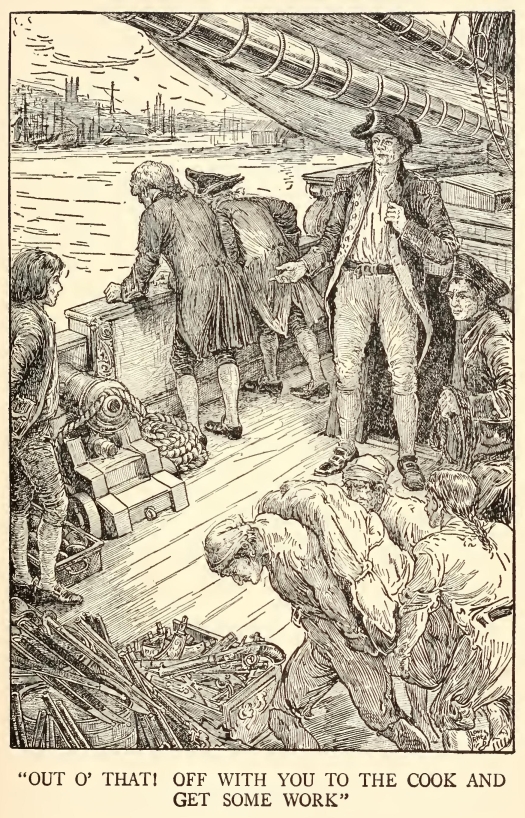
And then as I was hurrying off I heard him say, quite loudly, to the doctor,“I’ll have no favourites on my ship.”
I assure you I was quite of the squire’s way of thinking, and hated the captaindeeply.
X
The Voyage
ll that night we were in a great bustle getting things stowed in their place,and boatfuls of the squire’s friends, Mr. Blandly and the like, coming off towish him a good voyage and a safe return. We never had a night at the AdmiralBenbow when I had half the work; and I was dog-tired when, a little beforedawn, the boatswain sounded his pipe and the crew began to man thecapstan-bars. I might have been twice as weary, yet I would not have left thedeck, all was so new and interesting to me—the brief commands, the shrill noteof the whistle, the men bustling to their places in the glimmer of the ship’slanterns.
“Now, Barbecue, tip us a stave,” cried one voice.
“The old one,” cried another.
“Aye, aye, mates,” said Long John, who was standing by, with his crutch underhis arm, and at once broke out in the air and words I knew so well:
“Fifteen men on the dead man’s chest—”
And then the whole crew bore chorus:—
“Yo-ho-ho, and a bottle of rum!”
And at the third “Ho!” drove the bars before them with a will.
Even at that exciting moment it carried me back to the old Admiral Benbow in asecond, and I seemed to hear the voice of the captain piping in the chorus. Butsoon the anchor was short up; soon it was hanging dripping at the bows; soonthe sails began to draw, and the land and shipping to flit by on either side;and before I could lie down to snatch an hour of slumber the Hispaniolahad begun her voyage to the Isle of Treasure.
I am not going to relate that voyage in detail. It was fairly prosperous. Theship proved to be a good ship, the crew were capable seamen, and the captainthoroughly understood his business. But before we came the length of TreasureIsland, two or three things had happened which require to be known.
Mr. Arrow, first of all, turned out even worse than the captain had feared. Hehad no command among the men, and people did what they pleased with him. Butthat was by no means the worst of it, for after a day or two at sea he began toappear on deck with hazy eye, red cheeks, stuttering tongue, and other marks ofdrunkenness. Time after time he was ordered below in disgrace. Sometimes hefell and cut himself; sometimes he lay all day long in his little bunk at oneside of the companion; sometimes for a day or two he would be almost sober andattend to his work at least passably.
In the meantime, we could never make out where he got the drink. That was theship’s mystery. Watch him as we pleased, we could do nothing to solve it; andwhen we asked him to his face, he would only laugh if he were drunk, and if hewere sober deny solemnly that he ever tasted anything but water.
He was not only useless as an officer and a bad influence amongst the men, butit was plain that at this rate he must soon kill himself outright, so nobodywas much surprised, nor very sorry, when one dark night, with a head sea, hedisappeared entirely and was seen no more.
“Overboard!” said the captain. “Well, gentlemen, that saves the trouble ofputting him in irons.”
But there we were, without a mate; and it was necessary, of course, to advanceone of the men. The boatswain, Job Anderson, was the likeliest man aboard, andthough he kept his old title, he served in a way as mate. Mr. Trelawney hadfollowed the sea, and his knowledge made him very useful, for he often took awatch himself in easy weather. And the coxswain, Israel Hands, was a careful,wily, old, experienced seaman who could be trusted at a pinch with almostanything.
He was a great confidant of Long John Silver, and so the mention of his nameleads me on to speak of our ship’s cook, Barbecue, as the men called him.
Aboard ship he carried his crutch by a lanyard round his neck, to have bothhands as free as possible. It was something to see him wedge the foot of thecrutch against a bulkhead, and propped against it, yielding to every movementof the ship, get on with his cooking like someone safe ashore. Still morestrange was it to see him in the heaviest of weather cross the deck. He had aline or two rigged up to help him across the widest spaces—Long John’searrings, they were called; and he would hand himself from one place toanother, now using the crutch, now trailing it alongside by the lanyard, asquickly as another man could walk. Yet some of the men who had sailed with himbefore expressed their pity to see him so reduced.
“He’s no common man, Barbecue,” said the coxswain to me. “He had good schoolingin his young days and can speak like a book when so minded; and brave—a lion’snothing alongside of Long John! I seen him grapple four and knock their headstogether—him unarmed.”
All the crew respected and even obeyed him. He had a way of talking to each anddoing everybody some particular service. To me he was unweariedly kind, andalways glad to see me in the galley, which he kept as clean as a new pin, thedishes hanging up burnished and his parrot in a cage in one corner.
“Come away, Hawkins,” he would say; “come and have a yarn with John. Nobodymore welcome than yourself, my son. Sit you down and hear the news. Here’sCap’n Flint—I calls my parrot Cap’n Flint, after the famous buccaneer—here’sCap’n Flint predicting success to our v’yage. Wasn’t you, Cap’n?”
And the parrot would say, with great rapidity, “Pieces of eight! Pieces ofeight! Pieces of eight!” till you wondered that it was not out of breath, ortill John threw his handkerchief over the cage.
“Now, that bird,” he would say, “is, maybe, two hundred years old, Hawkins—theylive forever mostly; and if anybody’s seen more wickedness, it must be thedevil himself. She’s sailed with England, the great Cap’n England, the pirate.She’s been at Madagascar, and at Malabar, and Surinam, and Providence, andPortobello. She was at the fishing up of the wrecked plate ships. It’s thereshe learned ‘Pieces of eight,’ and little wonder; three hundred and fiftythousand of ’em, Hawkins! She was at the boarding of the Viceroy of theIndiesout of Goa, she was; and to look at her you would think she was ababby. But you smelt powder—didn’t you, Cap’n?”
“Stand by to go about,” the parrot would scream.
“Ah, she’s a handsome craft, she is,” the cook would say, and give her sugarfrom his pocket, and then the bird would peck at the bars and swear straighton, passing belief for wickedness. “There,” John would add, “you can’t touchpitch and not be mucked, lad. Here’s this poor old innocent bird o’ mineswearing blue fire, and none the wiser, you may lay to that. She would swearthe same, in a manner of speaking, before chaplain.” And John would touch hisforelock with a solemn way he had that made me think he was the best of men.
In the meantime, the squire and Captain Smollett were still on pretty distantterms with one another. The squire made no bones about the matter; he despisedthe captain. The captain, on his part, never spoke but when he was spoken to,and then sharp and short and dry, and not a word wasted. He owned, when driveninto a corner, that he seemed to have been wrong about the crew, that some ofthem were as brisk as he wanted to see and all had behaved fairly well. As forthe ship, he had taken a downright fancy to her. “She’ll lie a point nearer thewind than a man has a right to expect of his own married wife, sir. But,” hewould add, “all I say is, we’re not home again, and I don’t like the cruise.”
The squire, at this, would turn away and march up and down the deck, chin inair.
“A trifle more of that man,” he would say, “and I shall explode.”
We had some heavy weather, which only proved the qualities of theHispaniola. Every man on board seemed well content, and they must havebeen hard to please if they had been otherwise, for it is my belief there wasnever a ship’s company so spoiled since Noah put to sea. Double grog was goingon the least excuse; there was duff on odd days, as, for instance, if thesquire heard it was any man’s birthday, and always a barrel of apples standingbroached in the waist for anyone to help himself that had a fancy.
“Never knew good come of it yet,” the captain said to Dr. Livesey. “Spoilforecastle hands, make devils. That’s my belief.”
But good did come of the apple barrel, as you shall hear, for if it had notbeen for that, we should have had no note of warning and might all haveperished by the hand of treachery.
This was how it came about.
We had run up the trades to get the wind of the island we were after—I am notallowed to be more plain—and now we were running down for it with a brightlookout day and night. It was about the last day of our outward voyage by thelargest computation; some time that night, or at latest before noon of themorrow, we should sight the Treasure Island. We were heading S.S.W. and had asteady breeze abeam and a quiet sea. The Hispaniolarolled steadily,dipping her bowsprit now and then with a whiff of spray. All was drawing alowand aloft; everyone was in the bravest spirits because we were now so near anend of the first part of our adventure.
Now, just after sundown, when all my work was over and I was on my way to myberth, it occurred to me that I should like an apple. I ran on deck. The watchwas all forward looking out for the island. The man at the helm was watchingthe luff of the sail and whistling away gently to himself, and that was theonly sound excepting the swish of the sea against the bows and around the sidesof the ship.
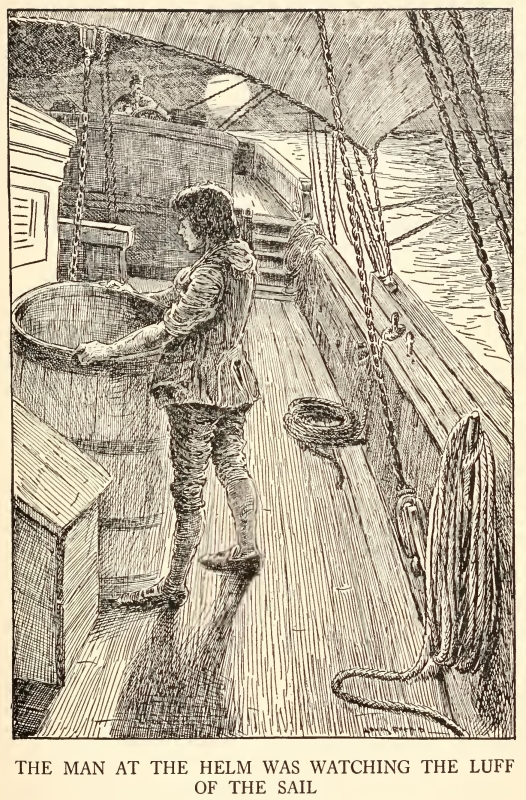
In I got bodily into the apple barrel, and found there was scarce an appleleft; but sitting down there in the dark, what with the sound of the waters andthe rocking movement of the ship, I had either fallen asleep or was on thepoint of doing so when a heavy man sat down with rather a clash close by. Thebarrel shook as he leaned his shoulders against it, and I was just about tojump up when the man began to speak. It was Silver’s voice, and before I hadheard a dozen words, I would not have shown myself for all the world, but laythere, trembling and listening, in the extreme of fear and curiosity, for fromthese dozen words I understood that the lives of all the honest men aboarddepended upon me alone.
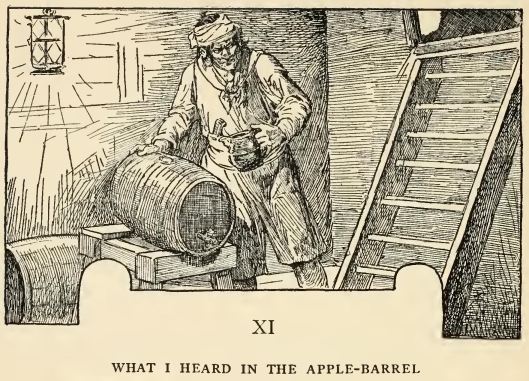
XI
What I Heard in the Apple-Barrel
o, not I,” said Silver. “Flint was cap’n; I was quartermaster, along of mytimber leg. The same broadside I lost my leg, old Pew lost his deadlights. Itwas a master surgeon, him that ampytated me—out of college and all—Latin by thebucket, and what not; but he was hanged like a dog, and sun-dried like therest, at Corso Castle. That was Roberts’ men, that was, and comed of changingnames to their ships—Royal Fortuneand so on. Now, what a ship waschristened, so let her stay, I says. So it was with the Cassandra, asbrought us all safe home from Malabar, after England took the Viceroy of theIndies;so it was with the old Walrus, Flint’s old ship, as I’veseen amuck with the red blood and fit to sink with gold.”
“Ah!” cried another voice, that of the youngest hand on board, and evidentlyfull of admiration. “He was the flower of the flock, was Flint!”
“Davis was a man too, by all accounts,” said Silver. “I never sailed along ofhim; first with England, then with Flint, that’s my story; and now here on myown account, in a manner of speaking. I laid by nine hundred safe, fromEngland, and two thousand after Flint. That ain’t bad for a man before themast—all safe in bank. ’Tain’t earning now, it’s saving does it, you may lay tothat. Where’s all England’s men now? I dunno. Where’s Flint’s? Why, most on ’emaboard here, and glad to get the duff—been begging before that, some on ’em.Old Pew, as had lost his sight, and might have thought shame, spends twelvehundred pound in a year, like a lord in Parliament. Where is he now? Well, he’sdead now and under hatches; but for two year before that, shiver my timbers,the man was starving! He begged, and he stole, and he cut throats, and starvedat that, by the powers!”
“Well, it ain’t much use, after all,” said the young seaman.
“’Tain’t much use for fools, you may lay to it—that, nor nothing,” criedSilver. “But now, you look here: you’re young, you are, but you’re as smart aspaint. I see that when I set my eyes on you, and I’ll talk to you like a man.”
You may imagine how I felt when I heard this abominable old rogue addressinganother in the very same words of flattery as he had used to myself. I think,if I had been able, that I would have killed him through the barrel. Meantime,he ran on, little supposing he was overheard.
“Here it is about gentlemen of fortune. They lives rough, and they riskswinging, but they eat and drink like fighting-cocks, and when a cruise isdone, why, it’s hundreds of pounds instead of hundreds of farthings in theirpockets. Now, the most goes for rum and a good fling, and to sea again in theirshirts. But that’s not the course I lay. I puts it all away, some here, somethere, and none too much anywheres, by reason of suspicion. I’m fifty, markyou; once back from this cruise, I set up gentleman in earnest. Time enoughtoo, says you. Ah, but I’ve lived easy in the meantime, never denied myself o’nothing heart desires, and slep’ soft and ate dainty all my days but when atsea. And how did I begin? Before the mast, like you!”
“Well,” said the other, “but all the other money’s gone now, ain’t it? Youdaren’t show face in Bristol after this.”
“Why, where might you suppose it was?” asked Silver derisively.
“At Bristol, in banks and places,” answered his companion.
“It were,” said the cook; “it were when we weighed anchor. But my old missishas it all by now. And the Spy-glass is sold, lease and goodwill and rigging;and the old girl’s off to meet me. I would tell you where, for I trust you, butit’d make jealousy among the mates.”
“And can you trust your missis?” asked the other.
“Gentlemen of fortune,” returned the cook, “usually trusts little amongthemselves, and right they are, you may lay to it. But I have a way with me, Ihave. When a mate brings a slip on his cable—one as knows me, I mean—it won’tbe in the same world with old John. There was some that was feared of Pew, andsome that was feared of Flint; but Flint his own self was feared of me. Fearedhe was, and proud. They was the roughest crew afloat, was Flint’s; the devilhimself would have been feared to go to sea with them. Well now, I tell you,I’m not a boasting man, and you seen yourself how easy I keep company, but whenI was quartermaster, lambswasn’t the word for Flint’s old buccaneers.Ah, you may be sure of yourself in old John’s ship.”
“Well, I tell you now,” replied the lad, “I didn’t half a quarter like the jobtill I had this talk with you, John; but there’s my hand on it now.”
“And a brave lad you were, and smart too,” answered Silver, shaking hands soheartily that all the barrel shook, “and a finer figurehead for a gentleman offortune I never clapped my eyes on.”
By this time I had begun to understand the meaning of their terms. By a“gentleman of fortune” they plainly meant neither more nor less than a commonpirate, and the little scene that I had overheard was the last act in thecorruption of one of the honest hands—perhaps of the last one left aboard. Buton this point I was soon to be relieved, for Silver giving a little whistle, athird man strolled up and sat down by the party.
“Dick’s square,” said Silver.
“Oh, I know’d Dick was square,” returned the voice of the coxswain, IsraelHands. “He’s no fool, is Dick.” And he turned his quid and spat. “But lookhere,” he went on, “here’s what I want to know, Barbecue: how long are wea-going to stand off and on like a blessed bumboat? I’ve had a’most enough o’Cap’n Smollett; he’s hazed me long enough, by thunder! I want to go into thatcabin, I do. I want their pickles and wines, and that.”
“Israel,” said Silver, “your head ain’t much account, nor ever was. But you’reable to hear, I reckon; leastways, your ears is big enough. Now, here’s what Isay: you’ll berth forward, and you’ll live hard, and you’ll speak soft, andyou’ll keep sober till I give the word; and you may lay to that, my son.”
“Well, I don’t say no, do I?” growled the coxswain. “What I say is, when?That’s what I say.”
“When! By the powers!” cried Silver. “Well now, if you want to know, I’ll tellyou when. The last moment I can manage, and that’s when. Here’s a first-rateseaman, Cap’n Smollett, sails the blessed ship for us. Here’s this squire anddoctor with a map and such—I don’t know where it is, do I? No more do you, saysyou. Well then, I mean this squire and doctor shall find the stuff, and help usto get it aboard, by the powers. Then we’ll see. If I was sure of you all, sonsof double Dutchmen, I’d have Cap’n Smollett navigate us half-way back againbefore I struck.”
“Why, we’re all seamen aboard here, I should think,” said the lad Dick.
“We’re all forecastle hands, you mean,” snapped Silver. “We can steer a course,but who’s to set one? That’s what all you gentlemen split on, first and last.If I had my way, I’d have Cap’n Smollett work us back into the trades at least;then we’d have no blessed miscalculations and a spoonful of water a day. But Iknow the sort you are. I’ll finish with ’em at the island, as soon’s theblunt’s on board, and a pity it is. But you’re never happy till you’re drunk.Split my sides, I’ve a sick heart to sail with the likes of you!”
“Easy all, Long John,” cried Israel. “Who’s a-crossin’ of you?”
“Why, how many tall ships, think ye, now, have I seen laid aboard? And how manybrisk lads drying in the sun at Execution Dock?” cried Silver. “And all forthis same hurry and hurry and hurry. You hear me? I seen a thing or two at sea,I have. If you would on’y lay your course, and a p’int to windward, you wouldride in carriages, you would. But not you! I know you. You’ll have yourmouthful of rum tomorrow, and go hang.”
“Everybody knowed you was a kind of a chapling, John; but there’s others ascould hand and steer as well as you,” said Israel. “They liked a bit o’ fun,they did. They wasn’t so high and dry, nohow, but took their fling, like jollycompanions every one.”
“So?” says Silver. “Well, and where are they now? Pew was that sort, and hedied a beggar-man. Flint was, and he died of rum at Savannah. Ah, they was asweet crew, they was! On’y, where are they?”
“But,” asked Dick, “when we do lay ’em athwart, what are we to do with ’em,anyhow?”
“There’s the man for me!” cried the cook admiringly. “That’s what I callbusiness. Well, what would you think? Put ’em ashore like maroons? That wouldhave been England’s way. Or cut ’em down like that much pork? That would havebeen Flint’s, or Billy Bones’s.”
“Billy was the man for that,” said Israel. “‘Dead men don’t bite,’ says he.Well, he’s dead now hisself; he knows the long and short on it now; and if evera rough hand come to port, it was Billy.”
“Right you are,” said Silver; “rough and ready. But mark you here, I’m an easyman—I’m quite the gentleman, says you; but this time it’s serious. Dooty isdooty, mates. I give my vote—death. When I’m in Parlyment and riding in mycoach, I don’t want none of these sea-lawyers in the cabin a-coming home,unlooked for, like the devil at prayers. Wait is what I say; but when the timecomes, why, let her rip!”
“John,” cries the coxswain, “you’re a man!”
“You’ll say so, Israel when you see,” said Silver. “Only one thing I claim—Iclaim Trelawney. I’ll wring his calf’s head off his body with these hands,Dick!” he added, breaking off. “You just jump up, like a sweet lad, and get mean apple, to wet my pipe like.”
You may fancy the terror I was in! I should have leaped out and run for it if Ihad found the strength, but my limbs and heart alike misgave me. I heard Dickbegin to rise, and then someone seemingly stopped him, and the voice of Handsexclaimed, “Oh, stow that! Don’t you get sucking of that bilge, John. Let’shave a go of the rum.”
“Dick,” said Silver, “I trust you. I’ve a gauge on the keg, mind. There’s thekey; you fill a pannikin and bring it up.”
Terrified as I was, I could not help thinking to myself that this must havebeen how Mr. Arrow got the strong waters that destroyed him.
Dick was gone but a little while, and during his absence Israel spoke straighton in the cook’s ear. It was but a word or two that I could catch, and yet Igathered some important news, for besides other scraps that tended to the samepurpose, this whole clause was audible: “Not another man of them’ll jine.”Hence there were still faithful men on board.
When Dick returned, one after another of the trio took the pannikin anddrank—one “To luck,” another with a “Here’s to old Flint,” and Silver himselfsaying, in a kind of song, “Here’s to ourselves, and hold your luff, plenty ofprizes and plenty of duff.”
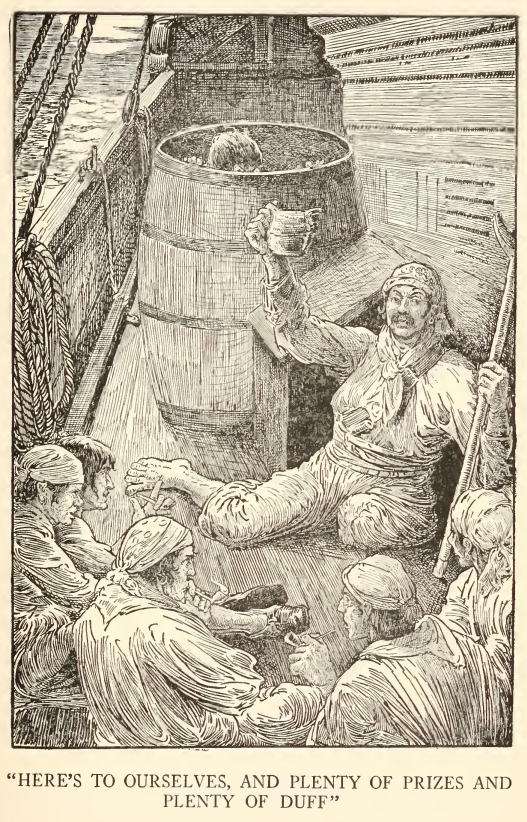
Just then a sort of brightness fell upon me in the barrel, and looking up, Ifound the moon had risen and was silvering the mizzen-top and shining white onthe luff of the fore-sail; and almost at the same time the voice of the lookoutshouted, “Land ho!”
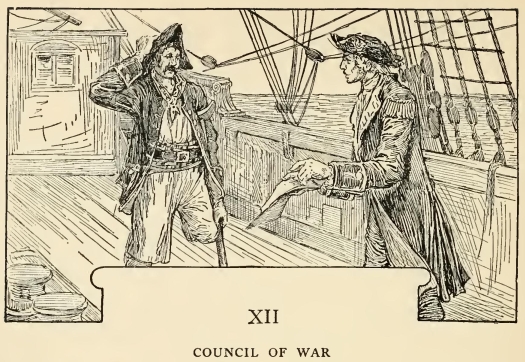
XII
Council of War
here was a great rush of feet across the deck. I could hear people tumbling upfrom the cabin and the forecastle, and slipping in an instant outside mybarrel, I dived behind the fore-sail, made a double towards the stern, and cameout upon the open deck in time to join Hunter and Dr. Livesey in the rush forthe weather bow.
There all hands were already congregated. A belt of fog had lifted almostsimultaneously with the appearance of the moon. Away to the south-west of us wesaw two low hills, about a couple of miles apart, and rising behind one of thema third and higher hill, whose peak was still buried in the fog. All threeseemed sharp and conical in figure.
So much I saw, almost in a dream, for I had not yet recovered from my horridfear of a minute or two before. And then I heard the voice of Captain Smollettissuing orders. The Hispaniolawas laid a couple of points nearer thewind and now sailed a course that would just clear the island on the east.
“And now, men,” said the captain, when all was sheeted home, “has any one ofyou ever seen that land ahead?”
“I have, sir,” said Silver. “I’ve watered there with a trader I was cook in.”
“The anchorage is on the south, behind an islet, I fancy?” asked the captain.
“Yes, sir; Skeleton Island they calls it. It were a main place for piratesonce, and a hand we had on board knowed all their names for it. That hill tothe nor’ard they calls the Foremast Hill; there are three hills in a rowrunning south’ard—fore, main, and mizzen, sir. But the main—that’s the big un,with the cloud on it—they usually calls the Spy-glass, by reason of a lookoutthey kept when they was in the anchorage cleaning, for it’s there they cleanedtheir ships, sir, asking your pardon.”
“I have a chart here,” says Captain Smollett. “See if that’s the place.”
Long John’s eyes burned in his head as he took the chart, but by the fresh lookof the paper I knew he was doomed to disappointment. This was not the map wefound in Billy Bones’s chest, but an accurate copy, complete in allthings—names and heights and soundings—with the single exception of the redcrosses and the written notes. Sharp as must have been his annoyance, Silverhad the strength of mind to hide it.
“Yes, sir,” said he, “this is the spot, to be sure, and very prettily drawedout. Who might have done that, I wonder? The pirates were too ignorant, Ireckon. Aye, here it is: ‘Capt. Kidd’s Anchorage’—just the name my shipmatecalled it. There’s a strong current runs along the south, and then away nor’ardup the west coast. Right you was, sir,” says he, “to haul your wind and keepthe weather of the island. Leastways, if such was your intention as to enterand careen, and there ain’t no better place for that in these waters.”
“Thank you, my man,” says Captain Smollett. “I’ll ask you later on to give us ahelp. You may go.”
I was surprised at the coolness with which John avowed his knowledge of theisland, and I own I was half-frightened when I saw him drawing nearer tomyself. He did not know, to be sure, that I had overheard his council from theapple barrel, and yet I had by this time taken such a horror of his cruelty,duplicity, and power that I could scarce conceal a shudder when he laid hishand upon my arm.
“Ah,” says he, “this here is a sweet spot, this island—a sweet spot for a ladto get ashore on. You’ll bathe, and you’ll climb trees, and you’ll hunt goats,you will; and you’ll get aloft on them hills like a goat yourself. Why, itmakes me young again. I was going to forget my timber leg, I was. It’s apleasant thing to be young and have ten toes, and you may lay to that. When youwant to go a bit of exploring, you just ask old John, and he’ll put up a snackfor you to take along.”
And clapping me in the friendliest way upon the shoulder, he hobbled offforward and went below.
Captain Smollett, the squire, and Dr. Livesey were talking together on thequarter-deck, and anxious as I was to tell them my story, I durst not interruptthem openly. While I was still casting about in my thoughts to find someprobable excuse, Dr. Livesey called me to his side. He had left his pipe below,and being a slave to tobacco, had meant that I should fetch it; but as soon asI was near enough to speak and not to be overheard, I broke immediately,“Doctor, let me speak. Get the captain and squire down to the cabin, and thenmake some pretence to send for me. I have terrible news.”
The doctor changed countenance a little, but next moment he was master ofhimself.
“Thank you, Jim,” said he quite loudly, “that was all I wanted to know,” as ifhe had asked me a question.
And with that he turned on his heel and rejoined the other two. They spoketogether for a little, and though none of them started, or raised his voice, orso much as whistled, it was plain enough that Dr. Livesey had communicated myrequest, for the next thing that I heard was the captain giving an order to JobAnderson, and all hands were piped on deck.
“My lads,” said Captain Smollett, “I’ve a word to say to you. This land that wehave sighted is the place we have been sailing for. Mr. Trelawney, being a veryopen-handed gentleman, as we all know, has just asked me a word or two, and asI was able to tell him that every man on board had done his duty, alow andaloft, as I never ask to see it done better, why, he and I and the doctor aregoing below to the cabin to drink yourhealth and luck, and you’ll havegrog served out for you to drink ourhealth and luck. I’ll tell you whatI think of this: I think it handsome. And if you think as I do, you’ll give agood sea-cheer for the gentleman that does it.”
The cheer followed—that was a matter of course; but it rang out so full andhearty that I confess I could hardly believe these same men were plotting forour blood.
“One more cheer for Cap’n Smollett,” cried Long John when the first hadsubsided.
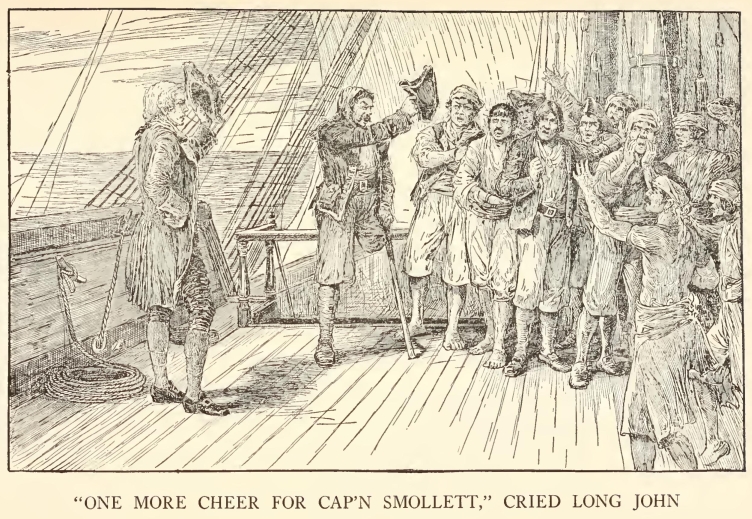
And this also was given with a will.
On the top of that the three gentlemen went below, and not long after, word wassent forward that Jim Hawkins was wanted in the cabin.
I found them all three seated round the table, a bottle of Spanish wine andsome raisins before them, and the doctor smoking away, with his wig on his lap,and that, I knew, was a sign that he was agitated. The stern window was open,for it was a warm night, and you could see the moon shining behind on theship’s wake.
“Now, Hawkins,” said the squire, “you have something to say. Speak up.”
I did as I was bid, and as short as I could make it, told the whole details ofSilver’s conversation. Nobody interrupted me till I was done, nor did any oneof the three of them make so much as a movement, but they kept their eyes uponmy face from first to last.
“Jim,” said Dr. Livesey, “take a seat.”
And they made me sit down at table beside them, poured me out a glass of wine,filled my hands with raisins, and all three, one after the other, and each witha bow, drank my good health, and their service to me, for my luck and courage.
“Now, captain,” said the squire, “you were right, and I was wrong. I own myselfan ass, and I await your orders.”
“No more an ass than I, sir,” returned the captain. “I never heard of a crewthat meant to mutiny but what showed signs before, for any man that had an eyein his head to see the mischief and take steps according. But this crew,” headded, “beats me.”
“Captain,” said the doctor, “with your permission, that’s Silver. A veryremarkable man.”
“He’d look remarkably well from a yard-arm, sir,” returned the captain. “Butthis is talk; this don’t lead to anything. I see three or four points, and withMr. Trelawney’s permission, I’ll name them.”
“You, sir, are the captain. It is for you to speak,” says Mr. Trelawneygrandly.
“First point,” began Mr. Smollett. “We must go on, because we can’t turn back.If I gave the word to go about, they would rise at once. Second point, we havetime before us—at least until this treasure’s found. Third point, there arefaithful hands. Now, sir, it’s got to come to blows sooner or later, and what Ipropose is to take time by the forelock, as the saying is, and come to blowssome fine day when they least expect it. We can count, I take it, on your ownhome servants, Mr. Trelawney?”
“As upon myself,” declared the squire.
“Three,” reckoned the captain; “ourselves make seven, counting Hawkins here.Now, about the honest hands?”
“Most likely Trelawney’s own men,” said the doctor; “those he had picked up forhimself before he lit on Silver.”
“Nay,” replied the squire. “Hands was one of mine.”
“I did think I could have trusted Hands,” added the captain.
“And to think that they’re all Englishmen!” broke out the squire. “Sir, I couldfind it in my heart to blow the ship up.”
“Well, gentlemen,” said the captain, “the best that I can say is not much. Wemust lay to, if you please, and keep a bright lookout. It’s trying on a man, Iknow. It would be pleasanter to come to blows. But there’s no help for it tillwe know our men. Lay to, and whistle for a wind, that’s my view.”
“Jim here,” said the doctor, “can help us more than anyone. The men are not shywith him, and Jim is a noticing lad.”
“Hawkins, I put prodigious faith in you,” added the squire.
I began to feel pretty desperate at this, for I felt altogether helpless; andyet, by an odd train of circumstances, it was indeed through me that safetycame. In the meantime, talk as we pleased, there were only seven out of thetwenty-six on whom we knew we could rely; and out of these seven one was a boy,so that the grown men on our side were six to their nineteen.
PART THREE—My Shore Adventure
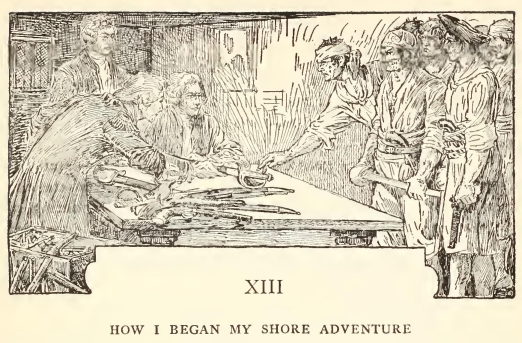
XIII
How I Began My Shore Adventure
he appearance of the island when I came on deck next morning was altogetherchanged. Although the breeze had now utterly ceased, we had made a great dealof way during the night and were now lying becalmed about half a mile to thesouth-east of the low eastern coast. Grey-coloured woods covered a large partof the surface. This even tint was indeed broken up by streaks of yellowsand-break in the lower lands, and by many tall trees of the pine family,out-topping the others—some singly, some in clumps; but the general colouringwas uniform and sad. The hills ran up clear above the vegetation in spires ofnaked rock. All were strangely shaped, and the Spy-glass, which was by three orfour hundred feet the tallest on the island, was likewise the strangest inconfiguration, running up sheer from almost every side and then suddenly cutoff at the top like a pedestal to put a statue on.
The Hispaniolawas rolling scuppers under in the ocean swell. The boomswere tearing at the blocks, the rudder was banging to and fro, and the wholeship creaking, groaning, and jumping like a manufactory. I had to cling tightto the backstay, and the world turned giddily before my eyes, for though I wasa good enough sailor when there was way on, this standing still and beingrolled about like a bottle was a thing I never learned to stand without a qualmor so, above all in the morning, on an empty stomach.
Perhaps it was this—perhaps it was the look of the island, with its grey,melancholy woods, and wild stone spires, and the surf that we could both seeand hear foaming and thundering on the steep beach—at least, although the sunshone bright and hot, and the shore birds were fishing and crying all aroundus, and you would have thought anyone would have been glad to get to land afterbeing so long at sea, my heart sank, as the saying is, into my boots; and fromthe first look onward, I hated the very thought of Treasure Island.
We had a dreary morning’s work before us, for there was no sign of any wind,and the boats had to be got out and manned, and the ship warped three or fourmiles round the corner of the island and up the narrow passage to the havenbehind Skeleton Island. I volunteered for one of the boats, where I had, ofcourse, no business. The heat was sweltering, and the men grumbled fiercelyover their work. Anderson was in command of my boat, and instead of keeping thecrew in order, he grumbled as loud as the worst.
“Well,” he said with an oath, “it’s not forever.”
I thought this was a very bad sign, for up to that day the men had gone brisklyand willingly about their business; but the very sight of the island hadrelaxed the cords of discipline.
All the way in, Long John stood by the steersman and conned the ship. He knewthe passage like the palm of his hand, and though the man in the chains goteverywhere more water than was down in the chart, John never hesitated once.
“There’s a strong scour with the ebb,” he said, “and this here passage has beendug out, in a manner of speaking, with a spade.”
We brought up just where the anchor was in the chart, about a third of a milefrom each shore, the mainland on one side and Skeleton Island on the other. Thebottom was clean sand. The plunge of our anchor sent up clouds of birdswheeling and crying over the woods, but in less than a minute they were downagain and all was once more silent.
The place was entirely land-locked, buried in woods, the trees coming rightdown to high-water mark, the shores mostly flat, and the hilltops standinground at a distance in a sort of amphitheatre, one here, one there. Two littlerivers, or rather two swamps, emptied out into this pond, as you might call it;and the foliage round that part of the shore had a kind of poisonousbrightness. From the ship we could see nothing of the house or stockade, forthey were quite buried among trees; and if it had not been for the chart on thecompanion, we might have been the first that had ever anchored there since theisland arose out of the seas.
There was not a breath of air moving, nor a sound but that of the surf boominghalf a mile away along the beaches and against the rocks outside. A peculiarstagnant smell hung over the anchorage—a smell of sodden leaves and rottingtree trunks. I observed the doctor sniffing and sniffing, like someone tastinga bad egg.
“I don’t know about treasure,” he said, “but I’ll stake my wig there’s feverhere.”
If the conduct of the men had been alarming in the boat, it became trulythreatening when they had come aboard. They lay about the deck growlingtogether in talk. The slightest order was received with a black look andgrudgingly and carelessly obeyed. Even the honest hands must have caught theinfection, for there was not one man aboard to mend another. Mutiny, it wasplain, hung over us like a thunder-cloud.
And it was not only we of the cabin party who perceived the danger. Long Johnwas hard at work going from group to group, spending himself in good advice,and as for example no man could have shown a better. He fairly outstrippedhimself in willingness and civility; he was all smiles to everyone. If an orderwere given, John would be on his crutch in an instant, with the cheeriest “Aye,aye, sir!” in the world; and when there was nothing else to do, he kept up onesong after another, as if to conceal the discontent of the rest.
Of all the gloomy features of that gloomy afternoon, this obvious anxiety onthe part of Long John appeared the worst.
We held a council in the cabin.
“Sir,” said the captain, “if I risk another order, the whole ship’ll come aboutour ears by the run. You see, sir, here it is. I get a rough answer, do I not?Well, if I speak back, pikes will be going in two shakes; if I don’t, Silverwill see there’s something under that, and the game’s up. Now, we’ve only oneman to rely on.”
“And who is that?” asked the squire.
“Silver, sir,” returned the captain; “he’s as anxious as you and I to smotherthings up. This is a tiff; he’d soon talk ’em out of it if he had the chance,and what I propose to do is to give him the chance. Let’s allow the men anafternoon ashore. If they all go, why we’ll fight the ship. If they none ofthem go, well then, we hold the cabin, and God defend the right. If some go,you mark my words, sir, Silver’ll bring ’em aboard again as mild as lambs.”
It was so decided; loaded pistols were served out to all the sure men; Hunter,Joyce, and Redruth were taken into our confidence and received the news withless surprise and a better spirit than we had looked for, and then the captainwent on deck and addressed the crew.
“My lads,” said he, “we’ve had a hot day and are all tired and out of sorts. Aturn ashore’ll hurt nobody—the boats are still in the water; you can take thegigs, and as many as please may go ashore for the afternoon. I’ll fire a gunhalf an hour before sundown.”
I believe the silly fellows must have thought they would break their shins overtreasure as soon as they were landed, for they all came out of their sulks in amoment and gave a cheer that started the echo in a faraway hill and sent thebirds once more flying and squalling round the anchorage.
The captain was too bright to be in the way. He whipped out of sight in amoment, leaving Silver to arrange the party, and I fancy it was as well he didso. Had he been on deck, he could no longer so much as have pretended not tounderstand the situation. It was as plain as day. Silver was the captain, and amighty rebellious crew he had of it. The honest hands—and I was soon to see itproved that there were such on board—must have been very stupid fellows. Orrather, I suppose the truth was this, that all hands were disaffected by theexample of the ringleaders—only some more, some less; and a few, being goodfellows in the main, could neither be led nor driven any further. It is onething to be idle and skulk and quite another to take a ship and murder a numberof innocent men.
At last, however, the party was made up. Six fellows were to stay on board, andthe remaining thirteen, including Silver, began to embark.
Then it was that there came into my head the first of the mad notions thatcontributed so much to save our lives. If six men were left by Silver, it wasplain our party could not take and fight the ship; and since only six wereleft, it was equally plain that the cabin party had no present need of myassistance. It occurred to me at once to go ashore. In a jiffy I had slippedover the side and curled up in the fore-sheets of the nearest boat, and almostat the same moment she shoved off.
No one took notice of me, only the bow oar saying, “Is that you, Jim? Keep yourhead down.” But Silver, from the other boat, looked sharply over and called outto know if that were me; and from that moment I began to regret what I haddone.
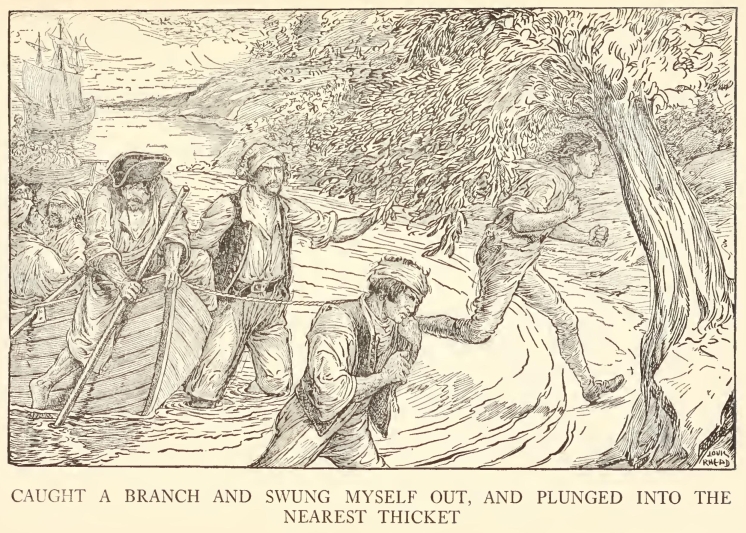
The crews raced for the beach, but the boat I was in, having some start andbeing at once the lighter and the better manned, shot far ahead of her consort,and the bow had struck among the shore-side trees and I had caught a branch andswung myself out and plunged into the nearest thicket while Silver and the restwere still a hundred yards behind.
“Jim, Jim!” I heard him shouting.
But you may suppose I paid no heed; jumping, ducking, and breaking through, Iran straight before my nose till I could run no longer.
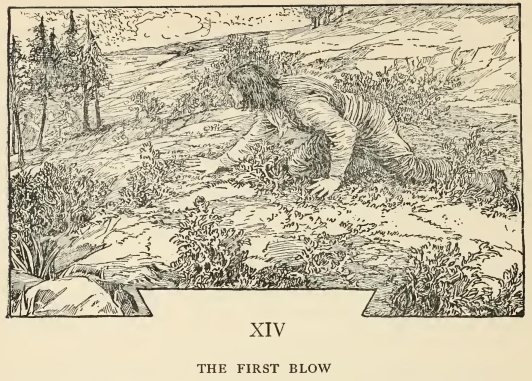
XIV
The First Blow
was so pleased at having given the slip to Long John that I began to enjoymyself and look around me with some interest on the strange land that I was in.
I had crossed a marshy tract full of willows, bulrushes, and odd, outlandish,swampy trees; and I had now come out upon the skirts of an open piece ofundulating, sandy country, about a mile long, dotted with a few pines and agreat number of contorted trees, not unlike the oak in growth, but pale in thefoliage, like willows. On the far side of the open stood one of the hills, withtwo quaint, craggy peaks shining vividly in the sun.
I now felt for the first time the joy of exploration. The isle was uninhabited;my shipmates I had left behind, and nothing lived in front of me but dumbbrutes and fowls. I turned hither and thither among the trees. Here and therewere flowering plants, unknown to me; here and there I saw snakes, and oneraised his head from a ledge of rock and hissed at me with a noise not unlikethe spinning of a top. Little did I suppose that he was a deadly enemy and thatthe noise was the famous rattle.
Then I came to a long thicket of these oaklike trees—live, or evergreen, oaks,I heard afterwards they should be called—which grew low along the sand likebrambles, the boughs curiously twisted, the foliage compact, like thatch. Thethicket stretched down from the top of one of the sandy knolls, spreading andgrowing taller as it went, until it reached the margin of the broad, reedy fen,through which the nearest of the little rivers soaked its way into theanchorage. The marsh was steaming in the strong sun, and the outline of theSpy-glass trembled through the haze.
All at once there began to go a sort of bustle among the bulrushes; a wild duckflew up with a quack, another followed, and soon over the whole surface of themarsh a great cloud of birds hung screaming and circling in the air. I judgedat once that some of my shipmates must be drawing near along the borders of thefen. Nor was I deceived, for soon I heard the very distant and low tones of ahuman voice, which, as I continued to give ear, grew steadily louder andnearer.
This put me in a great fear, and I crawled under cover of the nearest live-oakand squatted there, hearkening, as silent as a mouse.
Another voice answered, and then the first voice, which I now recognized to beSilver’s, once more took up the story and ran on for a long while in a stream,only now and again interrupted by the other. By the sound they must have beentalking earnestly, and almost fiercely; but no distinct word came to myhearing.
At last the speakers seemed to have paused and perhaps to have sat down, fornot only did they cease to draw any nearer, but the birds themselves began togrow more quiet and to settle again to their places in the swamp.
And now I began to feel that I was neglecting my business, that since I hadbeen so foolhardy as to come ashore with these desperadoes, the least I coulddo was to overhear them at their councils, and that my plain and obvious dutywas to draw as close as I could manage, under the favourable ambush of thecrouching trees.
I could tell the direction of the speakers pretty exactly, not only by thesound of their voices but by the behaviour of the few birds that still hung inalarm above the heads of the intruders.
Crawling on all fours, I made steadily but slowly towards them, till at last,raising my head to an aperture among the leaves, I could see clear down into alittle green dell beside the marsh, and closely set about with trees, whereLong John Silver and another of the crew stood face to face in conversation.
The sun beat full upon them. Silver had thrown his hat beside him on theground, and his great, smooth, blond face, all shining with heat, was lifted tothe other man’s in a kind of appeal.
“Mate,” he was saying, “it’s because I thinks gold dust of you—gold dust, andyou may lay to that! If I hadn’t took to you like pitch, do you think I’d havebeen here a-warning of you? All’s up—you can’t make nor mend; it’s to save yourneck that I’m a-speaking, and if one of the wild uns knew it, where’d I be,Tom—now, tell me, where’d I be?”
“Silver,” said the other man—and I observed he was not only red in the face,but spoke as hoarse as a crow, and his voice shook too, like a tautrope—“Silver,” says he, “you’re old, and you’re honest, or has the name for it;and you’ve money too, which lots of poor sailors hasn’t; and you’re brave, orI’m mistook. And will you tell me you’ll let yourself be led away with thatkind of a mess of swabs? Not you! As sure as God sees me, I’d sooner lose myhand. If I turn agin my dooty—”
And then all of a sudden he was interrupted by a noise. I had found one of thehonest hands—well, here, at that same moment, came news of another. Far awayout in the marsh there arose, all of a sudden, a sound like the cry of anger,then another on the back of it; and then one horrid, long-drawn scream. Therocks of the Spy-glass re-echoed it a score of times; the whole troop ofmarsh-birds rose again, darkening heaven, with a simultaneous whirr; and longafter that death yell was still ringing in my brain, silence had re-establishedits empire, and only the rustle of the redescending birds and the boom of thedistant surges disturbed the languor of the afternoon.
Tom had leaped at the sound, like a horse at the spur, but Silver had notwinked an eye. He stood where he was, resting lightly on his crutch, watchinghis companion like a snake about to spring.
“John!” said the sailor, stretching out his hand.
“Hands off!” cried Silver, leaping back a yard, as it seemed to me, with thespeed and security of a trained gymnast.
“Hands off, if you like, John Silver,” said the other. “It’s a black consciencethat can make you feared of me. But in heaven’s name, tell me, what was that?”
“That?” returned Silver, smiling away, but warier than ever, his eye a merepin-point in his big face, but gleaming like a crumb of glass. “That? Oh, Ireckon that’ll be Alan.”
And at this point Tom flashed out like a hero.
“Alan!” he cried. “Then rest his soul for a true seaman! And as for you, JohnSilver, long you’ve been a mate of mine, but you’re mate of mine no more. If Idie like a dog, I’ll die in my dooty. You’ve killed Alan, have you? Kill metoo, if you can. But I defies you.”
And with that, this brave fellow turned his back directly on the cook and setoff walking for the beach. But he was not destined to go far. With a cry Johnseized the branch of a tree, whipped the crutch out of his armpit, and sentthat uncouth missile hurtling through the air. It struck poor Tom, pointforemost, and with stunning violence, right between the shoulders in the middleof his back. His hands flew up, he gave a sort of gasp, and fell.
Whether he were injured much or little, none could ever tell. Like enough, tojudge from the sound, his back was broken on the spot. But he had no time givenhim to recover. Silver, agile as a monkey even without leg or crutch, was onthe top of him next moment and had twice buried his knife up to the hilt inthat defenceless body. From my place of ambush, I could hear him pant aloud ashe struck the blows.
I do not know what it rightly is to faint, but I do know that for the nextlittle while the whole world swam away from before me in a whirling mist;Silver and the birds, and the tall Spy-glass hilltop, going round and round andtopsy-turvy before my eyes, and all manner of bells ringing and distant voicesshouting in my ear.
When I came again to myself the monster had pulled himself together, his crutchunder his arm, his hat upon his head. Just before him Tom lay motionless uponthe sward; but the murderer minded him not a whit, cleansing his blood-stainedknife the while upon a wisp of grass. Everything else was unchanged, the sunstill shining mercilessly on the steaming marsh and the tall pinnacle of themountain, and I could scarce persuade myself that murder had been actually doneand a human life cruelly cut short a moment since before my eyes.
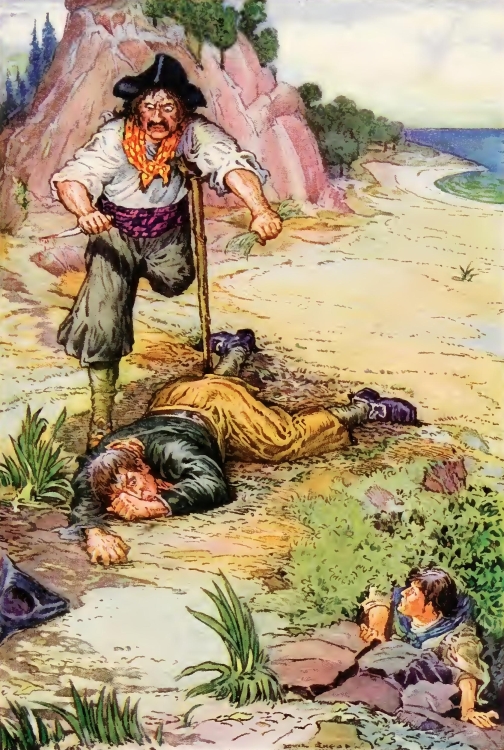
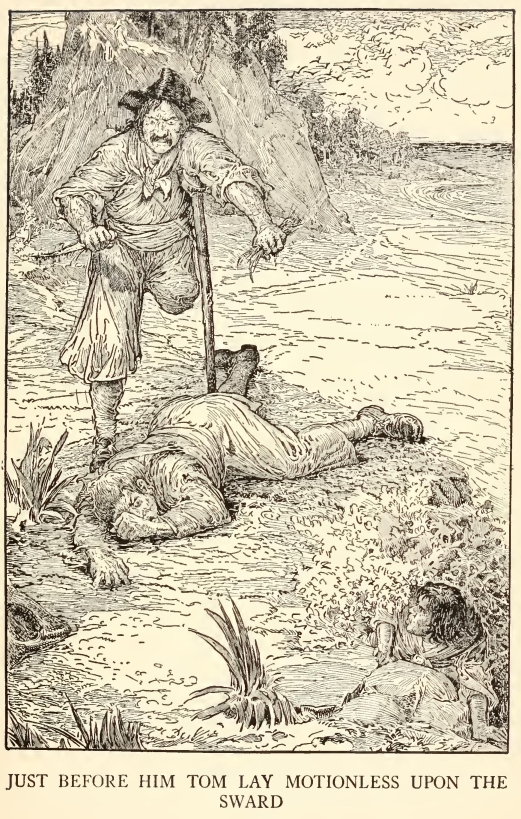
But now John put his hand into his pocket, brought out a whistle, and blew uponit several modulated blasts that rang far across the heated air. I could nottell, of course, the meaning of the signal, but it instantly awoke my fears.More men would be coming. I might be discovered. They had already slain two ofthe honest people; after Tom and Alan, might not I come next?
Instantly I began to extricate myself and crawl back again, with what speed andsilence I could manage, to the more open portion of the wood. As I did so, Icould hear hails coming and going between the old buccaneer and his comrades,and this sound of danger lent me wings. As soon as I was clear of the thicket,I ran as I never ran before, scarce minding the direction of my flight, so longas it led me from the murderers; and as I ran, fear grew and grew upon me untilit turned into a kind of frenzy.
Indeed, could anyone be more entirely lost than I? When the gun fired, howshould I dare to go down to the boats among those fiends, still smoking fromtheir crime? Would not the first of them who saw me wring my neck like asnipe’s? Would not my absence itself be an evidence to them of my alarm, andtherefore of my fatal knowledge? It was all over, I thought. Good-bye to theHispaniola; good-bye to the squire, the doctor, and the captain! Therewas nothing left for me but death by starvation or death by the hands of themutineers.
All this while, as I say, I was still running, and without taking any notice, Ihad drawn near to the foot of the little hill with the two peaks and had gotinto a part of the island where the live-oaks grew more widely apart and seemedmore like forest trees in their bearing and dimensions. Mingled with these werea few scattered pines, some fifty, some nearer seventy, feet high. The air toosmelt more freshly than down beside the marsh.
And here a fresh alarm brought me to a standstill with a thumping heart.
XV
The Man of the Island
rom the side of the hill, which was here steep and stony, a spout of gravel wasdislodged and fell rattling and bounding through the trees. My eyes turnedinstinctively in that direction, and I saw a figure leap with great rapiditybehind the trunk of a pine. What it was, whether bear or man or monkey, I couldin no wise tell. It seemed dark and shaggy; more I knew not. But the terror ofthis new apparition brought me to a stand.
I was now, it seemed, cut off upon both sides; behind me the murderers, beforeme this lurking nondescript. And immediately I began to prefer the dangers thatI knew to those I knew not. Silver himself appeared less terrible in contrastwith this creature of the woods, and I turned on my heel, and looking sharplybehind me over my shoulder, began to retrace my steps in the direction of theboats.
Instantly the figure reappeared, and making a wide circuit, began to head meoff. I was tired, at any rate; but had I been as fresh as when I rose, I couldsee it was in vain for me to contend in speed with such an adversary. Fromtrunk to trunk the creature flitted like a deer, running manlike on two legs,but unlike any man that I had ever seen, stooping almost double as it ran. Yeta man it was, I could no longer be in doubt about that.
I began to recall what I had heard of cannibals. I was within an ace of callingfor help. But the mere fact that he was a man, however wild, had somewhatreassured me, and my fear of Silver began to revive in proportion. I stoodstill, therefore, and cast about for some method of escape; and as I was sothinking, the recollection of my pistol flashed into my mind. As soon as Iremembered I was not defenceless, courage glowed again in my heart and I set myface resolutely for this man of the island and walked briskly towards him.
He was concealed by this time behind another tree trunk; but he must have beenwatching me closely, for as soon as I began to move in his direction hereappeared and took a step to meet me. Then he hesitated, drew back, cameforward again, and at last, to my wonder and confusion, threw himself on hisknees and held out his clasped hands in supplication.
At that I once more stopped.
“Who are you?” I asked.
“Ben Gunn,” he answered, and his voice sounded hoarse and awkward, like a rustylock. “I’m poor Ben Gunn, I am; and I haven’t spoke with a Christian thesethree years.”
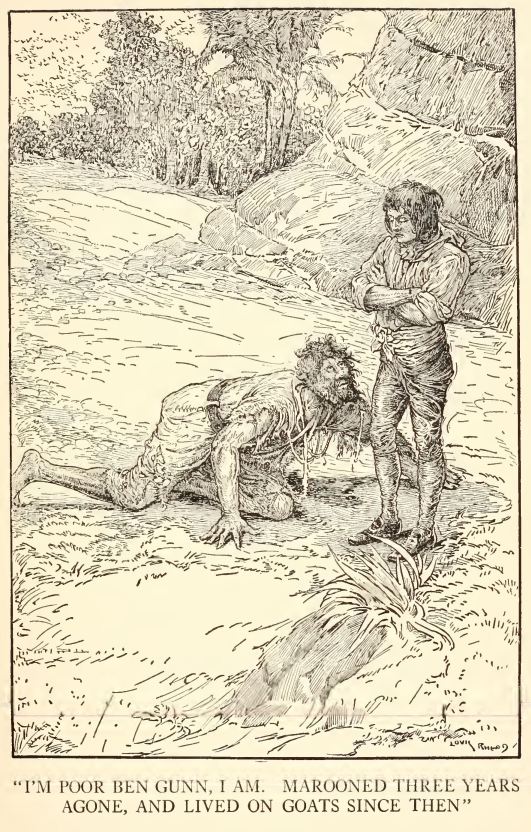
I could now see that he was a white man like myself and that his features wereeven pleasing. His skin, wherever it was exposed, was burnt by the sun; evenhis lips were black, and his fair eyes looked quite startling in so dark aface. Of all the beggar-men that I had seen or fancied, he was the chief forraggedness. He was clothed with tatters of old ship’s canvas and old sea-cloth,and this extraordinary patchwork was all held together by a system of the mostvarious and incongruous fastenings, brass buttons, bits of stick, and loops oftarry gaskin. About his waist he wore an old brass-buckled leather belt, whichwas the one thing solid in his whole accoutrement.
“Three years!” I cried. “Were you shipwrecked?”
“Nay, mate,” said he; “marooned.”
I had heard the word, and I knew it stood for a horrible kind of punishmentcommon enough among the buccaneers, in which the offender is put ashore with alittle powder and shot and left behind on some desolate and distant island.
“Marooned three years agone,” he continued, “and lived on goats since then, andberries, and oysters. Wherever a man is, says I, a man can do for himself. But,mate, my heart is sore for Christian diet. You mightn’t happen to have a pieceof cheese about you, now? No? Well, many’s the long night I’ve dreamed ofcheese—toasted, mostly—and woke up again, and here I were.”
“If ever I can get aboard again,” said I, “you shall have cheese by the stone.”
All this time he had been feeling the stuff of my jacket, smoothing my hands,looking at my boots, and generally, in the intervals of his speech, showing achildish pleasure in the presence of a fellow creature. But at my last words heperked up into a kind of startled slyness.
“If ever you can get aboard again, says you?” he repeated. “Why, now, who’s tohinder you?”
“Not you, I know,” was my reply.
“And right you was,” he cried. “Now you—what do you call yourself, mate?”
“Jim,” I told him.
“Jim, Jim,” says he, quite pleased apparently. “Well, now, Jim, I’ve lived thatrough as you’d be ashamed to hear of. Now, for instance, you wouldn’t think Ihad had a pious mother—to look at me?” he asked.
“Why, no, not in particular,” I answered.
“Ah, well,” said he, “but I had—remarkable pious. And I was a civil,pious boy, and could rattle off my catechism that fast, as you couldn’t tellone word from another. And here’s what it come to, Jim, and it begun withchuck-farthen on the blessed grave-stones! That’s what it begun with, but itwent further’n that; and so my mother told me, and predicked the whole, shedid, the pious woman! But it were Providence that put me here. I’ve thought itall out in this here lonely island, and I’m back on piety. You don’t catch metasting rum so much, but just a thimbleful for luck, of course, the firstchance I have. I’m bound I’ll be good, and I see the way to. And, Jim”—lookingall round him and lowering his voice to a whisper—“I’m rich.”
I now felt sure that the poor fellow had gone crazy in his solitude, and Isuppose I must have shown the feeling in my face, for he repeated the statementhotly: “Rich! Rich! I says. And I’ll tell you what: I’ll make a man of you,Jim. Ah, Jim, you’ll bless your stars, you will, you was the first that foundme!”
And at this there came suddenly a lowering shadow over his face, and hetightened his grasp upon my hand and raised a forefinger threateningly beforemy eyes.
“Now, Jim, you tell me true: that ain’t Flint’s ship?” he asked.
At this I had a happy inspiration. I began to believe that I had found an ally,and I answered him at once.
“It’s not Flint’s ship, and Flint is dead; but I’ll tell you true, as you askme—there are some of Flint’s hands aboard; worse luck for the rest of us.”
“Not a man—with one—leg?” he gasped.
“Silver?” I asked.
“Ah, Silver!” says he. “That were his name.”
“He’s the cook, and the ringleader too.”
He was still holding me by the wrist, and at that he give it quite a wring.
“If you was sent by Long John,” he said, “I’m as good as pork, and I know it.But where was you, do you suppose?”
I had made my mind up in a moment, and by way of answer told him the wholestory of our voyage and the predicament in which we found ourselves. He heardme with the keenest interest, and when I had done he patted me on the head.
“You’re a good lad, Jim,” he said; “and you’re all in a clove hitch, ain’t you?Well, you just put your trust in Ben Gunn—Ben Gunn’s the man to do it. Wouldyou think it likely, now, that your squire would prove a liberal-minded one incase of help—him being in a clove hitch, as you remark?”
I told him the squire was the most liberal of men.
“Aye, but you see,” returned Ben Gunn, “I didn’t mean giving me a gate to keep,and a suit of livery clothes, and such; that’s not my mark, Jim. What I meanis, would he be likely to come down to the toon of, say one thousand pounds outof money that’s as good as a man’s own already?”
“I am sure he would,” said I. “As it was, all hands were to share.”
“Anda passage home?” he added with a look of great shrewdness.
“Why,” I cried, “the squire’s a gentleman. And besides, if we got rid of theothers, we should want you to help work the vessel home.”
“Ah,” said he, “so you would.” And he seemed very much relieved.
“Now, I’ll tell you what,” he went on. “So much I’ll tell you, and no more. Iwere in Flint’s ship when he buried the treasure; he and six along—six strongseamen. They was ashore nigh on a week, and us standing off and on in the oldWalrus. One fine day up went the signal, and here come Flint by himselfin a little boat, and his head done up in a blue scarf. The sun was getting up,and mortal white he looked about the cutwater. But, there he was, you mind, andthe six all dead—dead and buried. How he done it, not a man aboard us couldmake out. It was battle, murder, and sudden death, leastways—him against six.Billy Bones was the mate; Long John, he was quartermaster; and they asked himwhere the treasure was. ‘Ah,’ says he, ‘you can go ashore, if you like, andstay,’ he says; ‘but as for the ship, she’ll beat up for more, by thunder!’That’s what he said.
“Well, I was in another ship three years back, and we sighted this island.‘Boys,’ said I, ‘here’s Flint’s treasure; let’s land and find it.’ The cap’nwas displeased at that, but my messmates were all of a mind and landed. Twelvedays they looked for it, and every day they had the worse word for me, untilone fine morning all hands went aboard. ‘As for you, Benjamin Gunn,’ says they,‘here’s a musket,’ they says, ‘and a spade, and pick-axe. You can stay here andfind Flint’s money for yourself,’ they says.
“Well, Jim, three years have I been here, and not a bite of Christian diet fromthat day to this. But now, you look here; look at me. Do I look like a manbefore the mast? No, says you. Nor I weren’t, neither, I says.”
And with that he winked and pinched me hard.
“Just you mention them words to your squire, Jim,” he went on. “Nor he weren’t,neither—that’s the words. Three years he were the man of this island, light anddark, fair and rain; and sometimes he would maybe think upon a prayer (saysyou), and sometimes he would maybe think of his old mother, so be as she’salive (you’ll say); but the most part of Gunn’s time (this is what you’llsay)—the most part of his time was took up with another matter. And then you’llgive him a nip, like I do.”
And he pinched me again in the most confidential manner.
“Then,” he continued, “then you’ll up, and you’ll say this: Gunn is a good man(you’ll say), and he puts a precious sight more confidence—a precious sight,mind that—in a gen’leman born than in these gen’leman of fortune, having beenone hisself.”
“Well,” I said, “I don’t understand one word that you’ve been saying. Butthat’s neither here nor there; for how am I to get on board?”
“Ah,” said he, “that’s the hitch, for sure. Well, there’s my boat, that I madewith my two hands. I keep her under the white rock. If the worst come to theworst, we might try that after dark. Hi!” he broke out. “What’s that?”
For just then, although the sun had still an hour or two to run, all the echoesof the island awoke and bellowed to the thunder of a cannon.
“They have begun to fight!” I cried. “Follow me.”
And I began to run towards the anchorage, my terrors all forgotten, while closeat my side the marooned man in his goatskins trotted easily and lightly.
“Left, left,” says he; “keep to your left hand, mate Jim! Under the trees withyou! Theer’s where I killed my first goat. They don’t come down here now;they’re all mastheaded on them mountings for the fear of Benjamin Gunn. Ah! Andthere’s the cetemery”—cemetery, he must have meant. “You see the mounds? I comehere and prayed, nows and thens, when I thought maybe a Sunday would be aboutdoo. It weren’t quite a chapel, but it seemed more solemn like; and then, saysyou, Ben Gunn was short-handed—no chapling, nor so much as a Bible and a flag,you says.”
So he kept talking as I ran, neither expecting nor receiving any answer.
The cannon-shot was followed after a considerable interval by a volley of smallarms.
Another pause, and then, not a quarter of a mile in front of me, I beheld theUnion Jack flutter in the air above a wood.
PART FOUR—The Stockade
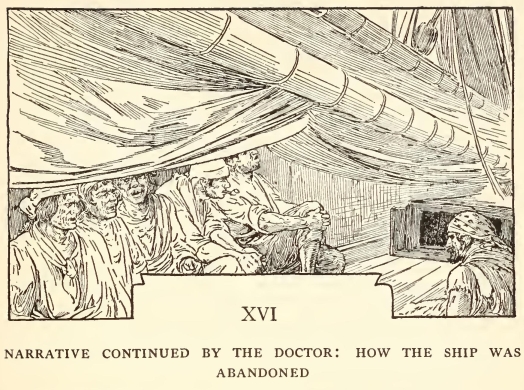
XVI
Narrative Continued by the Doctor: How the Ship Was Abandoned
t was about half past one—three bells in the sea phrase—that the two boats wentashore from the Hispaniola. The captain, the squire, and I were talkingmatters over in the cabin. Had there been a breath of wind, we should havefallen on the six mutineers who were left aboard with us, slipped our cable,and away to sea. But the wind was wanting; and to complete our helplessness,down came Hunter with the news that Jim Hawkins had slipped into a boat and wasgone ashore with the rest.
It never occurred to us to doubt Jim Hawkins, but we were alarmed for hissafety. With the men in the temper they were in, it seemed an even chance if weshould see the lad again. We ran on deck. The pitch was bubbling in the seams;the nasty stench of the place turned me sick; if ever a man smelt fever anddysentery, it was in that abominable anchorage. The six scoundrels were sittinggrumbling under a sail in the forecastle; ashore we could see the gigs madefast and a man sitting in each, hard by where the river runs in. One of themwas whistling “Lillibullero.”
Waiting was a strain, and it was decided that Hunter and I should go ashorewith the jolly-boat in quest of information.
The gigs had leaned to their right, but Hunter and I pulled straight in, in thedirection of the stockade upon the chart. The two who were left guarding theirboats seemed in a bustle at our appearance; “Lillibullero” stopped off, and Icould see the pair discussing what they ought to do. Had they gone and toldSilver, all might have turned out differently; but they had their orders, Isuppose, and decided to sit quietly where they were and hark back again to“Lillibullero.”
There was a slight bend in the coast, and I steered so as to put it between us;even before we landed we had thus lost sight of the gigs. I jumped out and cameas near running as I durst, with a big silk handkerchief under my hat forcoolness’ sake and a brace of pistols ready primed for safety.
I had not gone a hundred yards when I reached the stockade.
This was how it was: a spring of clear water rose almost at the top of a knoll.Well, on the knoll, and enclosing the spring, they had clapped a stout loghousefit to hold two score of people on a pinch and loopholed for musketry on eitherside. All round this they had cleared a wide space, and then the thing wascompleted by a paling six feet high, without door or opening, too strong topull down without time and labour and too open to shelter the besiegers. Thepeople in the log-house had them in every way; they stood quiet in shelter andshot the others like partridges. All they wanted was a good watch and food;for, short of a complete surprise, they might have held the place against aregiment.
What particularly took my fancy was the spring. For though we had a good enoughplace of it in the cabin of the Hispaniola, with plenty of arms andammunition, and things to eat, and excellent wines, there had been one thingoverlooked—we had no water. I was thinking this over when there came ringingover the island the cry of a man at the point of death. I was not new toviolent death—I have served his Royal Highness the Duke of Cumberland, and gota wound myself at Fontenoy—but I know my pulse went dot and carry one. “JimHawkins is gone,” was my first thought.
It is something to have been an old soldier, but more still to have been adoctor. There is no time to dilly-dally in our work. And so now I made up mymind instantly, and with no time lost returned to the shore and jumped on boardthe jolly-boat.
By good fortune Hunter pulled a good oar. We made the water fly, and the boatwas soon alongside and I aboard the schooner.
I found them all shaken, as was natural. The squire was sitting down, as whiteas a sheet, thinking of the harm he had led us to, the good soul! And one ofthe six forecastle hands was little better.
“There’s a man,” says Captain Smollett, nodding towards him, “new to this work.He came nigh-hand fainting, doctor, when he heard the cry. Another touch of therudder and that man would join us.”
I told my plan to the captain, and between us we settled on the details of itsaccomplishment.
We put old Redruth in the gallery between the cabin and the forecastle, withthree or four loaded muskets and a mattress for protection. Hunter brought theboat round under the stern-port, and Joyce and I set to work loading her withpowder tins, muskets, bags of biscuits, kegs of pork, a cask of cognac, and myinvaluable medicine chest.
In the meantime, the squire and the captain stayed on deck, and the latterhailed the coxswain, who was the principal man aboard.
“Mr. Hands,” he said, “here are two of us with a brace of pistols each. If anyone of you six make a signal of any description, that man’s dead.”
They were a good deal taken aback, and after a little consultation one and alltumbled down the fore companion, thinking no doubt to take us on the rear. Butwhen they saw Redruth waiting for them in the sparred galley, they went aboutship at once, and a head popped out again on deck.
“Down, dog!” cries the captain.
And the head popped back again; and we heard no more, for the time, of thesesix very faint-hearted seamen.
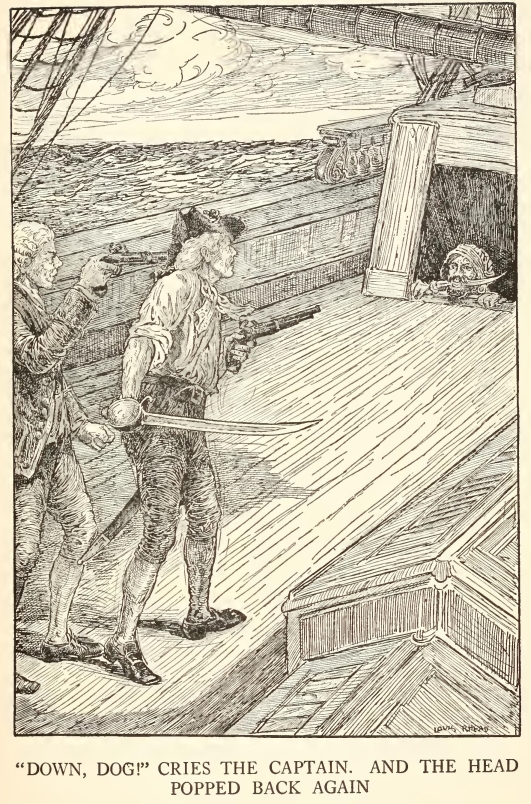
By this time, tumbling things in as they came, we had the jolly-boat loaded asmuch as we dared. Joyce and I got out through the stern-port, and we made forshore again as fast as oars could take us.
This second trip fairly aroused the watchers along shore. “Lillibullero” wasdropped again; and just before we lost sight of them behind the little point,one of them whipped ashore and disappeared. I had half a mind to change my planand destroy their boats, but I feared that Silver and the others might be closeat hand, and all might very well be lost by trying for too much.
We had soon touched land in the same place as before and set to provision theblock house. All three made the first journey, heavily laden, and tossed ourstores over the palisade. Then, leaving Joyce to guard them—one man, to besure, but with half a dozen muskets—Hunter and I returned to the jolly-boat andloaded ourselves once more. So we proceeded without pausing to take breath,till the whole cargo was bestowed, when the two servants took up their positionin the block house, and I, with all my power, sculled back to theHispaniola.
That we should have risked a second boat load seems more daring than it reallywas. They had the advantage of numbers, of course, but we had the advantage ofarms. Not one of the men ashore had a musket, and before they could get withinrange for pistol shooting, we flattered ourselves we should be able to give agood account of a half-dozen at least.
The squire was waiting for me at the stern window, all his faintness gone fromhim. He caught the painter and made it fast, and we fell to loading the boatfor our very lives. Pork, powder, and biscuit was the cargo, with only a musketand a cutlass apiece for the squire and me and Redruth and the captain. Therest of the arms and powder we dropped overboard in two fathoms and a half ofwater, so that we could see the bright steel shining far below us in the sun,on the clean, sandy bottom.
By this time the tide was beginning to ebb, and the ship was swinging round toher anchor. Voices were heard faintly halloaing in the direction of the twogigs; and though this reassured us for Joyce and Hunter, who were well to theeastward, it warned our party to be off.
Redruth retreated from his place in the gallery and dropped into the boat,which we then brought round to the ship’s counter, to be handier for CaptainSmollett.
“Now, men,” said he, “do you hear me?”
There was no answer from the forecastle.
“It’s to you, Abraham Gray—it’s to you I am speaking.”
Still no reply.
“Gray,” resumed Mr. Smollett, a little louder, “I am leaving this ship, and Iorder you to follow your captain. I know you are a good man at bottom, and Idare say not one of the lot of you’s as bad as he makes out. I have my watchhere in my hand; I give you thirty seconds to join me in.”
There was a pause.
“Come, my fine fellow,” continued the captain; “don’t hang so long in stays.I’m risking my life and the lives of these good gentlemen every second.”
There was a sudden scuffle, a sound of blows, and out burst Abraham Gray with aknife cut on the side of the cheek, and came running to the captain like a dogto the whistle.
“I’m with you, sir,” said he.
And the next moment he and the captain had dropped aboard of us, and we hadshoved off and given way.
We were clear out of the ship, but not yet ashore in our stockade.
XVII
Narrative Continued by the Doctor: The Jolly-boat’s Last Trip
his fifth trip was quite different from any of the others. In the first place,the little gallipot of a boat that we were in was gravely overloaded. Fivegrown men, and three of them—Trelawney, Redruth, and the captain—over six feethigh, was already more than she was meant to carry. Add to that the powder,pork, and bread-bags. The gunwale was lipping astern. Several times we shippeda little water, and my breeches and the tails of my coat were all soaking wetbefore we had gone a hundred yards.
The captain made us trim the boat, and we got her to lie a little more evenly.All the same, we were afraid to breathe.
In the second place, the ebb was now making—a strong rippling current runningwestward through the basin, and then south’ard and seaward down the straits bywhich we had entered in the morning. Even the ripples were a danger to ouroverloaded craft, but the worst of it was that we were swept out of our truecourse and away from our proper landing-place behind the point. If we let thecurrent have its way we should come ashore beside the gigs, where the piratesmight appear at any moment.
“I cannot keep her head for the stockade, sir,” said I to the captain. I wassteering, while he and Redruth, two fresh men, were at the oars. “The tidekeeps washing her down. Could you pull a little stronger?”
“Not without swamping the boat,” said he. “You must bear up, sir, if youplease—bear up until you see you’re gaining.”
I tried and found by experiment that the tide kept sweeping us westward until Ihad laid her head due east, or just about right angles to the way we ought togo.
“We’ll never get ashore at this rate,” said I.
“If it’s the only course that we can lie, sir, we must even lie it,” returnedthe captain. “We must keep upstream. You see, sir,” he went on, “if once wedropped to leeward of the landing-place, it’s hard to say where we should getashore, besides the chance of being boarded by the gigs; whereas, the way we gothe current must slacken, and then we can dodge back along the shore.”
“The current’s less a’ready, sir,” said the man Gray, who was sitting in thefore-sheets; “you can ease her off a bit.”
“Thank you, my man,” said I, quite as if nothing had happened, for we had allquietly made up our minds to treat him like one of ourselves.
Suddenly the captain spoke up again, and I thought his voice was a littlechanged.
“The gun!” said he.
“I have thought of that,” said I, for I made sure he was thinking of abombardment of the fort. “They could never get the gun ashore, and if they did,they could never haul it through the woods.”
“Look astern, doctor,” replied the captain.
We had entirely forgotten the long nine; and there, to our horror, were thefive rogues busy about her, getting off her jacket, as they called the stouttarpaulin cover under which she sailed. Not only that, but it flashed into mymind at the same moment that the round-shot and the powder for the gun had beenleft behind, and a stroke with an axe would put it all into the possession ofthe evil ones abroad.
“Israel was Flint’s gunner,” said Gray hoarsely.
At any risk, we put the boat’s head direct for the landing-place. By this timewe had got so far out of the run of the current that we kept steerage way evenat our necessarily gentle rate of rowing, and I could keep her steady for thegoal. But the worst of it was that with the course I now held we turned ourbroadside instead of our stern to the Hispaniolaand offered a targetlike a barn door.
I could hear as well as see that brandy-faced rascal Israel Hands plumping downa round-shot on the deck.
“Who’s the best shot?” asked the captain.
“Mr. Trelawney, out and away,” said I.
“Mr. Trelawney, will you please pick me off one of these men, sir? Hands, ifpossible,” said the captain.
Trelawney was as cool as steel. He looked to the priming of his gun.
“Now,” cried the captain, “easy with that gun, sir, or you’ll swamp the boat.All hands stand by to trim her when he aims.”
The squire raised his gun, the rowing ceased, and we leaned over to the otherside to keep the balance, and all was so nicely contrived that we did not shipa drop.
They had the gun, by this time, slewed round upon the swivel, and Hands, whowas at the muzzle with the rammer, was in consequence the most exposed.However, we had no luck, for just as Trelawney fired, down he stooped, the ballwhistled over him, and it was one of the other four who fell.
The cry he gave was echoed not only by his companions on board but by a greatnumber of voices from the shore, and looking in that direction I saw the otherpirates trooping out from among the trees and tumbling into their places in theboats.
“Here come the gigs, sir,” said I.
“Give way, then,” cried the captain. “We mustn’t mind if we swamp her now. Ifwe can’t get ashore, all’s up.”
“Only one of the gigs is being manned, sir,” I added; “the crew of the othermost likely going round by shore to cut us off.”
“They’ll have a hot run, sir,” returned the captain. “Jack ashore, you know.It’s not them I mind; it’s the round-shot. Carpet bowls! My lady’s maidcouldn’t miss. Tell us, squire, when you see the match, and we’ll hold water.”
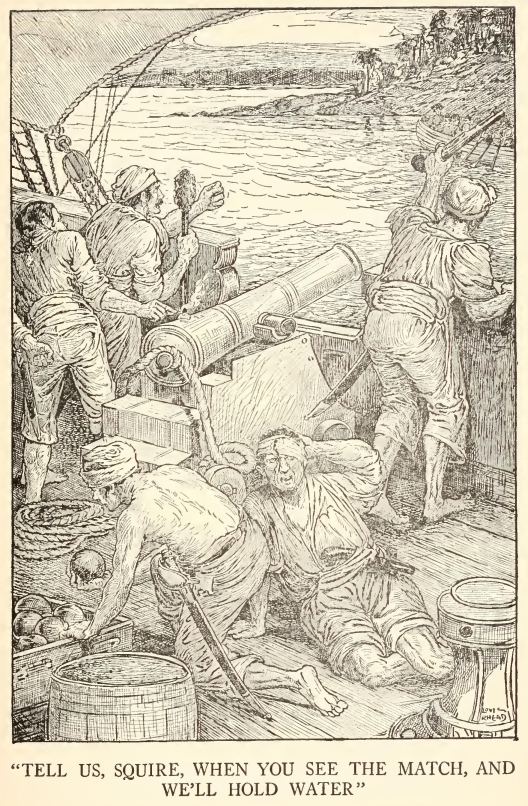
In the meanwhile we had been making headway at a good pace for a boat sooverloaded, and we had shipped but little water in the process. We were nowclose in; thirty or forty strokes and we should beach her, for the ebb hadalready disclosed a narrow belt of sand below the clustering trees. The gig wasno longer to be feared; the little point had already concealed it from oureyes. The ebb-tide, which had so cruelly delayed us, was now making reparationand delaying our assailants. The one source of danger was the gun.
“If I durst,” said the captain, “I’d stop and pick off another man.”
But it was plain that they meant nothing should delay their shot. They hadnever so much as looked at their fallen comrade, though he was not dead, and Icould see him trying to crawl away.
“Ready!” cried the squire.
“Hold!” cried the captain, quick as an echo.
And he and Redruth backed with a great heave that sent her stern bodily underwater. The report fell in at the same instant of time. This was the first thatJim heard, the sound of the squire’s shot not having reached him. Where theball passed, not one of us precisely knew, but I fancy it must have been overour heads and that the wind of it may have contributed to our disaster.
At any rate, the boat sank by the stern, quite gently, in three feet of water,leaving the captain and myself, facing each other, on our feet. The other threetook complete headers, and came up again drenched and bubbling.
So far there was no great harm. No lives were lost, and we could wade ashore insafety. But there were all our stores at the bottom, and to make things worse,only two guns out of five remained in a state for service. Mine I had snatchedfrom my knees and held over my head, by a sort of instinct. As for the captain,he had carried his over his shoulder by a bandoleer, and like a wise man, lockuppermost. The other three had gone down with the boat.
To add to our concern, we heard voices already drawing near us in the woodsalong shore, and we had not only the danger of being cut off from the stockadein our half-crippled state but the fear before us whether, if Hunter and Joycewere attacked by half a dozen, they would have the sense and conduct to standfirm. Hunter was steady, that we knew; Joyce was a doubtful case—a pleasant,polite man for a valet and to brush one’s clothes, but not entirely fitted fora man of war.
With all this in our minds, we waded ashore as fast as we could, leaving behindus the poor jolly-boat and a good half of all our powder and provisions.
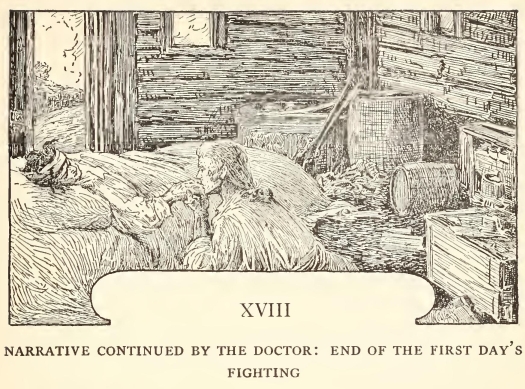
XVIII
Narrative Continued by the Doctor: End of the First Day’s Fighting
e made our best speed across the strip of wood that now divided us from thestockade, and at every step we took the voices of the buccaneers rang nearer.Soon we could hear their footfalls as they ran and the cracking of the branchesas they breasted across a bit of thicket.
I began to see we should have a brush for it in earnest and looked to mypriming.
“Captain,” said I, “Trelawney is the dead shot. Give him your gun; his own isuseless.”
They exchanged guns, and Trelawney, silent and cool as he had been since thebeginning of the bustle, hung a moment on his heel to see that all was fit forservice. At the same time, observing Gray to be unarmed, I handed him mycutlass. It did all our hearts good to see him spit in his hand, knit hisbrows, and make the blade sing through the air. It was plain from every line ofhis body that our new hand was worth his salt.
Forty paces farther we came to the edge of the wood and saw the stockade infront of us. We struck the enclosure about the middle of the south side, andalmost at the same time, seven mutineers—Job Anderson, the boatswain, at theirhead—appeared in full cry at the southwestern corner.
They paused as if taken aback, and before they recovered, not only the squireand I, but Hunter and Joyce from the block house, had time to fire. The fourshots came in rather a scattering volley, but they did the business: one of theenemy actually fell, and the rest, without hesitation, turned and plunged intothe trees.
After reloading, we walked down the outside of the palisade to see to thefallen enemy. He was stone dead—shot through the heart.
We began to rejoice over our good success when just at that moment a pistolcracked in the bush, a ball whistled close past my ear, and poor Tom Redruthstumbled and fell his length on the ground. Both the squire and I returned theshot, but as we had nothing to aim at, it is probable we only wasted powder.Then we reloaded and turned our attention to poor Tom.
The captain and Gray were already examining him, and I saw with half an eyethat all was over.
I believe the readiness of our return volley had scattered the mutineers oncemore, for we were suffered without further molestation to get the poor oldgamekeeper hoisted over the stockade and carried, groaning and bleeding, intothe log-house.
Poor old fellow, he had not uttered one word of surprise, complaint, fear, oreven acquiescence from the very beginning of our troubles till now, when we hadlaid him down in the log-house to die. He had lain like a Trojan behind hismattress in the gallery; he had followed every order silently, doggedly, andwell; he was the oldest of our party by a score of years; and now, sullen, old,serviceable servant, it was he that was to die.
The squire dropped down beside him on his knees and kissed his hand, cryinglike a child.
“Be I going, doctor?” he asked.
“Tom, my man,” said I, “you’re going home.”
“I wish I had had a lick at them with the gun first,” he replied.
“Tom,” said the squire, “say you forgive me, won’t you?”
“Would that be respectful like, from me to you, squire?” was the answer.“Howsoever, so be it, amen!”
After a little while of silence, he said he thought somebody might read aprayer. “It’s the custom, sir,” he added apologetically. And not long after,without another word, he passed away.
In the meantime the captain, whom I had observed to be wonderfully swollenabout the chest and pockets, had turned out a great many various stores—theBritish colours, a Bible, a coil of stoutish rope, pen, ink, the log-book, andpounds of tobacco. He had found a longish fir-tree lying felled and trimmed inthe enclosure, and with the help of Hunter he had set it up at the corner ofthe log-house where the trunks crossed and made an angle. Then, climbing on theroof, he had with his own hand bent and run up the colours.
This seemed mightily to relieve him. He re-entered the log-house and set aboutcounting up the stores as if nothing else existed. But he had an eye on Tom’spassage for all that, and as soon as all was over, came forward with anotherflag and reverently spread it on the body.
“Don’t you take on, sir,” he said, shaking the squire’s hand. “All’s well withhim; no fear for a hand that’s been shot down in his duty to captain and owner.It mayn’t be good divinity, but it’s a fact.”
Then he pulled me aside.
“Dr. Livesey,” he said, “in how many weeks do you and squire expect theconsort?”
I told him it was a question not of weeks but of months, that if we were notback by the end of August Blandly was to send to find us, but neither soonernor later. “You can calculate for yourself,” I said.
“Why, yes,” returned the captain, scratching his head; “and making a largeallowance, sir, for all the gifts of Providence, I should say we were prettyclose hauled.”
“How do you mean?” I asked.
“It’s a pity, sir, we lost that second load. That’s what I mean,” replied thecaptain. “As for powder and shot, we’ll do. But the rations are short, veryshort—so short, Dr. Livesey, that we’re perhaps as well without that extramouth.”
And he pointed to the dead body under the flag.
Just then, with a roar and a whistle, a round-shot passed high above the roofof the log-house and plumped far beyond us in the wood.
“Oho!” said the captain. “Blaze away! You’ve little enough powder already, mylads.”
At the second trial, the aim was better, and the ball descended inside thestockade, scattering a cloud of sand but doing no further damage.
“Captain,” said the squire, “the house is quite invisible from the ship. Itmust be the flag they are aiming at. Would it not be wiser to take it in?”
“Strike my colours!” cried the captain. “No, sir, not I”; and as soon as he hadsaid the words, I think we all agreed with him. For it was not only a piece ofstout, seamanly, good feeling; it was good policy besides and showed ourenemies that we despised their cannonade.
All through the evening they kept thundering away. Ball after ball flew over orfell short or kicked up the sand in the enclosure, but they had to fire so highthat the shot fell dead and buried itself in the soft sand. We had no ricochetto fear, and though one popped in through the roof of the log-house and outagain through the floor, we soon got used to that sort of horse-play and mindedit no more than cricket.
“There is one good thing about all this,” observed the captain; “the wood infront of us is likely clear. The ebb has made a good while; our stores shouldbe uncovered. Volunteers to go and bring in pork.”
Gray and Hunter were the first to come forward. Well armed, they stole out ofthe stockade, but it proved a useless mission. The mutineers were bolder thanwe fancied or they put more trust in Israel’s gunnery. For four or five of themwere busy carrying off our stores and wading out with them to one of the gigsthat lay close by, pulling an oar or so to hold her steady against the current.Silver was in the stern-sheets in command; and every man of them was nowprovided with a musket from some secret magazine of their own.
The captain sat down to his log, and here is the beginning of the entry:
Alexander Smollett, master; David Livesey, ship’s doctor; Abraham Gray,carpenter’s mate; John Trelawney, owner; John Hunter and Richard Joyce, owner’sservants, landsmen—being all that is left faithful of the ship’s company—withstores for ten days at short rations, came ashore this day and flew Britishcolours on the log-house in Treasure Island. Thomas Redruth, owner’s servant,landsman, shot by the mutineers; James Hawkins, cabin-boy—
And at the same time, I was wondering over poor Jim Hawkins’ fate.
A hail on the land side.
“Somebody hailing us,” said Hunter, who was on guard.
“Doctor! Squire! Captain! Hullo, Hunter, is that you?” came the cries.
And I ran to the door in time to see Jim Hawkins, safe and sound, come climbingover the stockade.
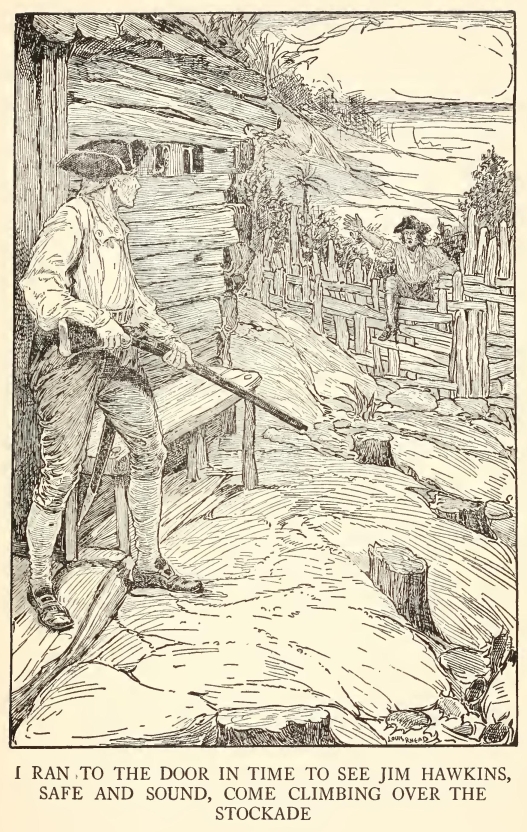
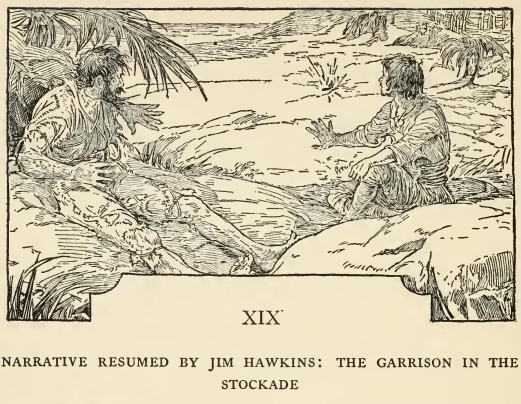
XIX
Narrative Resumed by Jim Hawkins: The Garrison in the Stockade
s soon as Ben Gunn saw the colours he came to a halt, stopped me by the arm,and sat down.
“Now,” said he, “there’s your friends, sure enough.”
“Far more likely it’s the mutineers,” I answered.
“That!” he cried. “Why, in a place like this, where nobody puts in butgen’lemen of fortune, Silver would fly the Jolly Roger, you don’t make no doubtof that. No, that’s your friends. There’s been blows too, and I reckon yourfriends has had the best of it; and here they are ashore in the old stockade,as was made years and years ago by Flint. Ah, he was the man to have aheadpiece, was Flint! Barring rum, his match were never seen. He were afraid ofnone, not he; on’y Silver—Silver was that genteel.”
“Well,” said I, “that may be so, and so be it; all the more reason that Ishould hurry on and join my friends.”
“Nay, mate,” returned Ben, “not you. You’re a good boy, or I’m mistook; butyou’re on’y a boy, all told. Now, Ben Gunn is fly. Rum wouldn’t bring me there,where you’re going—not rum wouldn’t, till I see your born gen’leman and gets iton his word of honour. And you won’t forget my words; ‘A precious sight (that’swhat you’ll say), a precious sight more confidence’—and then nips him.”
And he pinched me the third time with the same air of cleverness.
“And when Ben Gunn is wanted, you know where to find him, Jim. Just wheer youfound him today. And him that comes is to have a white thing in his hand, andhe’s to come alone. Oh! And you’ll say this: ‘Ben Gunn,’ says you, ‘has reasonsof his own.’”
“Well,” said I, “I believe I understand. You have something to propose, and youwish to see the squire or the doctor, and you’re to be found where I found you.Is that all?”
“And when? says you,” he added. “Why, from about noon observation to about sixbells.”
“Good,” said I, “and now may I go?”
“You won’t forget?” he inquired anxiously. “Precious sight, and reasons of hisown, says you. Reasons of his own; that’s the mainstay; as between man and man.Well, then”—still holding me—“I reckon you can go, Jim. And, Jim, if you was tosee Silver, you wouldn’t go for to sell Ben Gunn? Wild horses wouldn’t draw itfrom you? No, says you. And if them pirates camp ashore, Jim, what would yousay but there’d be widders in the morning?”
Here he was interrupted by a loud report, and a cannonball came tearing throughthe trees and pitched in the sand not a hundred yards from where we two weretalking. The next moment each of us had taken to his heels in a differentdirection.
For a good hour to come frequent reports shook the island, and balls keptcrashing through the woods. I moved from hiding-place to hiding-place, alwayspursued, or so it seemed to me, by these terrifying missiles. But towards theend of the bombardment, though still I durst not venture in the direction ofthe stockade, where the balls fell oftenest, I had begun, in a manner, to pluckup my heart again, and after a long detour to the east, crept down among theshore-side trees.
The sun had just set, the sea breeze was rustling and tumbling in the woods andruffling the grey surface of the anchorage; the tide, too, was far out, andgreat tracts of sand lay uncovered; the air, after the heat of the day, chilledme through my jacket.
The Hispaniolastill lay where she had anchored; but, sure enough, therewas the Jolly Roger—the black flag of piracy—flying from her peak. Even as Ilooked, there came another red flash and another report that sent the echoesclattering, and one more round-shot whistled through the air. It was the lastof the cannonade.
I lay for some time watching the bustle which succeeded the attack. Men weredemolishing something with axes on the beach near the stockade—the poorjolly-boat, I afterwards discovered. Away, near the mouth of the river, a greatfire was glowing among the trees, and between that point and the ship one ofthe gigs kept coming and going, the men, whom I had seen so gloomy, shouting atthe oars like children. But there was a sound in their voices which suggestedrum.
At length I thought I might return towards the stockade. I was pretty far downon the low, sandy spit that encloses the anchorage to the east, and is joinedat half-water to Skeleton Island; and now, as I rose to my feet, I saw, somedistance further down the spit and rising from among low bushes, an isolatedrock, pretty high, and peculiarly white in colour. It occurred to me that thismight be the white rock of which Ben Gunn had spoken and that some day or othera boat might be wanted and I should know where to look for one.
Then I skirted among the woods until I had regained the rear, or shorewardside, of the stockade, and was soon warmly welcomed by the faithful party.
I had soon told my story and began to look about me. The log-house was made ofunsquared trunks of pine—roof, walls, and floor. The latter stood in severalplaces as much as a foot or a foot and a half above the surface of the sand.There was a porch at the door, and under this porch the little spring welled upinto an artificial basin of a rather odd kind—no other than a great ship’skettle of iron, with the bottom knocked out, and sunk “to her bearings,” as thecaptain said, among the sand.
Little had been left besides the framework of the house, but in one cornerthere was a stone slab laid down by way of hearth and an old rusty iron basketto contain the fire.
The slopes of the knoll and all the inside of the stockade had been cleared oftimber to build the house, and we could see by the stumps what a fine and loftygrove had been destroyed. Most of the soil had been washed away or buried indrift after the removal of the trees; only where the streamlet ran down fromthe kettle a thick bed of moss and some ferns and little creeping bushes werestill green among the sand. Very close around the stockade—too close fordefence, they said—the wood still flourished high and dense, all of fir on theland side, but towards the sea with a large admixture of live-oaks.
The cold evening breeze, of which I have spoken, whistled through every chinkof the rude building and sprinkled the floor with a continual rain of finesand. There was sand in our eyes, sand in our teeth, sand in our suppers, sanddancing in the spring at the bottom of the kettle, for all the world likeporridge beginning to boil. Our chimney was a square hole in the roof; it wasbut a little part of the smoke that found its way out, and the rest eddiedabout the house and kept us coughing and piping the eye.
Add to this that Gray, the new man, had his face tied up in a bandage for a cuthe had got in breaking away from the mutineers and that poor old Tom Redruth,still unburied, lay along the wall, stiff and stark, under the Union Jack.
If we had been allowed to sit idle, we should all have fallen in the blues, butCaptain Smollett was never the man for that. All hands were called up beforehim, and he divided us into watches. The doctor and Gray and I for one; thesquire, Hunter, and Joyce upon the other. Tired though we all were, two weresent out for firewood; two more were set to dig a grave for Redruth; the doctorwas named cook; I was put sentry at the door; and the captain himself went fromone to another, keeping up our spirits and lending a hand wherever it waswanted.
From time to time the doctor came to the door for a little air and to rest hiseyes, which were almost smoked out of his head, and whenever he did so, he hada word for me.
“That man Smollett,” he said once, “is a better man than I am. And when I saythat it means a deal, Jim.”
Another time he came and was silent for a while. Then he put his head on oneside, and looked at me.
“Is this Ben Gunn a man?” he asked.
“I do not know, sir,” said I. “I am not very sure whether he’s sane.”
“If there’s any doubt about the matter, he is,” returned the doctor. “A man whohas been three years biting his nails on a desert island, Jim, can’t expect toappear as sane as you or me. It doesn’t lie in human nature. Was it cheese yousaid he had a fancy for?”
“Yes, sir, cheese,” I answered.
“Well, Jim,” says he, “just see the good that comes of being dainty in yourfood. You’ve seen my snuff-box, haven’t you? And you never saw me take snuff,the reason being that in my snuff-box I carry a piece of Parmesan cheese—acheese made in Italy, very nutritious. Well, that’s for Ben Gunn!”
Before supper was eaten we buried old Tom in the sand and stood round him for awhile bare-headed in the breeze. A good deal of firewood had been got in, butnot enough for the captain’s fancy, and he shook his head over it and told uswe “must get back to this tomorrow rather livelier.” Then, when we had eatenour pork and each had a good stiff glass of brandy grog, the three chiefs gottogether in a corner to discuss our prospects.
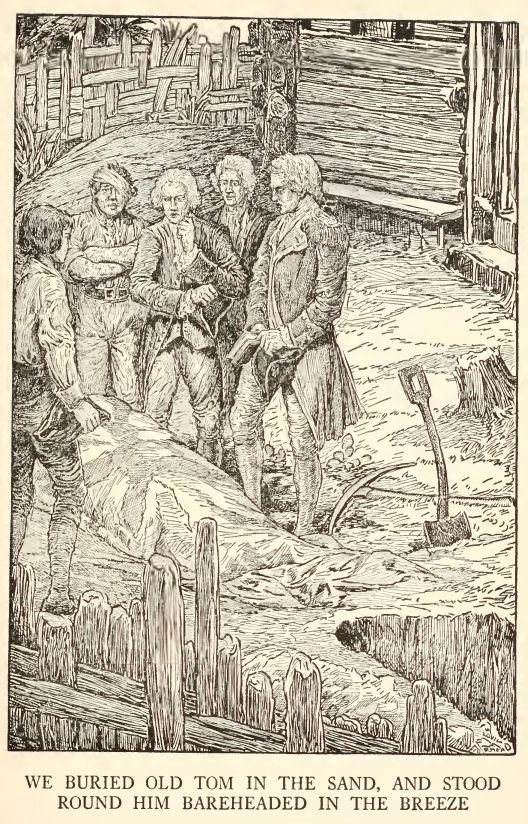
It appears they were at their wits’ end what to do, the stores being so lowthat we must have been starved into surrender long before help came. But ourbest hope, it was decided, was to kill off the buccaneers until they eitherhauled down their flag or ran away with the Hispaniola. From nineteenthey were already reduced to fifteen, two others were wounded, and one atleast—the man shot beside the gun—severely wounded, if he were not dead. Everytime we had a crack at them, we were to take it, saving our own lives, with theextremest care. And besides that, we had two able allies—rum and the climate.
As for the first, though we were about half a mile away, we could hear themroaring and singing late into the night; and as for the second, the doctorstaked his wig that, camped where they were in the marsh and unprovided withremedies, the half of them would be on their backs before a week.
“So,” he added, “if we are not all shot down first they’ll be glad to bepacking in the schooner. It’s always a ship, and they can get to buccaneeringagain, I suppose.”
“First ship that ever I lost,” said Captain Smollett.
I was dead tired, as you may fancy; and when I got to sleep, which was not tillafter a great deal of tossing, I slept like a log of wood.
The rest had long been up and had already breakfasted and increased the pile offirewood by about half as much again when I was wakened by a bustle and thesound of voices.
“Flag of truce!” I heard someone say; and then, immediately after, with a cryof surprise, “Silver himself!”
And at that, up I jumped, and rubbing my eyes, ran to a loophole in the wall.
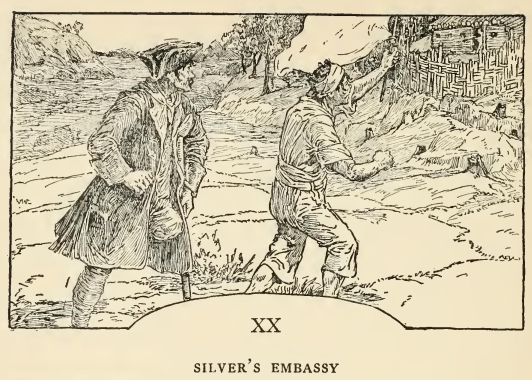
XX
Silver’s Embassy
ure enough, there were two men just outside the stockade, one of them waving awhite cloth, the other, no less a person than Silver himself, standing placidlyby.
It was still quite early, and the coldest morning that I think I ever wasabroad in—a chill that pierced into the marrow. The sky was bright andcloudless overhead, and the tops of the trees shone rosily in the sun. Butwhere Silver stood with his lieutenant, all was still in shadow, and they wadedknee-deep in a low white vapour that had crawled during the night out of themorass. The chill and the vapour taken together told a poor tale of the island.It was plainly a damp, feverish, unhealthy spot.
“Keep indoors, men,” said the captain. “Ten to one this is a trick.”
Then he hailed the buccaneer.
“Who goes? Stand, or we fire.”
“Flag of truce,” cried Silver.
The captain was in the porch, keeping himself carefully out of the way of atreacherous shot, should any be intended. He turned and spoke to us, “Doctor’swatch on the lookout. Dr. Livesey take the north side, if you please; Jim, theeast; Gray, west. The watch below, all hands to load muskets. Lively, men, andcareful.”
And then he turned again to the mutineers.
“And what do you want with your flag of truce?” he cried.
This time it was the other man who replied.
“Cap’n Silver, sir, to come on board and make terms,” he shouted.
“Cap’n Silver! Don’t know him. Who’s he?” cried the captain. And we could hearhim adding to himself, “Cap’n, is it? My heart, and here’s promotion!”
Long John answered for himself. “Me, sir. These poor lads have chosen me cap’n,after your desertion, sir”—laying a particular emphasis upon the word“desertion.” “We’re willing to submit, if we can come to terms, and no bonesabout it. All I ask is your word, Cap’n Smollett, to let me safe and sound outof this here stockade, and one minute to get out o’ shot before a gun isfired.”
“My man,” said Captain Smollett, “I have not the slightest desire to talk toyou. If you wish to talk to me, you can come, that’s all. If there’s anytreachery, it’ll be on your side, and the Lord help you.”
“That’s enough, Cap’n,” shouted Long John cheerily. “A word from you’s enough.I know a gentleman, and you may lay to that.”
We could see the man who carried the flag of truce attempting to hold Silverback. Nor was that wonderful, seeing how cavalier had been the captain’sanswer. But Silver laughed at him aloud and slapped him on the back as if theidea of alarm had been absurd. Then he advanced to the stockade, threw over hiscrutch, got a leg up, and with great vigour and skill succeeded in surmountingthe fence and dropping safely to the other side.
I will confess that I was far too much taken up with what was going on to be ofthe slightest use as sentry; indeed, I had already deserted my eastern loopholeand crept up behind the captain, who had now seated himself on the threshold,with his elbows on his knees, his head in his hands, and his eyes fixed on thewater as it bubbled out of the old iron kettle in the sand. He was whistling“Come, Lasses and Lads.”
Silver had terrible hard work getting up the knoll. What with the steepness ofthe incline, the thick tree stumps, and the soft sand, he and his crutch wereas helpless as a ship in stays. But he stuck to it like a man in silence, andat last arrived before the captain, whom he saluted in the handsomest style. Hewas tricked out in his best; an immense blue coat, thick with brass buttons,hung as low as to his knees, and a fine laced hat was set on the back of hishead.
“Here you are, my man,” said the captain, raising his head. “You had better sitdown.”
“You ain’t a-going to let me inside, Cap’n?” complained Long John. “It’s a maincold morning, to be sure, sir, to sit outside upon the sand.”
“Why, Silver,” said the captain, “if you had pleased to be an honest man, youmight have been sitting in your galley. It’s your own doing. You’re either myship’s cook—and then you were treated handsome—or Cap’n Silver, a commonmutineer and pirate, and then you can go hang!”
“Well, well, Cap’n,” returned the sea-cook, sitting down as he was bidden onthe sand, “you’ll have to give me a hand up again, that’s all. A sweet prettyplace you have of it here. Ah, there’s Jim! The top of the morning to you, Jim.Doctor, here’s my service. Why, there you all are together like a happy family,in a manner of speaking.”
“If you have anything to say, my man, better say it,” said the captain.
“Right you were, Cap’n Smollett,” replied Silver. “Dooty is dooty, to be sure.Well now, you look here, that was a good lay of yours last night. I don’t denyit was a good lay. Some of you pretty handy with a handspike-end. And I’ll notdeny neither but what some of my people was shook—maybe all was shook; maybe Iwas shook myself; maybe that’s why I’m here for terms. But you mark me, Cap’n,it won’t do twice, by thunder! We’ll have to do sentry-go and ease off a pointor so on the rum. Maybe you think we were all a sheet in the wind’s eye. ButI’ll tell you I was sober; I was on’y dog tired; and if I’d awoke a secondsooner, I’d ’a caught you at the act, I would. He wasn’t dead when I got roundto him, not he.”
“Well?” says Captain Smollett as cool as can be.
All that Silver said was a riddle to him, but you would never have guessed itfrom his tone. As for me, I began to have an inkling. Ben Gunn’s last wordscame back to my mind. I began to suppose that he had paid the buccaneers avisit while they all lay drunk together round their fire, and I reckoned upwith glee that we had only fourteen enemies to deal with.
“Well, here it is,” said Silver. “We want that treasure, and we’ll haveit—that’s our point! You would just as soon save your lives, I reckon; andthat’s yours. You have a chart, haven’t you?”
“That’s as may be,” replied the captain.
“Oh, well, you have, I know that,” returned Long John. “You needn’t be so huskywith a man; there ain’t a particle of service in that, and you may lay to it.What I mean is, we want your chart. Now, I never meant you no harm, myself.”
“That won’t do with me, my man,” interrupted the captain. “We know exactly whatyou meant to do, and we don’t care, for now, you see, you can’t do it.”
And the captain looked at him calmly and proceeded to fill a pipe.
“If Abe Gray—” Silver broke out.
“Avast there!” cried Mr. Smollett. “Gray told me nothing, and I asked himnothing; and what’s more, I would see you and him and this whole island blownclean out of the water into blazes first. So there’s my mind for you, my man,on that.”
This little whiff of temper seemed to cool Silver down. He had been growingnettled before, but now he pulled himself together.
“Like enough,” said he. “I would set no limits to what gentlemen might considershipshape, or might not, as the case were. And seein’ as how you are about totake a pipe, Cap’n, I’ll make so free as do likewise.”
And he filled a pipe and lighted it; and the two men sat silently smoking forquite a while, now looking each other in the face, now stopping their tobacco,now leaning forward to spit. It was as good as the play to see them.
“Now,” resumed Silver, “here it is. You give us the chart to get the treasureby, and drop shooting poor seamen and stoving of their heads in while asleep.You do that, and we’ll offer you a choice. Either you come aboard along of us,once the treasure shipped, and then I’ll give you my affy-davy, upon my word ofhonour, to clap you somewhere safe ashore. Or if that ain’t to your fancy, someof my hands being rough and having old scores on account of hazing, then youcan stay here, you can. We’ll divide stores with you, man for man; and I’llgive my affy-davy, as before to speak the first ship I sight, and send ’em hereto pick you up. Now, you’ll own that’s talking. Handsomer you couldn’t look toget, now you. And I hope”—raising his voice—“that all hands in this here blockhouse will overhaul my words, for what is spoke to one is spoke to all.”
Captain Smollett rose from his seat and knocked out the ashes of his pipe inthe palm of his left hand.
“Is that all?” he asked.
“Every last word, by thunder!” answered John. “Refuse that, and you’ve seen thelast of me but musket-balls.”
“Very good,” said the captain. “Now you’ll hear me. If you’ll come up one byone, unarmed, I’ll engage to clap you all in irons and take you home to a fairtrial in England. If you won’t, my name is Alexander Smollett, I’ve flown mysovereign’s colours, and I’ll see you all to Davy Jones. You can’t find thetreasure. You can’t sail the ship—there’s not a man among you fit to sail theship. You can’t fight us—Gray, there, got away from five of you. Your ship’s inirons, Master Silver; you’re on a lee shore, and so you’ll find. I stand hereand tell you so; and they’re the last good words you’ll get from me, for in thename of heaven, I’ll put a bullet in your back when next I meet you. Tramp, mylad. Bundle out of this, please, hand over hand, and double quick.”
Silver’s face was a picture; his eyes started in his head with wrath. He shookthe fire out of his pipe.
“Give me a hand up!” he cried.
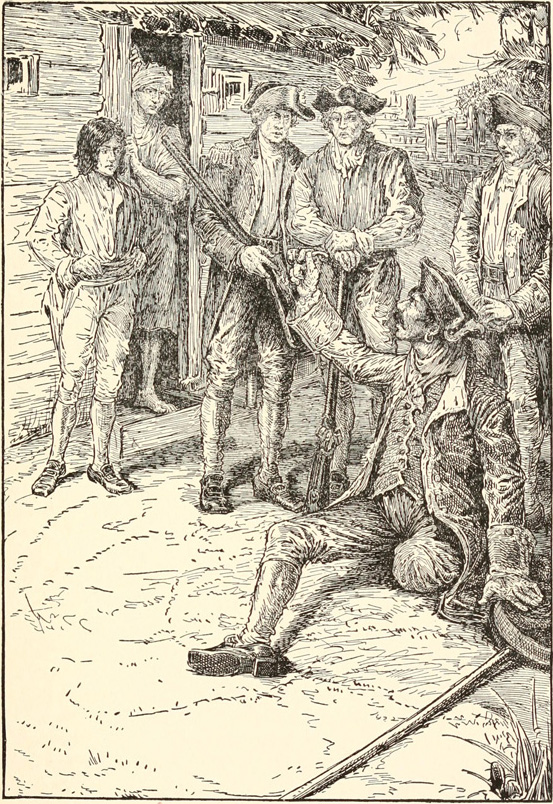
“Give me a hand up!” he cried. “Not I,” returned the captain.
“Not I,” returned the captain.
“Who’ll give me a hand up?” he roared.
Not a man among us moved. Growling the foulest imprecations, he crawled alongthe sand till he got hold of the porch and could hoist himself again upon hiscrutch. Then he spat into the spring.
“There!” he cried. “That’s what I think of ye. Before an hour’s out, I’ll stovein your old block house like a rum puncheon. Laugh, by thunder, laugh! Beforean hour’s out, ye’ll laugh upon the other side. Them that die’ll be the luckyones.”
And with a dreadful oath he stumbled off, ploughed down the sand, was helpedacross the stockade, after four or five failures, by the man with the flag oftruce, and disappeared in an instant afterwards among the trees.
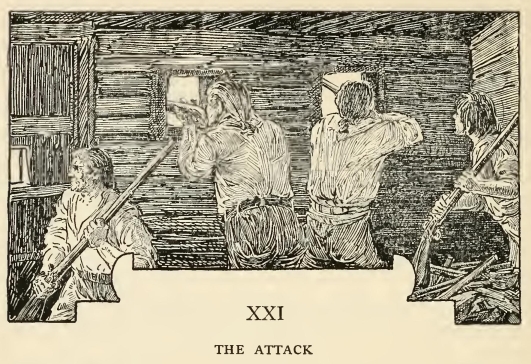
XXI
The Attack
s soon as Silver disappeared, the captain, who had been closely watching him,turned towards the interior of the house and found not a man of us at his postbut Gray. It was the first time we had ever seen him angry.
“Quarters!” he roared. And then, as we all slunk back to our places, “Gray,” hesaid, “I’ll put your name in the log; you’ve stood by your duty like a seaman.Mr. Trelawney, I’m surprised at you, sir. Doctor, I thought you had worn theking’s coat! If that was how you served at Fontenoy, sir, you’d have beenbetter in your berth.”
The doctor’s watch were all back at their loopholes, the rest were busy loadingthe spare muskets, and everyone with a red face, you may be certain, and a fleain his ear, as the saying is.
The captain looked on for a while in silence. Then he spoke.
“My lads,” said he, “I’ve given Silver a broadside. I pitched it in red-hot onpurpose; and before the hour’s out, as he said, we shall be boarded. We’reoutnumbered, I needn’t tell you that, but we fight in shelter; and a minute agoI should have said we fought with discipline. I’ve no manner of doubt that wecan drub them, if you choose.”
Then he went the rounds and saw, as he said, that all was clear.
On the two short sides of the house, east and west, there were only twoloopholes; on the south side where the porch was, two again; and on the northside, five. There was a round score of muskets for the seven of us; thefirewood had been built into four piles—tables, you might say—one about themiddle of each side, and on each of these tables some ammunition and fourloaded muskets were laid ready to the hand of the defenders. In the middle, thecutlasses lay ranged.
“Toss out the fire,” said the captain; “the chill is past, and we mustn’t havesmoke in our eyes.”
The iron fire-basket was carried bodily out by Mr. Trelawney, and the emberssmothered among sand.
“Hawkins hasn’t had his breakfast. Hawkins, help yourself, and back to yourpost to eat it,” continued Captain Smollett. “Lively, now, my lad; you’ll wantit before you’ve done. Hunter, serve out a round of brandy to all hands.”
And while this was going on, the captain completed, in his own mind, the planof the defence.
“Doctor, you will take the door,” he resumed. “See, and don’t expose yourself;keep within, and fire through the porch. Hunter, take the east side, there.Joyce, you stand by the west, my man. Mr. Trelawney, you are the best shot—youand Gray will take this long north side, with the five loopholes; it’s therethe danger is. If they can get up to it and fire in upon us through our ownports, things would begin to look dirty. Hawkins, neither you nor I are muchaccount at the shooting; we’ll stand by to load and bear a hand.”
As the captain had said, the chill was past. As soon as the sun had climbedabove our girdle of trees, it fell with all its force upon the clearing anddrank up the vapours at a draught. Soon the sand was baking and the resinmelting in the logs of the block house. Jackets and coats were flung aside,shirts thrown open at the neck and rolled up to the shoulders; and we stoodthere, each at his post, in a fever of heat and anxiety.
An hour passed away.
“Hang them!” said the captain. “This is as dull as the doldrums. Gray, whistlefor a wind.”
And just at that moment came the first news of the attack.
“If you please, sir,” said Joyce, “if I see anyone, am I to fire?”
“I told you so!” cried the captain.
“Thank you, sir,” returned Joyce with the same quiet civility.
Nothing followed for a time, but the remark had set us all on the alert,straining ears and eyes—the musketeers with their pieces balanced in theirhands, the captain out in the middle of the block house with his mouth verytight and a frown on his face.
So some seconds passed, till suddenly Joyce whipped up his musket and fired.The report had scarcely died away ere it was repeated and repeated from withoutin a scattering volley, shot behind shot, like a string of geese, from everyside of the enclosure. Several bullets struck the log-house, but not oneentered; and as the smoke cleared away and vanished, the stockade and the woodsaround it looked as quiet and empty as before. Not a bough waved, not the gleamof a musket-barrel betrayed the presence of our foes.
“Did you hit your man?” asked the captain.
“No, sir,” replied Joyce. “I believe not, sir.”
“Next best thing to tell the truth,” muttered Captain Smollett. “Load his gun,Hawkins. How many should say there were on your side, doctor?”
“I know precisely,” said Dr. Livesey. “Three shots were fired on this side. Isaw the three flashes—two close together—one farther to the west.”
“Three!” repeated the captain. “And how many on yours, Mr. Trelawney?”
But this was not so easily answered. There had come many from the north—sevenby the squire’s computation, eight or nine according to Gray. From the east andwest only a single shot had been fired. It was plain, therefore, that theattack would be developed from the north and that on the other three sides wewere only to be annoyed by a show of hostilities. But Captain Smollett made nochange in his arrangements. If the mutineers succeeded in crossing thestockade, he argued, they would take possession of any unprotected loophole andshoot us down like rats in our own stronghold.
Nor had we much time left to us for thought. Suddenly, with a loud huzza, alittle cloud of pirates leaped from the woods on the north side and ranstraight on the stockade. At the same moment, the fire was once more openedfrom the woods, and a rifle ball sang through the doorway and knocked thedoctor’s musket into bits.
The boarders swarmed over the fence like monkeys. Squire and Gray fired againand yet again; three men fell, one forwards into the enclosure, two back on theoutside. But of these, one was evidently more frightened than hurt, for he wason his feet again in a crack and instantly disappeared among the trees.
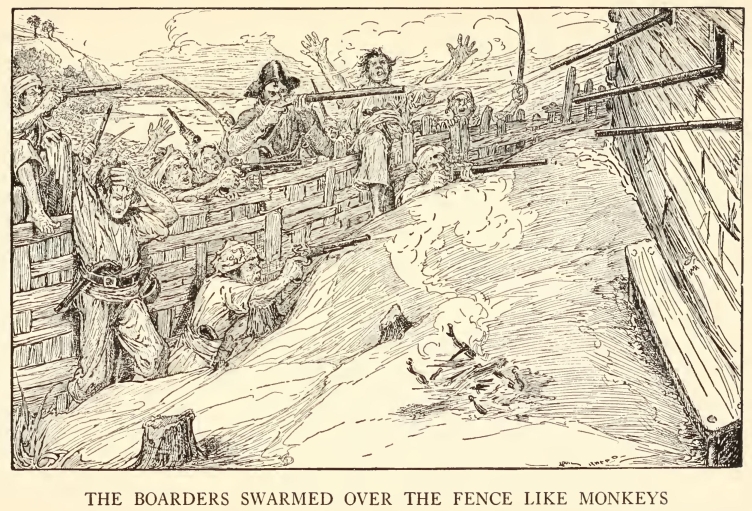
Two had bit the dust, one had fled, four had made good their footing inside ourdefences, while from the shelter of the woods seven or eight men, eachevidently supplied with several muskets, kept up a hot though useless fire onthe log-house.
The four who had boarded made straight before them for the building, shoutingas they ran, and the men among the trees shouted back to encourage them.Several shots were fired, but such was the hurry of the marksmen that not oneappears to have taken effect. In a moment, the four pirates had swarmed up themound and were upon us.
The head of Job Anderson, the boatswain, appeared at the middle loophole.
“At ’em, all hands—all hands!” he roared in a voice of thunder.
At the same moment, another pirate grasped Hunter’s musket by the muzzle,wrenched it from his hands, plucked it through the loophole, and with onestunning blow, laid the poor fellow senseless on the floor. Meanwhile a third,running unharmed all around the house, appeared suddenly in the doorway andfell with his cutlass on the doctor.
Our position was utterly reversed. A moment since we were firing, under cover,at an exposed enemy; now it was we who lay uncovered and could not return ablow.
The log-house was full of smoke, to which we owed our comparative safety. Criesand confusion, the flashes and reports of pistol-shots, and one loud groan rangin my ears.
“Out, lads, out, and fight ’em in the open! Cutlasses!” cried the captain.
I snatched a cutlass from the pile, and someone, at the same time snatchinganother, gave me a cut across the knuckles which I hardly felt. I dashed out ofthe door into the clear sunlight. Someone was close behind, I knew not whom.Right in front, the doctor was pursuing his assailant down the hill, and justas my eyes fell upon him, beat down his guard and sent him sprawling on hisback with a great slash across the face.
“Round the house, lads! Round the house!” cried the captain; and even in thehurly-burly, I perceived a change in his voice.
Mechanically, I obeyed, turned eastwards, and with my cutlass raised, ran roundthe corner of the house. Next moment I was face to face with Anderson. Heroared aloud, and his hanger went up above his head, flashing in the sunlight.I had not time to be afraid, but as the blow still hung impending, leaped in atrice upon one side, and missing my foot in the soft sand, rolled headlong downthe slope.
When I had first sallied from the door, the other mutineers had been alreadyswarming up the palisade to make an end of us. One man, in a red night-cap,with his cutlass in his mouth, had even got upon the top and thrown a legacross. Well, so short had been the interval that when I found my feet againall was in the same posture, the fellow with the red night-cap still half-wayover, another still just showing his head above the top of the stockade. Andyet, in this breath of time, the fight was over and the victory was ours.
Gray, following close behind me, had cut down the big boatswain ere he had timeto recover from his last blow. Another had been shot at a loophole in the veryact of firing into the house and now lay in agony, the pistol still smoking inhis hand. A third, as I had seen, the doctor had disposed of at a blow. Of thefour who had scaled the palisade, one only remained unaccounted for, and he,having left his cutlass on the field, was now clambering out again with thefear of death upon him.
“Fire—fire from the house!” cried the doctor. “And you, lads, back into cover.”
But his words were unheeded, no shot was fired, and the last boarder made goodhis escape and disappeared with the rest into the wood. In three secondsnothing remained of the attacking party but the five who had fallen, four onthe inside and one on the outside of the palisade.
The doctor and Gray and I ran full speed for shelter. The survivors would soonbe back where they had left their muskets, and at any moment the fire mightrecommence.
The house was by this time somewhat cleared of smoke, and we saw at a glancethe price we had paid for victory. Hunter lay beside his loophole, stunned;Joyce by his, shot through the head, never to move again; while right in thecentre, the squire was supporting the captain, one as pale as the other.
“The captain’s wounded,” said Mr. Trelawney.
“Have they run?” asked Mr. Smollett.
“All that could, you may be bound,” returned the doctor; “but there’s five ofthem will never run again.”
“Five!” cried the captain. “Come, that’s better. Five against three leaves usfour to nine. That’s better odds than we had at starting. We were seven tonineteen then, or thought we were, and that’s as bad to bear.”
**The mutineers were soon only eight in number, for the man shot by Mr.Trelawney on board the schooner died that same evening of his wound. But thiswas, of course, not known till after by the faithful party.
PART FIVE—My Sea Adventure
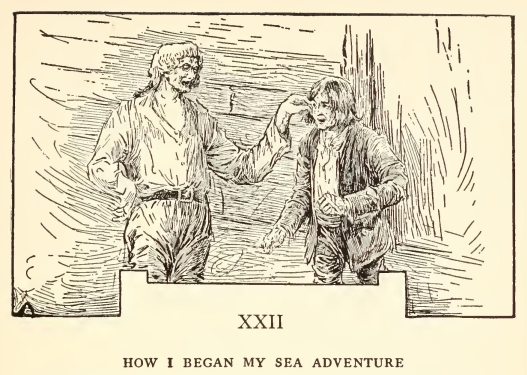
XXII
How I Began My Sea Adventure
here was no return of the mutineers—not so much as another shot out of thewoods. They had “got their rations for that day,” as the captain put it, and wehad the place to ourselves and a quiet time to overhaul the wounded and getdinner. Squire and I cooked outside in spite of the danger, and even outside wecould hardly tell what we were at, for horror of the loud groans that reachedus from the doctor’s patients.
Out of the eight men who had fallen in the action, only three stillbreathed—that one of the pirates who had been shot at the loophole, Hunter, andCaptain Smollett; and of these, the first two were as good as dead; themutineer indeed died under the doctor’s knife, and Hunter, do what we could,never recovered consciousness in this world. He lingered all day, breathingloudly like the old buccaneer at home in his apoplectic fit, but the bones ofhis chest had been crushed by the blow and his skull fractured in falling, andsome time in the following night, without sign or sound, he went to his Maker.
As for the captain, his wounds were grievous indeed, but not dangerous. Noorgan was fatally injured. Anderson’s ball—for it was Job that shot himfirst—had broken his shoulder-blade and touched the lung, not badly; the secondhad only torn and displaced some muscles in the calf. He was sure to recover,the doctor said, but in the meantime, and for weeks to come, he must not walknor move his arm, nor so much as speak when he could help it.
My own accidental cut across the knuckles was a flea-bite. Doctor Liveseypatched it up with plaster and pulled my ears for me into the bargain.
After dinner the squire and the doctor sat by the captain’s side awhile inconsultation; and when they had talked to their hearts’ content, it being thena little past noon, the doctor took up his hat and pistols, girt on a cutlass,put the chart in his pocket, and with a musket over his shoulder crossed thepalisade on the north side and set off briskly through the trees.
Gray and I were sitting together at the far end of the block house, to be outof earshot of our officers consulting; and Gray took his pipe out of his mouthand fairly forgot to put it back again, so thunder-struck he was at thisoccurrence.
“Why, in the name of Davy Jones,” said he, “is Dr. Livesey mad?”
“Why no,” says I. “He’s about the last of this crew for that, I take it.”
“Well, shipmate,” said Gray, “mad he may not be; but if he’snot, youmark my words, Iam.”
“I take it,” replied I, “the doctor has his idea; and if I am right, he’s goingnow to see Ben Gunn.”
I was right, as appeared later; but in the meantime, the house being stiflinghot and the little patch of sand inside the palisade ablaze with midday sun, Ibegan to get another thought into my head, which was not by any means so right.What I began to do was to envy the doctor walking in the cool shadow of thewoods with the birds about him and the pleasant smell of the pines, while I satgrilling, with my clothes stuck to the hot resin, and so much blood about meand so many poor dead bodies lying all around that I took a disgust of theplace that was almost as strong as fear.
All the time I was washing out the block house, and then washing up the thingsfrom dinner, this disgust and envy kept growing stronger and stronger, till atlast, being near a bread-bag, and no one then observing me, I took the firststep towards my escapade and filled both pockets of my coat with biscuit.
I was a fool, if you like, and certainly I was going to do a foolish, over-boldact; but I was determined to do it with all the precautions in my power. Thesebiscuits, should anything befall me, would keep me, at least, from starvingtill far on in the next day.
The next thing I laid hold of was a brace of pistols, and as I already had apowder-horn and bullets, I felt myself well supplied with arms.
As for the scheme I had in my head, it was not a bad one in itself. I was to godown the sandy spit that divides the anchorage on the east from the open sea,find the white rock I had observed last evening, and ascertain whether it wasthere or not that Ben Gunn had hidden his boat, a thing quite worth doing, as Istill believe. But as I was certain I should not be allowed to leave theenclosure, my only plan was to take French leave and slip out when nobody waswatching, and that was so bad a way of doing it as made the thing itself wrong.But I was only a boy, and I had made my mind up.
Well, as things at last fell out, I found an admirable opportunity. The squireand Gray were busy helping the captain with his bandages, the coast was clear,I made a bolt for it over the stockade and into the thickest of the trees, andbefore my absence was observed I was out of cry of my companions.
This was my second folly, far worse than the first, as I left but two sound mento guard the house; but like the first, it was a help towards saving all of us.
I took my way straight for the east coast of the island, for I was determinedto go down the sea side of the spit to avoid all chance of observation from theanchorage. It was already late in the afternoon, although still warm and sunny.As I continued to thread the tall woods, I could hear from far before me notonly the continuous thunder of the surf, but a certain tossing of foliage andgrinding of boughs which showed me the sea breeze had set in higher than usual.Soon cool draughts of air began to reach me, and a few steps farther I cameforth into the open borders of the grove, and saw the sea lying blue and sunnyto the horizon and the surf tumbling and tossing its foam along the beach.
I have never seen the sea quiet round Treasure Island. The sun might blazeoverhead, the air be without a breath, the surface smooth and blue, but stillthese great rollers would be running along all the external coast, thunderingand thundering by day and night; and I scarce believe there is one spot in theisland where a man would be out of earshot of their noise.
I walked along beside the surf with great enjoyment, till, thinking I was nowgot far enough to the south, I took the cover of some thick bushes and creptwarily up to the ridge of the spit.
Behind me was the sea, in front the anchorage. The sea breeze, as though it hadthe sooner blown itself out by its unusual violence, was already at an end; ithad been succeeded by light, variable airs from the south and south-east,carrying great banks of fog; and the anchorage, under lee of Skeleton Island,lay still and leaden as when first we entered it. The Hispaniola, inthat unbroken mirror, was exactly portrayed from the truck to the waterline,the Jolly Roger hanging from her peak.
Alongside lay one of the gigs, Silver in the stern-sheets—him I could alwaysrecognize—while a couple of men were leaning over the stern bulwarks, one ofthem with a red cap—the very rogue that I had seen some hours beforestride-legs upon the palisade. Apparently they were talking and laughing,though at that distance—upwards of a mile—I could, of course, hear no word ofwhat was said. All at once there began the most horrid, unearthly screaming,which at first startled me badly, though I had soon remembered the voice ofCaptain Flint and even thought I could make out the bird by her bright plumageas she sat perched upon her master’s wrist.
Soon after, the jolly-boat shoved off and pulled for shore, and the man withthe red cap and his comrade went below by the cabin companion.
Just about the same time, the sun had gone down behind the Spy-glass, and asthe fog was collecting rapidly, it began to grow dark in earnest. I saw I mustlose no time if I were to find the boat that evening.
The white rock, visible enough above the brush, was still some eighth of a milefurther down the spit, and it took me a goodish while to get up with it,crawling, often on all fours, among the scrub. Night had almost come when Ilaid my hand on its rough sides. Right below it there was an exceedingly smallhollow of green turf, hidden by banks and a thick underwood about knee-deep,that grew there very plentifully; and in the centre of the dell, sure enough, alittle tent of goat-skins, like what the gipsies carry about with them inEngland.
I dropped into the hollow, lifted the side of the tent, and there was BenGunn’s boat—home-made if ever anything was home-made; a rude, lop-sidedframework of tough wood, and stretched upon that a covering of goat-skin, withthe hair inside. The thing was extremely small, even for me, and I can hardlyimagine that it could have floated with a full-sized man. There was one thwartset as low as possible, a kind of stretcher in the bows, and a double paddlefor propulsion.
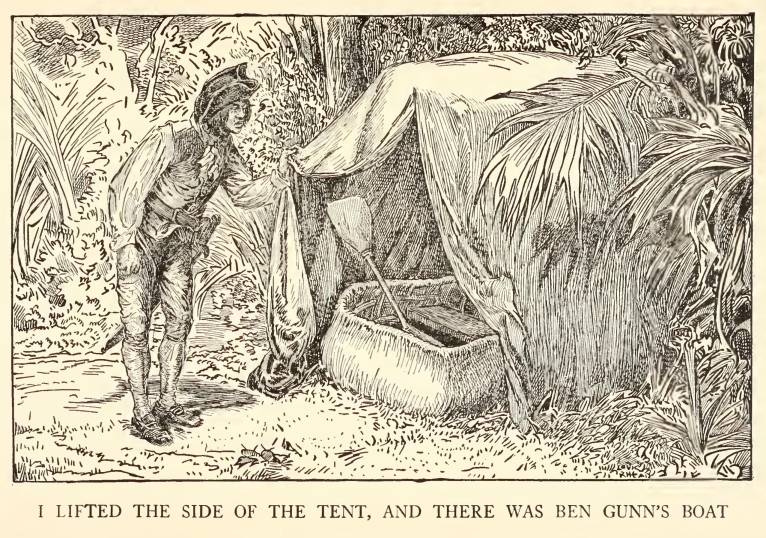
I had not then seen a coracle, such as the ancient Britons made, but I haveseen one since, and I can give you no fairer idea of Ben Gunn’s boat than bysaying it was like the first and the worst coracle ever made by man. But thegreat advantage of the coracle it certainly possessed, for it was exceedinglylight and portable.
Well, now that I had found the boat, you would have thought I had had enough oftruantry for once, but in the meantime I had taken another notion and become soobstinately fond of it that I would have carried it out, I believe, in theteeth of Captain Smollett himself. This was to slip out under cover of thenight, cut the Hispaniolaadrift, and let her go ashore where shefancied. I had quite made up my mind that the mutineers, after their repulse ofthe morning, had nothing nearer their hearts than to up anchor and away to sea;this, I thought, it would be a fine thing to prevent, and now that I had seenhow they left their watchmen unprovided with a boat, I thought it might be donewith little risk.
Down I sat to wait for darkness, and made a hearty meal of biscuit. It was anight out of ten thousand for my purpose. The fog had now buried all heaven. Asthe last rays of daylight dwindled and disappeared, absolute blackness settleddown on Treasure Island. And when, at last, I shouldered the coracle and gropedmy way stumblingly out of the hollow where I had supped, there were but twopoints visible on the whole anchorage.
One was the great fire on shore, by which the defeated pirates lay carousing inthe swamp. The other, a mere blur of light upon the darkness, indicated theposition of the anchored ship. She had swung round to the ebb—her bow was nowtowards me—the only lights on board were in the cabin, and what I saw wasmerely a reflection on the fog of the strong rays that flowed from the sternwindow.
The ebb had already run some time, and I had to wade through a long belt ofswampy sand, where I sank several times above the ankle, before I came to theedge of the retreating water, and wading a little way in, with some strengthand dexterity, set my coracle, keel downwards, on the surface.
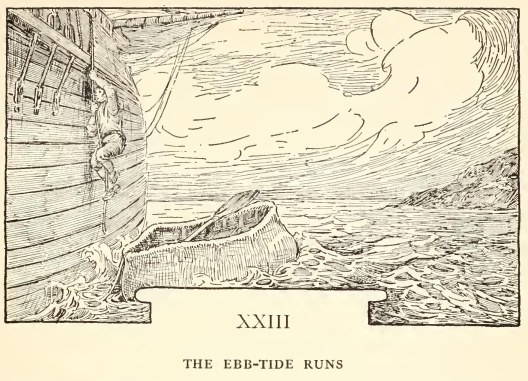
XXIII
The Ebb-tide Runs
he coracle—as I had ample reason to know before I was done with her—was a verysafe boat for a person of my height and weight, both buoyant and clever in aseaway; but she was the most cross-grained, lop-sided craft to manage. Do asyou pleased, she always made more leeway than anything else, and turning roundand round was the manoeuvre she was best at. Even Ben Gunn himself has admittedthat she was “queer to handle till you knew her way.”
Certainly I did not know her way. She turned in every direction but the one Iwas bound to go; the most part of the time we were broadside on, and I am verysure I never should have made the ship at all but for the tide. By goodfortune, paddle as I pleased, the tide was still sweeping me down; and therelay the Hispaniolaright in the fairway, hardly to be missed.
First she loomed before me like a blot of something yet blacker than darkness,then her spars and hull began to take shape, and the next moment, as it seemed(for, the farther I went, the brisker grew the current of the ebb), I wasalongside of her hawser and had laid hold.
The hawser was as taut as a bowstring, and the current so strong she pulledupon her anchor. All round the hull, in the blackness, the rippling currentbubbled and chattered like a little mountain stream. One cut with my sea-gullyand the Hispaniolawould go humming down the tide.
So far so good, but it next occurred to my recollection that a taut hawser,suddenly cut, is a thing as dangerous as a kicking horse. Ten to one, if I wereso foolhardy as to cut the Hispaniolafrom her anchor, I and the coraclewould be knocked clean out of the water.
This brought me to a full stop, and if fortune had not again particularlyfavoured me, I should have had to abandon my design. But the light airs whichhad begun blowing from the south-east and south had hauled round afternightfall into the south-west. Just while I was meditating, a puff came, caughtthe Hispaniola, and forced her up into the current; and to my great joy,I felt the hawser slacken in my grasp, and the hand by which I held it dip fora second under water.
With that I made my mind up, took out my gully, opened it with my teeth, andcut one strand after another, till the vessel swung only by two. Then I layquiet, waiting to sever these last when the strain should be once morelightened by a breath of wind.
All this time I had heard the sound of loud voices from the cabin, but to saytruth, my mind had been so entirely taken up with other thoughts that I hadscarcely given ear. Now, however, when I had nothing else to do, I began to paymore heed.
One I recognized for the coxswain’s, Israel Hands, that had been Flint’s gunnerin former days. The other was, of course, my friend of the red night-cap. Bothmen were plainly the worse of drink, and they were still drinking, for evenwhile I was listening, one of them, with a drunken cry, opened the stern windowand threw out something, which I divined to be an empty bottle. But they werenot only tipsy; it was plain that they were furiously angry. Oaths flew likehailstones, and every now and then there came forth such an explosion as Ithought was sure to end in blows. But each time the quarrel passed off and thevoices grumbled lower for a while, until the next crisis came and in its turnpassed away without result.
On shore, I could see the glow of the great camp-fire burning warmly throughthe shore-side trees. Someone was singing, a dull, old, droning sailor’s song,with a droop and a quaver at the end of every verse, and seemingly no end to itat all but the patience of the singer. I had heard it on the voyage more thanonce and remembered these words:
“But one man of her crew alive,
What put to sea with seventy-five.”
And I thought it was a ditty rather too dolefully appropriate for a companythat had met such cruel losses in the morning. But, indeed, from what I saw,all these buccaneers were as callous as the sea they sailed on.
At last the breeze came; the schooner sidled and drew nearer in the dark; Ifelt the hawser slacken once more, and with a good, tough effort, cut the lastfibres through.
The breeze had but little action on the coracle, and I was almost instantlyswept against the bows of the Hispaniola. At the same time, the schoonerbegan to turn upon her heel, spinning slowly, end for end, across the current.
I wrought like a fiend, for I expected every moment to be swamped; and since Ifound I could not push the coracle directly off, I now shoved straight astern.At length I was clear of my dangerous neighbour, and just as I gave the lastimpulsion, my hands came across a light cord that was trailing overboard acrossthe stern bulwarks. Instantly I grasped it.
Why I should have done so I can hardly say. It was at first mere instinct, butonce I had it in my hands and found it fast, curiosity began to get the upperhand, and I determined I should have one look through the cabin window.
I pulled in hand over hand on the cord, and when I judged myself near enough,rose at infinite risk to about half my height and thus commanded the roof and aslice of the interior of the cabin.
By this time the schooner and her little consort were gliding pretty swiftlythrough the water; indeed, we had already fetched up level with the camp-fire.The ship was talking, as sailors say, loudly, treading the innumerable rippleswith an incessant weltering splash; and until I got my eye above thewindow-sill I could not comprehend why the watchmen had taken no alarm. Oneglance, however, was sufficient; and it was only one glance that I durst takefrom that unsteady skiff. It showed me Hands and his companion locked togetherin deadly wrestle, each with a hand upon the other’s throat.
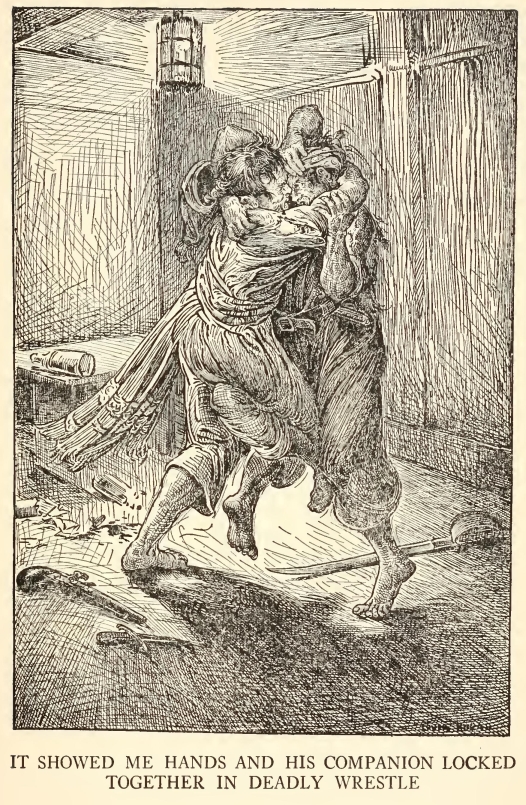
I dropped upon the thwart again, none too soon, for I was near overboard. Icould see nothing for the moment but these two furious, encrimsoned facesswaying together under the smoky lamp, and I shut my eyes to let them grow oncemore familiar with the darkness.
The endless ballad had come to an end at last, and the whole diminished companyabout the camp-fire had broken into the chorus I had heard so often:
“Fifteen men on the dead man’s chest—
Yo-ho-ho, and a bottle of rum!
Drink and the devil had done for the rest—
Yo-ho-ho, and a bottle of rum!”
I was just thinking how busy drink and the devil were at that very moment inthe cabin of the Hispaniola, when I was surprised by a sudden lurch ofthe coracle. At the same moment, she yawed sharply and seemed to change hercourse. The speed in the meantime had strangely increased.
I opened my eyes at once. All round me were little ripples, combing over with asharp, bristling sound and slightly phosphorescent. The Hispaniolaherself, a few yards in whose wake I was still being whirled along, seemed tostagger in her course, and I saw her spars toss a little against the blacknessof the night; nay, as I looked longer, I made sure she also was wheeling to thesouthward.
I glanced over my shoulder, and my heart jumped against my ribs. There, rightbehind me, was the glow of the camp-fire. The current had turned at rightangles, sweeping round along with it the tall schooner and the little dancingcoracle; ever quickening, ever bubbling higher, ever muttering louder, it wentspinning through the narrows for the open sea.
Suddenly the schooner in front of me gave a violent yaw, turning, perhaps,through twenty degrees; and almost at the same moment one shout followedanother from on board; I could hear feet pounding on the companion ladder and Iknew that the two drunkards had at last been interrupted in their quarrel andawakened to a sense of their disaster.
I lay down flat in the bottom of that wretched skiff and devoutly recommendedmy spirit to its Maker. At the end of the straits, I made sure we must fallinto some bar of raging breakers, where all my troubles would be endedspeedily; and though I could, perhaps, bear to die, I could not bear to lookupon my fate as it approached.
So I must have lain for hours, continually beaten to and fro upon the billows,now and again wetted with flying sprays, and never ceasing to expect death atthe next plunge. Gradually weariness grew upon me; a numbness, an occasionalstupor, fell upon my mind even in the midst of my terrors, until sleep at lastsupervened and in my sea-tossed coracle I lay and dreamed of home and the oldAdmiral Benbow.
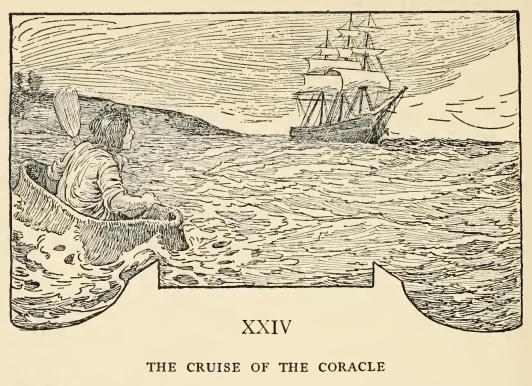
XXIV
The Cruise of the Coracle
t was broad day when I awoke and found myself tossing at the south-west end ofTreasure Island. The sun was up but was still hid from me behind the great bulkof the Spy-glass, which on this side descended almost to the sea in formidablecliffs.
Haulbowline Head and Mizzenmast Hill were at my elbow, the hill bare and dark,the head bound with cliffs forty or fifty feet high and fringed with greatmasses of fallen rock. I was scarce a quarter of a mile to seaward, and it wasmy first thought to paddle in and land.
That notion was soon given over. Among the fallen rocks the breakers spoutedand bellowed; loud reverberations, heavy sprays flying and falling, succeededone another from second to second; and I saw myself, if I ventured nearer,dashed to death upon the rough shore or spending my strength in vain to scalethe beetling crags.
Nor was that all, for crawling together on flat tables of rock or lettingthemselves drop into the sea with loud reports I beheld huge slimymonsters—soft snails, as it were, of incredible bigness—two or three score ofthem together, making the rocks to echo with their barkings.
I have understood since that they were sea lions, and entirely harmless. Butthe look of them, added to the difficulty of the shore and the high running ofthe surf, was more than enough to disgust me of that landing-place. I feltwilling rather to starve at sea than to confront such perils.
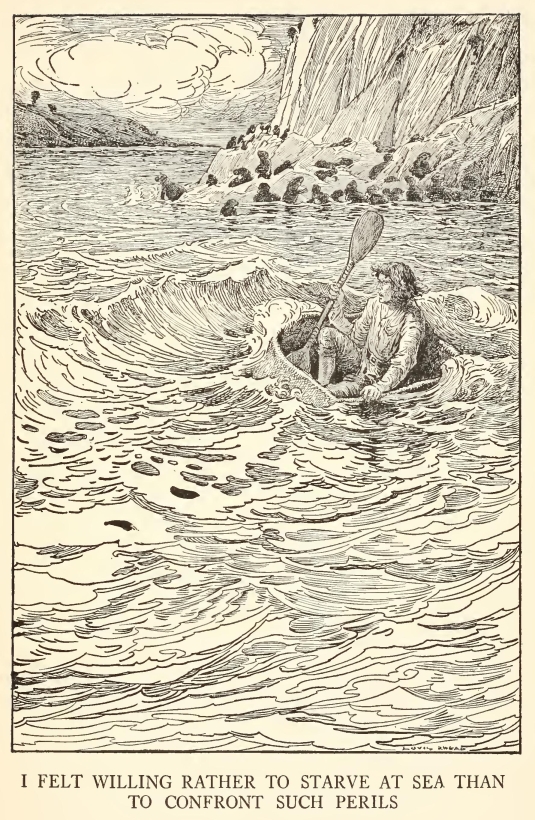
In the meantime I had a better chance, as I supposed, before me. North ofHaulbowline Head, the land runs in a long way, leaving at low tide a longstretch of yellow sand. To the north of that, again, there comes anothercape—Cape of the Woods, as it was marked upon the chart—buried in tall greenpines, which descended to the margin of the sea.
I remembered what Silver had said about the current that sets northward alongthe whole west coast of Treasure Island, and seeing from my position that I wasalready under its influence, I preferred to leave Haulbowline Head behind meand reserve my strength for an attempt to land upon the kindlier-looking Capeof the Woods.
There was a great, smooth swell upon the sea. The wind blowing steady andgentle from the south, there was no contrariety between that and the current,and the billows rose and fell unbroken.
Had it been otherwise, I must long ago have perished; but as it was, it issurprising how easily and securely my little and light boat could ride. Often,as I still lay at the bottom and kept no more than an eye above the gunwale, Iwould see a big blue summit heaving close above me; yet the coracle would butbounce a little, dance as if on springs, and subside on the other side into thetrough as lightly as a bird.
I began after a little to grow very bold and sat up to try my skill atpaddling. But even a small change in the disposition of the weight will produceviolent changes in the behaviour of a coracle. And I had hardly moved beforethe boat, giving up at once her gentle dancing movement, ran straight down aslope of water so steep that it made me giddy, and struck her nose, with aspout of spray, deep into the side of the next wave.
I was drenched and terrified, and fell instantly back into my old position,whereupon the coracle seemed to find her head again and led me as softly asbefore among the billows. It was plain she was not to be interfered with, andat that rate, since I could in no way influence her course, what hope had Ileft of reaching land?
I began to be horribly frightened, but I kept my head, for all that. First,moving with all care, I gradually baled out the coracle with my sea-cap; then,getting my eye once more above the gunwale, I set myself to study how it wasshe managed to slip so quietly through the rollers.
I found each wave, instead of the big, smooth glossy mountain it looks fromshore or from a vessel’s deck, was for all the world like any range of hills ondry land, full of peaks and smooth places and valleys. The coracle, left toherself, turning from side to side, threaded, so to speak, her way throughthese lower parts and avoided the steep slopes and higher, toppling summits ofthe wave.
“Well, now,” thought I to myself, “it is plain I must lie where I am and notdisturb the balance; but it is plain also that I can put the paddle over theside and from time to time, in smooth places, give her a shove or two towardsland.” No sooner thought upon than done. There I lay on my elbows in the mosttrying attitude, and every now and again gave a weak stroke or two to turn herhead to shore.
It was very tiring and slow work, yet I did visibly gain ground; and as we drewnear the Cape of the Woods, though I saw I must infallibly miss that point, Ihad still made some hundred yards of easting. I was, indeed, close in. I couldsee the cool green tree-tops swaying together in the breeze, and I felt sure Ishould make the next promontory without fail.
It was high time, for I now began to be tortured with thirst. The glow of thesun from above, its thousandfold reflection from the waves, the sea-water thatfell and dried upon me, caking my very lips with salt, combined to make mythroat burn and my brain ache. The sight of the trees so near at hand hadalmost made me sick with longing, but the current had soon carried me past thepoint, and as the next reach of sea opened out, I beheld a sight that changedthe nature of my thoughts.
Right in front of me, not half a mile away, I beheld the Hispaniolaunder sail. I made sure, of course, that I should be taken; but I was sodistressed for want of water that I scarce knew whether to be glad or sorry atthe thought, and long before I had come to a conclusion, surprise had takenentire possession of my mind and I could do nothing but stare and wonder.
The Hispaniolawas under her main-sail and two jibs, and the beautifulwhite canvas shone in the sun like snow or silver. When I first sighted her,all her sails were drawing; she was lying a course about north-west, and Ipresumed the men on board were going round the island on their way back to theanchorage. Presently she began to fetch more and more to the westward, so thatI thought they had sighted me and were going about in chase. At last, however,she fell right into the wind’s eye, was taken dead aback, and stood thereawhile helpless, with her sails shivering.
“Clumsy fellows,” said I; “they must still be drunk as owls.” And I thought howCaptain Smollett would have set them skipping.
Meanwhile the schooner gradually fell off and filled again upon another tack,sailed swiftly for a minute or so, and brought up once more dead in the wind’seye. Again and again was this repeated. To and fro, up and down, north, south,east, and west, the Hispaniolasailed by swoops and dashes, and at eachrepetition ended as she had begun, with idly flapping canvas. It became plainto me that nobody was steering. And if so, where were the men? Either they weredead drunk or had deserted her, I thought, and perhaps if I could get on boardI might return the vessel to her captain.
The current was bearing coracle and schooner southward at an equal rate. As forthe latter’s sailing, it was so wild and intermittent, and she hung each timeso long in irons, that she certainly gained nothing, if she did not even lose.If only I dared to sit up and paddle, I made sure that I could overhaul her.The scheme had an air of adventure that inspired me, and the thought of thewater breaker beside the fore companion doubled my growing courage.
Up I got, was welcomed almost instantly by another cloud of spray, but thistime stuck to my purpose and set myself, with all my strength and caution, topaddle after the unsteered Hispaniola. Once I shipped a sea so heavythat I had to stop and bail, with my heart fluttering like a bird, butgradually I got into the way of the thing and guided my coracle among thewaves, with only now and then a blow upon her bows and a dash of foam in myface.
I was now gaining rapidly on the schooner; I could see the brass glisten on thetiller as it banged about, and still no soul appeared upon her decks. I couldnot choose but suppose she was deserted. If not, the men were lying drunkbelow, where I might batten them down, perhaps, and do what I chose with theship.
For some time she had been doing the worse thing possible for me—standingstill. She headed nearly due south, yawing, of course, all the time. Each timeshe fell off, her sails partly filled, and these brought her in a moment rightto the wind again. I have said this was the worst thing possible for me, forhelpless as she looked in this situation, with the canvas cracking like cannonand the blocks trundling and banging on the deck, she still continued to runaway from me, not only with the speed of the current, but by the whole amountof her leeway, which was naturally great.
But now, at last, I had my chance. The breeze fell for some seconds, very low,and the current gradually turning her, the Hispaniolarevolved slowlyround her centre and at last presented me her stern, with the cabin windowstill gaping open and the lamp over the table still burning on into the day.The main-sail hung drooped like a banner. She was stock-still but for thecurrent.
For the last little while I had even lost, but now redoubling my efforts, Ibegan once more to overhaul the chase.
I was not a hundred yards from her when the wind came again in a clap; shefilled on the port tack and was off again, stooping and skimming like aswallow.
My first impulse was one of despair, but my second was towards joy. Round shecame, till she was broadside on to me—round still till she had covered a halfand then two thirds and then three quarters of the distance that separated us.I could see the waves boiling white under her forefoot. Immensely tall shelooked to me from my low station in the coracle.
And then, of a sudden, I began to comprehend. I had scarce time to think—scarcetime to act and save myself. I was on the summit of one swell when the schoonercame stooping over the next. The bowsprit was over my head. I sprang to my feetand leaped, stamping the coracle under water. With one hand I caught thejib-boom, while my foot was lodged between the stay and the brace; and as Istill clung there panting, a dull blow told me that the schooner had chargeddown upon and struck the coracle and that I was left without retreat on theHispaniola.
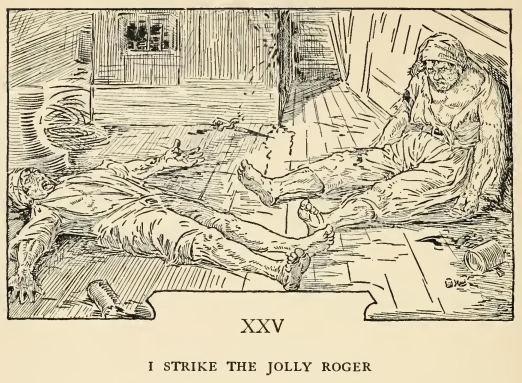
XXV
I Strike the Jolly Roger
had scarce gained a position on the bowsprit when the flying jib flapped andfilled upon the other tack, with a report like a gun. The schooner trembled toher keel under the reverse, but next moment, the other sails still drawing, thejib flapped back again and hung idle.
This had nearly tossed me off into the sea; and now I lost no time, crawledback along the bowsprit, and tumbled head foremost on the deck.
I was on the lee side of the forecastle, and the mainsail, which was stilldrawing, concealed from me a certain portion of the after-deck. Not a soul wasto be seen. The planks, which had not been swabbed since the mutiny, bore theprint of many feet, and an empty bottle, broken by the neck, tumbled to and frolike a live thing in the scuppers.
Suddenly the Hispaniolacame right into the wind. The jibs behind mecracked aloud, the rudder slammed to, the whole ship gave a sickening heave andshudder, and at the same moment the main-boom swung inboard, the sheet groaningin the blocks, and showed me the lee after-deck.
There were the two watchmen, sure enough: red-cap on his back, as stiff as ahandspike, with his arms stretched out like those of a crucifix and his teethshowing through his open lips; Israel Hands propped against the bulwarks, hischin on his chest, his hands lying open before him on the deck, his face aswhite, under its tan, as a tallow candle.
For a while the ship kept bucking and sidling like a vicious horse, the sailsfilling, now on one tack, now on another, and the boom swinging to and fro tillthe mast groaned aloud under the strain. Now and again too there would come acloud of light sprays over the bulwark and a heavy blow of the ship’s bowsagainst the swell; so much heavier weather was made of it by this great riggedship than by my home-made, lop-sided coracle, now gone to the bottom of thesea.
At every jump of the schooner, red-cap slipped to and fro, but—what was ghastlyto behold—neither his attitude nor his fixed teeth-disclosing grin was anywaydisturbed by this rough usage. At every jump too, Hands appeared still more tosink into himself and settle down upon the deck, his feet sliding ever thefarther out, and the whole body canting towards the stern, so that his facebecame, little by little, hid from me; and at last I could see nothing beyondhis ear and the frayed ringlet of one whisker.
At the same time, I observed, around both of them, splashes of dark blood uponthe planks and began to feel sure that they had killed each other in theirdrunken wrath.
While I was thus looking and wondering, in a calm moment, when the ship wasstill, Israel Hands turned partly round and with a low moan writhed himselfback to the position in which I had seen him first. The moan, which told ofpain and deadly weakness, and the way in which his jaw hung open went right tomy heart. But when I remembered the talk I had overheard from the apple barrel,all pity left me.
I walked aft until I reached the main-mast.
“Come aboard, Mr. Hands,” I said ironically.
He rolled his eyes round heavily, but he was too far gone to express surprise.All he could do was to utter one word, “Brandy.”
It occurred to me there was no time to lose, and dodging the boom as it oncemore lurched across the deck, I slipped aft and down the companion stairs intothe cabin.
It was such a scene of confusion as you can hardly fancy. All the lockfastplaces had been broken open in quest of the chart. The floor was thick with mudwhere ruffians had sat down to drink or consult after wading in the marshesround their camp. The bulkheads, all painted in clear white and beaded roundwith gilt, bore a pattern of dirty hands. Dozens of empty bottles clinkedtogether in corners to the rolling of the ship. One of the doctor’s medicalbooks lay open on the table, half of the leaves gutted out, I suppose, forpipelights. In the midst of all this the lamp still cast a smoky glow, obscureand brown as umber.
I went into the cellar; all the barrels were gone, and of the bottles a mostsurprising number had been drunk out and thrown away. Certainly, since themutiny began, not a man of them could ever have been sober.
Foraging about, I found a bottle with some brandy left, for Hands; and formyself I routed out some biscuit, some pickled fruits, a great bunch ofraisins, and a piece of cheese. With these I came on deck, put down my ownstock behind the rudder head and well out of the coxswain’s reach, went forwardto the water-breaker, and had a good deep drink of water, and then, and nottill then, gave Hands the brandy.
He must have drunk a gill before he took the bottle from his mouth.
“Aye,” said he, “by thunder, but I wanted some o’ that!”
I had sat down already in my own corner and begun to eat.
“Much hurt?” I asked him.
He grunted, or rather, I might say, he barked.
“If that doctor was aboard,” he said, “I’d be right enough in a couple ofturns, but I don’t have no manner of luck, you see, and that’s what’s thematter with me. As for that swab, he’s good and dead, he is,” he added,indicating the man with the red cap. “He warn’t no seaman anyhow. And wheremought you have come from?”
“Well,” said I, “I’ve come aboard to take possession of this ship, Mr. Hands;and you’ll please regard me as your captain until further notice.”
He looked at me sourly enough but said nothing. Some of the colour had comeback into his cheeks, though he still looked very sick and still continued toslip out and settle down as the ship banged about.
“By the by,” I continued, “I can’t have these colours, Mr. Hands; and by yourleave, I’ll strike ’em. Better none than these.”
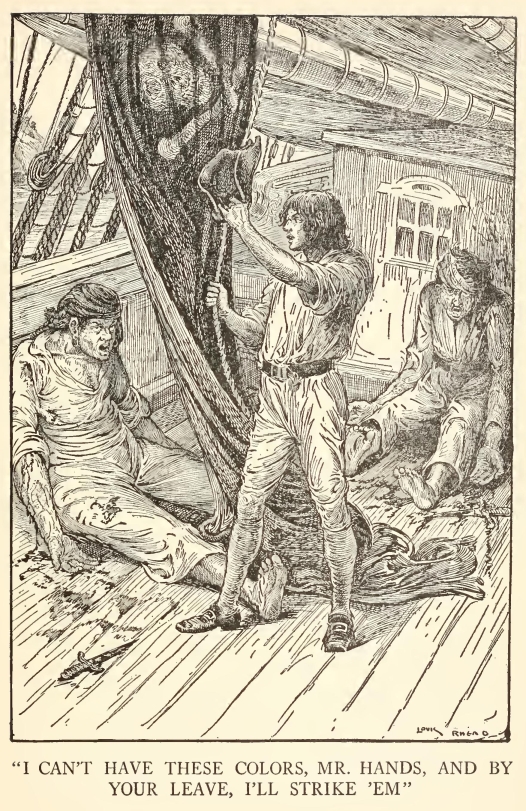
And again dodging the boom, I ran to the colour lines, handed down their cursedblack flag, and chucked it overboard.
“God save the king!” said I, waving my cap. “And there’s an end to CaptainSilver!”
He watched me keenly and slyly, his chin all the while on his breast.
“I reckon,” he said at last, “I reckon, Cap’n Hawkins, you’ll kind of want toget ashore now. S’pose we talks.”
“Why, yes,” says I, “with all my heart, Mr. Hands. Say on.” And I went back tomy meal with a good appetite.
“This man,” he began, nodding feebly at the corpse “—O’Brien were his name, arank Irelander—this man and me got the canvas on her, meaning for to sail herback. Well, he’sdead now, he is—as dead as bilge; and who’s to sailthis ship, I don’t see. Without I gives you a hint, you ain’t that man, asfar’s I can tell. Now, look here, you gives me food and drink and a old scarfor ankecher to tie my wound up, you do, and I’ll tell you how to sail her, andthat’s about square all round, I take it.”
“I’ll tell you one thing,” says I: “I’m not going back to Captain Kidd’sanchorage. I mean to get into North Inlet and beach her quietly there.”
“To be sure you did,” he cried. “Why, I ain’t sich an infernal lubber afterall. I can see, can’t I? I’ve tried my fling, I have, and I’ve lost, and it’syou has the wind of me. North Inlet? Why, I haven’t no ch’ice, not I! I’d helpyou sail her up to Execution Dock, by thunder! So I would.”
Well, as it seemed to me, there was some sense in this. We struck our bargainon the spot. In three minutes I had the Hispaniolasailing easily beforethe wind along the coast of Treasure Island, with good hopes of turning thenorthern point ere noon and beating down again as far as North Inlet beforehigh water, when we might beach her safely and wait till the subsiding tidepermitted us to land.
Then I lashed the tiller and went below to my own chest, where I got a softsilk handkerchief of my mother’s. With this, and with my aid, Hands bound upthe great bleeding stab he had received in the thigh, and after he had eaten alittle and had a swallow or two more of the brandy, he began to pick upvisibly, sat straighter up, spoke louder and clearer, and looked in every wayanother man.
The breeze served us admirably. We skimmed before it like a bird, the coast ofthe island flashing by and the view changing every minute. Soon we were pastthe high lands and bowling beside low, sandy country, sparsely dotted withdwarf pines, and soon we were beyond that again and had turned the corner ofthe rocky hill that ends the island on the north.
I was greatly elated with my new command, and pleased with the bright, sunshinyweather and these different prospects of the coast. I had now plenty of waterand good things to eat, and my conscience, which had smitten me hard for mydesertion, was quieted by the great conquest I had made. I should, I think,have had nothing left me to desire but for the eyes of the coxswain as theyfollowed me derisively about the deck and the odd smile that appearedcontinually on his face. It was a smile that had in it something both of painand weakness—a haggard old man’s smile; but there was, besides that, a grain ofderision, a shadow of treachery, in his expression as he craftily watched, andwatched, and watched me at my work.
XXVI
Israel Hands
he wind, serving us to a desire, now hauled into the west. We could run so muchthe easier from the north-east corner of the island to the mouth of the NorthInlet. Only, as we had no power to anchor and dared not beach her till the tidehad flowed a good deal farther, time hung on our hands. The coxswain told mehow to lay the ship to; after a good many trials I succeeded, and we both satin silence over another meal.
“Cap’n,” said he at length with that same uncomfortable smile, “here’s my oldshipmate, O’Brien; s’pose you was to heave him overboard. I ain’t partic’lar asa rule, and I don’t take no blame for settling his hash, but I don’t reckon himornamental now, do you?”
“I’m not strong enough, and I don’t like the job; and there he lies, for me,”said I.
“This here’s an unlucky ship, this Hispaniola, Jim,” he went on,blinking. “There’s a power of men been killed in this Hispaniola—a sighto’ poor seamen dead and gone since you and me took ship to Bristol. I neverseen sich dirty luck, not I. There was this here O’Brien now—he’s dead, ain’the? Well now, I’m no scholar, and you’re a lad as can read and figure, and toput it straight, do you take it as a dead man is dead for good, or do he comealive again?”
“You can kill the body, Mr. Hands, but not the spirit; you must know thatalready,” I replied. “O’Brien there is in another world, and may be watchingus.”
“Ah!” says he. “Well, that’s unfort’nate—appears as if killing parties was awaste of time. Howsomever, sperrits don’t reckon for much, by what I’ve seen.I’ll chance it with the sperrits, Jim. And now, you’ve spoke up free, and I’lltake it kind if you’d step down into that there cabin and get me a—well,a—shiver my timbers! I can’t hit the name on ’t; well, you get me a bottle ofwine, Jim—this here brandy’s too strong for my head.”
Now, the coxswain’s hesitation seemed to be unnatural, and as for the notion ofhis preferring wine to brandy, I entirely disbelieved it. The whole story was apretext. He wanted me to leave the deck—so much was plain; but with whatpurpose I could in no way imagine. His eyes never met mine; they kept wanderingto and fro, up and down, now with a look to the sky, now with a flitting glanceupon the dead O’Brien. All the time he kept smiling and putting his tongue outin the most guilty, embarrassed manner, so that a child could have told that hewas bent on some deception. I was prompt with my answer, however, for I sawwhere my advantage lay and that with a fellow so densely stupid I could easilyconceal my suspicions to the end.
“Some wine?” I said. “Far better. Will you have white or red?”
“Well, I reckon it’s about the blessed same to me, shipmate,” he replied; “soit’s strong, and plenty of it, what’s the odds?”
“All right,” I answered. “I’ll bring you port, Mr. Hands. But I’ll have to digfor it.”
With that I scuttled down the companion with all the noise I could, slipped offmy shoes, ran quietly along the sparred gallery, mounted the forecastle ladder,and popped my head out of the fore companion. I knew he would not expect to seeme there, yet I took every precaution possible, and certainly the worst of mysuspicions proved too true.
He had risen from his position to his hands and knees, and though his legobviously hurt him pretty sharply when he moved—for I could hear him stifle agroan—yet it was at a good, rattling rate that he trailed himself across thedeck. In half a minute he had reached the port scuppers and picked, out of acoil of rope, a long knife, or rather a short dirk, discoloured to the hiltwith blood. He looked upon it for a moment, thrusting forth his under jaw,tried the point upon his hand, and then, hastily concealing it in the bosom ofhis jacket, trundled back again into his old place against the bulwark.
This was all that I required to know. Israel could move about, he was nowarmed, and if he had been at so much trouble to get rid of me, it was plainthat I was meant to be the victim. What he would do afterwards—whether he wouldtry to crawl right across the island from North Inlet to the camp among theswamps or whether he would fire Long Tom, trusting that his own comrades mightcome first to help him—was, of course, more than I could say.
Yet I felt sure that I could trust him in one point, since in that ourinterests jumped together, and that was in the disposition of the schooner. Weboth desired to have her stranded safe enough, in a sheltered place, and sothat, when the time came, she could be got off again with as little labour anddanger as might be; and until that was done I considered that my life wouldcertainly be spared.
While I was thus turning the business over in my mind, I had not been idle withmy body. I had stolen back to the cabin, slipped once more into my shoes, andlaid my hand at random on a bottle of wine, and now, with this for an excuse, Imade my reappearance on the deck.
Hands lay as I had left him, all fallen together in a bundle and with hiseyelids lowered as though he were too weak to bear the light. He looked up,however, at my coming, knocked the neck off the bottle like a man who had donethe same thing often, and took a good swig, with his favourite toast of “Here’sluck!” Then he lay quiet for a little, and then, pulling out a stick oftobacco, begged me to cut him a quid.
“Cut me a junk o’ that,” says he, “for I haven’t no knife and hardly strengthenough, so be as I had. Ah, Jim, Jim, I reckon I’ve missed stays! Cut me aquid, as’ll likely be the last, lad, for I’m for my long home, and no mistake.”
“Well,” said I, “I’ll cut you some tobacco, but if I was you and thought myselfso badly, I would go to my prayers like a Christian man.”
“Why?” said he. “Now, you tell me why.”
“Why?” I cried. “You were asking me just now about the dead. You’ve broken yourtrust; you’ve lived in sin and lies and blood; there’s a man you killed lyingat your feet this moment, and you ask me why! For God’s mercy, Mr. Hands,that’s why.”
I spoke with a little heat, thinking of the bloody dirk he had hidden in hispocket and designed, in his ill thoughts, to end me with. He, for his part,took a great draught of the wine and spoke with the most unusual solemnity.
“For thirty years,” he said, “I’ve sailed the seas and seen good and bad,better and worse, fair weather and foul, provisions running out, knives going,and what not. Well, now I tell you, I never seen good come o’ goodness yet. Himas strikes first is my fancy; dead men don’t bite; them’s my views—amen, so beit. And now, you look here,” he added, suddenly changing his tone, “we’ve hadabout enough of this foolery. The tide’s made good enough by now. You just takemy orders, Cap’n Hawkins, and we’ll sail slap in and be done with it.”
All told, we had scarce two miles to run; but the navigation was delicate, theentrance to this northern anchorage was not only narrow and shoal, but lay eastand west, so that the schooner must be nicely handled to be got in. I think Iwas a good, prompt subaltern, and I am very sure that Hands was an excellentpilot, for we went about and about and dodged in, shaving the banks, with acertainty and a neatness that were a pleasure to behold.
Scarcely had we passed the heads before the land closed around us. The shoresof North Inlet were as thickly wooded as those of the southern anchorage, butthe space was longer and narrower and more like, what in truth it was, theestuary of a river. Right before us, at the southern end, we saw the wreck of aship in the last stages of dilapidation. It had been a great vessel of threemasts but had lain so long exposed to the injuries of the weather that it washung about with great webs of dripping seaweed, and on the deck of it shorebushes had taken root and now flourished thick with flowers. It was a sadsight, but it showed us that the anchorage was calm.
“Now,” said Hands, “look there; there’s a pet bit for to beach a ship in. Fineflat sand, never a cat’s paw, trees all around of it, and flowers a-blowinglike a garding on that old ship.”
“And once beached,” I inquired, “how shall we get her off again?”
“Why, so,” he replied: “you take a line ashore there on the other side at lowwater, take a turn about one of them big pines; bring it back, take a turnaround the capstan, and lie to for the tide. Come high water, all hands take apull upon the line, and off she comes as sweet as natur’. And now, boy, youstand by. We’re near the bit now, and she’s too much way on her. Starboard alittle—so—steady—starboard—larboard a little—steady—steady!”
So he issued his commands, which I breathlessly obeyed, till, all of a sudden,he cried, “Now, my hearty, luff!” And I put the helm hard up, and theHispaniolaswung round rapidly and ran stem on for the low, woodedshore.
The excitement of these last manoeuvres had somewhat interfered with the watchI had kept hitherto, sharply enough, upon the coxswain. Even then I was stillso much interested, waiting for the ship to touch, that I had quite forgot theperil that hung over my head and stood craning over the starboard bulwarks andwatching the ripples spreading wide before the bows. I might have fallenwithout a struggle for my life had not a sudden disquietude seized upon me andmade me turn my head. Perhaps I had heard a creak or seen his shadow movingwith the tail of my eye; perhaps it was an instinct like a cat’s; but, sureenough, when I looked round, there was Hands, already half-way towards me, withthe dirk in his right hand.
We must both have cried out aloud when our eyes met, but while mine was theshrill cry of terror, his was a roar of fury like a charging bully’s. At thesame instant, he threw himself forward and I leapt sideways towards the bows.As I did so, I let go of the tiller, which sprang sharp to leeward, and I thinkthis saved my life, for it struck Hands across the chest and stopped him, forthe moment, dead.
Before he could recover, I was safe out of the corner where he had me trapped,with all the deck to dodge about. Just forward of the main-mast I stopped, drewa pistol from my pocket, took a cool aim, though he had already turned and wasonce more coming directly after me, and drew the trigger. The hammer fell, butthere followed neither flash nor sound; the priming was useless with sea-water.I cursed myself for my neglect. Why had not I, long before, reprimed andreloaded my only weapons? Then I should not have been as now, a mere fleeingsheep before this butcher.
Wounded as he was, it was wonderful how fast he could move, his grizzled hairtumbling over his face, and his face itself as red as a red ensign with hishaste and fury. I had no time to try my other pistol, nor indeed muchinclination, for I was sure it would be useless. One thing I saw plainly: Imust not simply retreat before him, or he would speedily hold me boxed into thebows, as a moment since he had so nearly boxed me in the stern. Once so caught,and nine or ten inches of the blood-stained dirk would be my last experience onthis side of eternity. I placed my palms against the main-mast, which was of agoodish bigness, and waited, every nerve upon the stretch.
Seeing that I meant to dodge, he also paused; and a moment or two passed infeints on his part and corresponding movements upon mine. It was such a game asI had often played at home about the rocks of Black Hill Cove, but neverbefore, you may be sure, with such a wildly beating heart as now. Still, as Isay, it was a boy’s game, and I thought I could hold my own at it against anelderly seaman with a wounded thigh. Indeed my courage had begun to rise sohigh that I allowed myself a few darting thoughts on what would be the end ofthe affair, and while I saw certainly that I could spin it out for long, I sawno hope of any ultimate escape.
Well, while things stood thus, suddenly the Hispaniolastruck,staggered, ground for an instant in the sand, and then, swift as a blow, cantedover to the port side till the deck stood at an angle of forty-five degrees andabout a puncheon of water splashed into the scupper holes and lay, in a pool,between the deck and bulwark.
We were both of us capsized in a second, and both of us rolled, almosttogether, into the scuppers, the dead red-cap, with his arms still spread out,tumbling stiffly after us. So near were we, indeed, that my head came againstthe coxswain’s foot with a crack that made my teeth rattle. Blow and all, I wasthe first afoot again, for Hands had got involved with the dead body. Thesudden canting of the ship had made the deck no place for running on; I had tofind some new way of escape, and that upon the instant, for my foe was almosttouching me. Quick as thought, I sprang into the mizzen shrouds, rattled uphand over hand, and did not draw a breath till I was seated on the cross-trees.
I had been saved by being prompt; the dirk had struck not half a foot below meas I pursued my upward flight; and there stood Israel Hands with his mouth openand his face upturned to mine, a perfect statue of surprise and disappointment.
Now that I had a moment to myself, I lost no time in changing the priming of mypistol, and then, having one ready for service, and to make assurance doublysure, I proceeded to draw the load of the other and recharge it afresh from thebeginning.
My new employment struck Hands all of a heap; he began to see the dice goingagainst him, and after an obvious hesitation, he also hauled himself heavilyinto the shrouds, and with the dirk in his teeth, began slowly and painfully tomount. It cost him no end of time and groans to haul his wounded leg behindhim, and I had quietly finished my arrangements before he was much more than athird of the way up. Then, with a pistol in either hand, I addressed him.
“One more step, Mr. Hands,” said I, “and I’ll blow your brains out! Dead mendon’t bite, you know,” I added with a chuckle.
He stopped instantly. I could see by the working of his face that he was tryingto think, and the process was so slow and laborious that, in my new-foundsecurity, I laughed aloud. At last, with a swallow or two, he spoke, his facestill wearing the same expression of extreme perplexity. In order to speak hehad to take the dagger from his mouth, but in all else he remained unmoved.
“Jim,” says he, “I reckon we’re fouled, you and me, and we’ll have to signarticles. I’d have had you but for that there lurch, but I don’t have no luck,not I; and I reckon I’ll have to strike, which comes hard, you see, for amaster mariner to a ship’s younker like you, Jim.”
I was drinking in his words and smiling away, as conceited as a cock upon awall, when, all in a breath, back went his right hand over his shoulder.Something sang like an arrow through the air; I felt a blow and then a sharppang, and there I was pinned by the shoulder to the mast. In the horrid painand surprise of the moment—I scarce can say it was by my own volition, and I amsure it was without a conscious aim—both my pistols went off, and both escapedout of my hands. They did not fall alone; with a choked cry, the coxswainloosed his grasp upon the shrouds and plunged head first into the water.
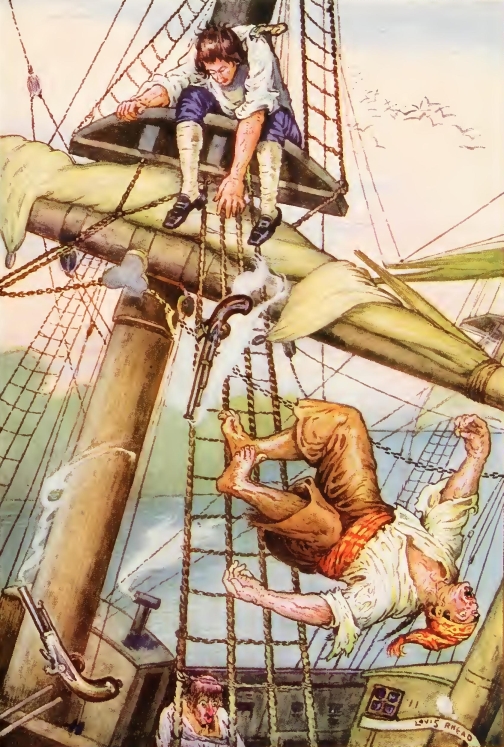
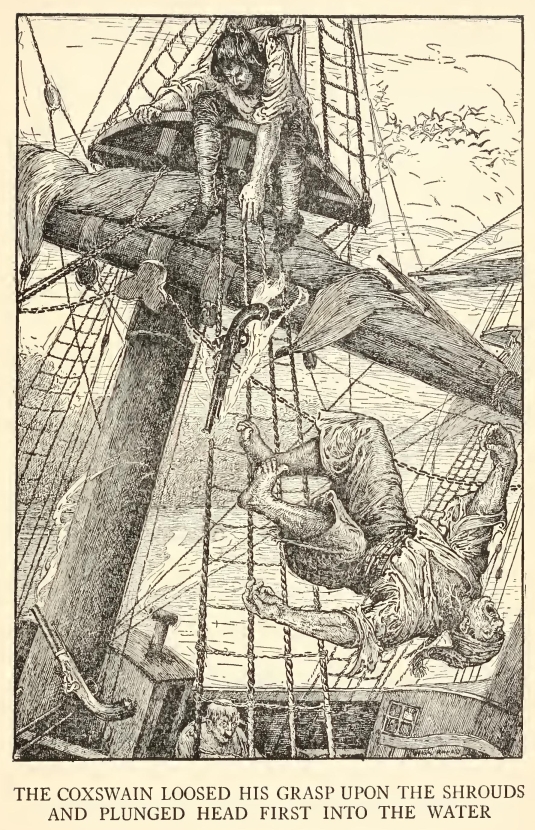
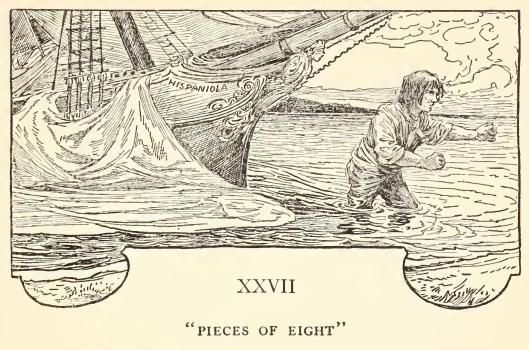
XXVII
“Pieces of Eight”
wing to the cant of the vessel, the masts hung far out over the water, and frommy perch on the cross-trees I had nothing below me but the surface of the bay.Hands, who was not so far up, was in consequence nearer to the ship and fellbetween me and the bulwarks. He rose once to the surface in a lather of foamand blood and then sank again for good. As the water settled, I could see himlying huddled together on the clean, bright sand in the shadow of the vessel’ssides. A fish or two whipped past his body. Sometimes, by the quivering of thewater, he appeared to move a little, as if he were trying to rise. But he wasdead enough, for all that, being both shot and drowned, and was food for fishin the very place where he had designed my slaughter.
I was no sooner certain of this than I began to feel sick, faint, andterrified. The hot blood was running over my back and chest. The dirk, where ithad pinned my shoulder to the mast, seemed to burn like a hot iron; yet it wasnot so much these real sufferings that distressed me, for these, it seemed tome, I could bear without a murmur; it was the horror I had upon my mind offalling from the cross-trees into that still green water, beside the body ofthe coxswain.
I clung with both hands till my nails ached, and I shut my eyes as if to coverup the peril. Gradually my mind came back again, my pulses quieted down to amore natural time, and I was once more in possession of myself.
It was my first thought to pluck forth the dirk, but either it stuck too hardor my nerve failed me, and I desisted with a violent shudder. Oddly enough,that very shudder did the business. The knife, in fact, had come the nearest inthe world to missing me altogether; it held me by a mere pinch of skin, andthis the shudder tore away. The blood ran down the faster, to be sure, but Iwas my own master again and only tacked to the mast by my coat and shirt.
These last I broke through with a sudden jerk, and then regained the deck bythe starboard shrouds. For nothing in the world would I have again ventured,shaken as I was, upon the overhanging port shrouds from which Israel had solately fallen.
I went below and did what I could for my wound; it pained me a good deal andstill bled freely, but it was neither deep nor dangerous, nor did it greatlygall me when I used my arm. Then I looked around me, and as the ship was now,in a sense, my own, I began to think of clearing it from its last passenger—thedead man, O’Brien.
He had pitched, as I have said, against the bulwarks, where he lay like somehorrible, ungainly sort of puppet, life-size, indeed, but how different fromlife’s colour or life’s comeliness! In that position I could easily have my waywith him, and as the habit of tragical adventures had worn off almost all myterror for the dead, I took him by the waist as if he had been a sack of branand with one good heave, tumbled him overboard. He went in with a soundingplunge; the red cap came off and remained floating on the surface; and as soonas the splash subsided, I could see him and Israel lying side by side, bothwavering with the tremulous movement of the water. O’Brien, though still quitea young man, was very bald. There he lay, with that bald head across the kneesof the man who had killed him and the quick fishes steering to and fro overboth.
I was now alone upon the ship; the tide had just turned. The sun was within sofew degrees of setting that already the shadow of the pines upon the westernshore began to reach right across the anchorage and fall in patterns on thedeck. The evening breeze had sprung up, and though it was well warded off bythe hill with the two peaks upon the east, the cordage had begun to sing alittle softly to itself and the idle sails to rattle to and fro.
I began to see a danger to the ship. The jibs I speedily doused and broughttumbling to the deck, but the main-sail was a harder matter. Of course, whenthe schooner canted over, the boom had swung out-board, and the cap of it and afoot or two of sail hung even under water. I thought this made it still moredangerous; yet the strain was so heavy that I half feared to meddle. At last Igot my knife and cut the halyards. The peak dropped instantly, a great belly ofloose canvas floated broad upon the water, and since, pull as I liked, I couldnot budge the downhall, that was the extent of what I could accomplish. For therest, the Hispaniolamust trust to luck, like myself.
By this time the whole anchorage had fallen into shadow—the last rays, Iremember, falling through a glade of the wood and shining bright as jewels onthe flowery mantle of the wreck. It began to be chill; the tide was rapidlyfleeting seaward, the schooner settling more and more on her beam-ends.
I scrambled forward and looked over. It seemed shallow enough, and holding thecut hawser in both hands for a last security, I let myself drop softlyoverboard. The water scarcely reached my waist; the sand was firm and coveredwith ripple marks, and I waded ashore in great spirits, leaving theHispaniolaon her side, with her main-sail trailing wide upon thesurface of the bay. About the same time, the sun went fairly down and thebreeze whistled low in the dusk among the tossing pines.
At least, and at last, I was off the sea, nor had I returned thenceempty-handed. There lay the schooner, clear at last from buccaneers and readyfor our own men to board and get to sea again. I had nothing nearer my fancythan to get home to the stockade and boast of my achievements. Possibly I mightbe blamed a bit for my truantry, but the recapture of the Hispaniolawasa clenching answer, and I hoped that even Captain Smollett would confess I hadnot lost my time.
So thinking, and in famous spirits, I began to set my face homeward for theblock house and my companions. I remembered that the most easterly of therivers which drain into Captain Kidd’s anchorage ran from the two-peaked hillupon my left, and I bent my course in that direction that I might pass thestream while it was small. The wood was pretty open, and keeping along thelower spurs, I had soon turned the corner of that hill, and not long afterwaded to the mid-calf across the watercourse.
This brought me near to where I had encountered Ben Gunn, the maroon; and Iwalked more circumspectly, keeping an eye on every side. The dusk had come nighhand completely, and as I opened out the cleft between the two peaks, I becameaware of a wavering glow against the sky, where, as I judged, the man of theisland was cooking his supper before a roaring fire. And yet I wondered, in myheart, that he should show himself so careless. For if I could see thisradiance, might it not reach the eyes of Silver himself where he camped uponthe shore among the marshes?
Gradually the night fell blacker; it was all I could do to guide myself evenroughly towards my destination; the double hill behind me and the Spy-glass onmy right hand loomed faint and fainter; the stars were few and pale; and in thelow ground where I wandered I kept tripping among bushes and rolling into sandypits.
Suddenly a kind of brightness fell about me. I looked up; a pale glimmer ofmoonbeams had alighted on the summit of the Spy-glass, and soon after I sawsomething broad and silvery moving low down behind the trees, and knew the moonhad risen.
With this to help me, I passed rapidly over what remained to me of my journey,and sometimes walking, sometimes running, impatiently drew near to thestockade. Yet, as I began to thread the grove that lies before it, I was not sothoughtless but that I slacked my pace and went a trifle warily. It would havebeen a poor end of my adventures to get shot down by my own party in mistake.
The moon was climbing higher and higher, its light began to fall here and therein masses through the more open districts of the wood, and right in front of mea glow of a different colour appeared among the trees. It was red and hot, andnow and again it was a little darkened—as it were, the embers of a bonfiresmouldering.
For the life of me I could not think what it might be.
At last I came right down upon the borders of the clearing. The western end wasalready steeped in moonshine; the rest, and the block house itself, still layin a black shadow chequered with long silvery streaks of light. On the otherside of the house an immense fire had burned itself into clear embers and sheda steady, red reverberation, contrasted strongly with the mellow paleness ofthe moon. There was not a soul stirring nor a sound beside the noises of thebreeze.
I stopped, with much wonder in my heart, and perhaps a little terror also. Ithad not been our way to build great fires; we were, indeed, by the captain’sorders, somewhat niggardly of firewood, and I began to fear that something hadgone wrong while I was absent.
I stole round by the eastern end, keeping close in shadow, and at a convenientplace, where the darkness was thickest, crossed the palisade.
To make assurance surer, I got upon my hands and knees and crawled, without asound, towards the corner of the house. As I drew nearer, my heart was suddenlyand greatly lightened. It is not a pleasant noise in itself, and I have oftencomplained of it at other times, but just then it was like music to hear myfriends snoring together so loud and peaceful in their sleep. The sea-cry ofthe watch, that beautiful “All’s well,” never fell more reassuringly on my ear.
In the meantime, there was no doubt of one thing; they kept an infamous badwatch. If it had been Silver and his lads that were now creeping in on them,not a soul would have seen daybreak. That was what it was, thought I, to havethe captain wounded; and again I blamed myself sharply for leaving them in thatdanger with so few to mount guard.
By this time I had got to the door and stood up. All was dark within, so that Icould distinguish nothing by the eye. As for sounds, there was the steady droneof the snorers and a small occasional noise, a flickering or pecking that Icould in no way account for.
With my arms before me I walked steadily in. I should lie down in my own place(I thought with a silent chuckle) and enjoy their faces when they found me inthe morning.
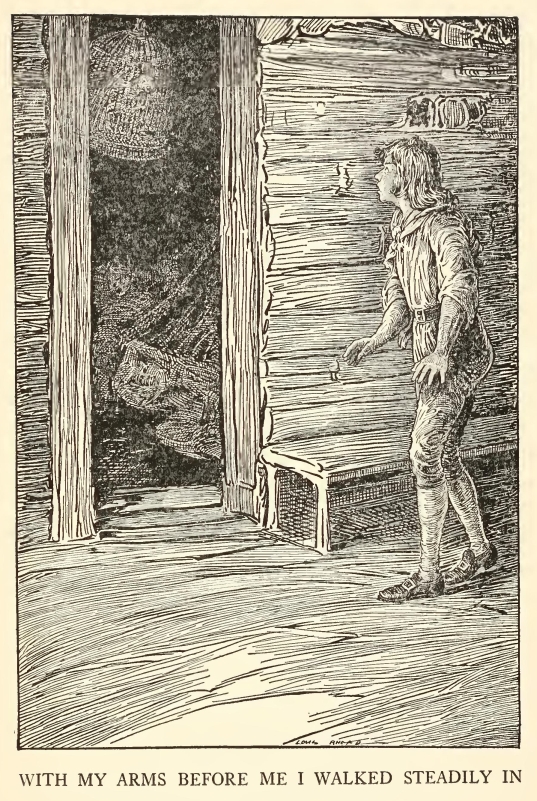
My foot struck something yielding—it was a sleeper’s leg; and he turned andgroaned, but without awaking.
And then, all of a sudden, a shrill voice broke forth out of the darkness:
“Pieces of eight! Pieces of eight! Pieces of eight! Pieces of eight! Pieces ofeight!” and so forth, without pause or change, like the clacking of a tinymill.
Silver’s green parrot, Captain Flint! It was she whom I had heard pecking at apiece of bark; it was she, keeping better watch than any human being, who thusannounced my arrival with her wearisome refrain.
I had no time left me to recover. At the sharp, clipping tone of the parrot,the sleepers awoke and sprang up; and with a mighty oath, the voice of Silvercried, “Who goes?”
I turned to run, struck violently against one person, recoiled, and ran fullinto the arms of a second, who for his part closed upon and held me tight.
“Bring a torch, Dick,” said Silver when my capture was thus assured.
And one of the men left the log-house and presently returned with a lightedbrand.
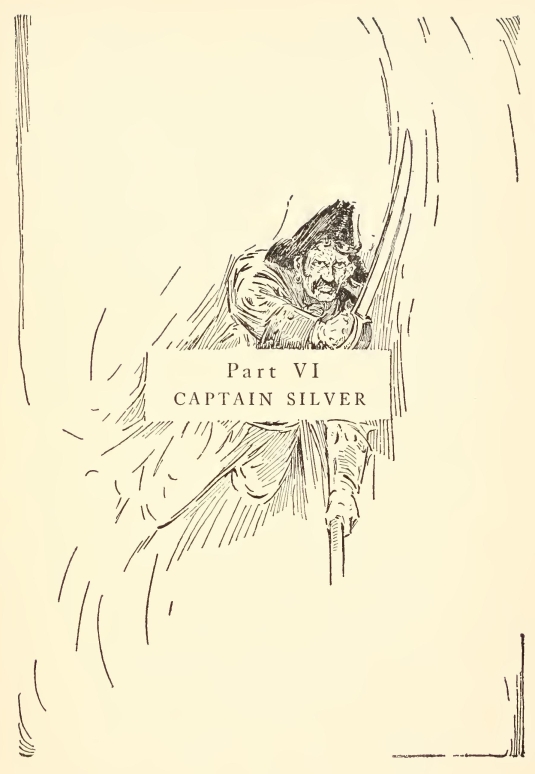
PART SIX—Captain Silver
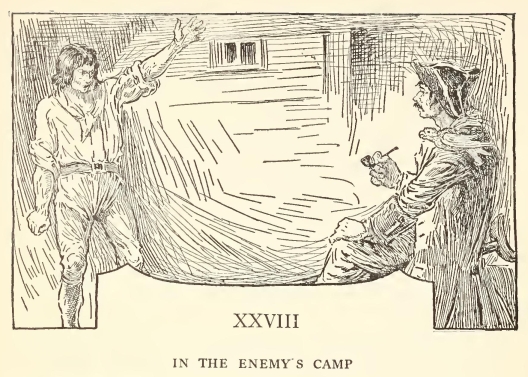
XXVIII
In the Enemy’s Camp
he red glare of the torch, lighting up the interior of the block house, showedme the worst of my apprehensions realized. The pirates were in possession ofthe house and stores: there was the cask of cognac, there were the pork andbread, as before, and what tenfold increased my horror, not a sign of anyprisoner. I could only judge that all had perished, and my heart smote mesorely that I had not been there to perish with them.
There were six of the buccaneers, all told; not another man was left alive.Five of them were on their feet, flushed and swollen, suddenly called out ofthe first sleep of drunkenness. The sixth had only risen upon his elbow; he wasdeadly pale, and the blood-stained bandage round his head told that he hadrecently been wounded, and still more recently dressed. I remembered the manwho had been shot and had run back among the woods in the great attack, anddoubted not that this was he.
The parrot sat, preening her plumage, on Long John’s shoulder. He himself, Ithought, looked somewhat paler and more stern than I was used to. He still worethe fine broadcloth suit in which he had fulfilled his mission, but it wasbitterly the worse for wear, daubed with clay and torn with the sharp briers ofthe wood.
“So,” said he, “here’s Jim Hawkins, shiver my timbers! Dropped in, like, eh?Well, come, I take that friendly.”
And thereupon he sat down across the brandy cask and began to fill a pipe.
“Give me a loan of the link, Dick,” said he; and then, when he had a goodlight, “That’ll do, lad,” he added; “stick the glim in the wood heap; and you,gentlemen, bring yourselves to! You needn’t stand up for Mr. Hawkins;he’llexcuse you, you may lay to that. And so, Jim”—stopping thetobacco—“here you were, and quite a pleasant surprise for poor old John. I seeyou were smart when first I set my eyes on you, but this here gets away from meclean, it do.”
To all this, as may be well supposed, I made no answer. They had set me with myback against the wall, and I stood there, looking Silver in the face, pluckilyenough, I hope, to all outward appearance, but with black despair in my heart.
Silver took a whiff or two of his pipe with great composure and then ran onagain.
“Now, you see, Jim, so be as you arehere,” says he, “I’ll give you apiece of my mind. I’ve always liked you, I have, for a lad of spirit, and thepicter of my own self when I was young and handsome. I always wanted you tojine and take your share, and die a gentleman, and now, my cock, you’ve got to.Cap’n Smollett’s a fine seaman, as I’ll own up to any day, but stiff ondiscipline. ‘Dooty is dooty,’ says he, and right he is. Just you keep clear ofthe cap’n. The doctor himself is gone dead again’ you—‘ungrateful scamp’ waswhat he said; and the short and the long of the whole story is about here: youcan’t go back to your own lot, for they won’t have you; and without you start athird ship’s company all by yourself, which might be lonely, you’ll have tojine with Cap’n Silver.”
So far so good. My friends, then, were still alive, and though I partlybelieved the truth of Silver’s statement, that the cabin party were incensed atme for my desertion, I was more relieved than distressed by what I heard.
“I don’t say nothing as to your being in our hands,” continued Silver, “thoughthere you are, and you may lay to it. I’m all for argyment; I never seen goodcome out o’ threatening. If you like the service, well, you’ll jine; and if youdon’t, Jim, why, you’re free to answer no—free and welcome, shipmate; and iffairer can be said by mortal seaman, shiver my sides!”
“Am I to answer, then?” I asked with a very tremulous voice. Through all thissneering talk, I was made to feel the threat of death that overhung me, and mycheeks burned and my heart beat painfully in my breast.
“Lad,” said Silver, “no one’s a-pressing of you. Take your bearings. None of uswon’t hurry you, mate; time goes so pleasant in your company, you see.”
“Well,” says I, growing a bit bolder, “if I’m to choose, I declare I have aright to know what’s what, and why you’re here, and where my friends are.”
“Wot’s wot?” repeated one of the buccaneers in a deep growl. “Ah, he’d be alucky one as knowed that!”
“You’ll perhaps batten down your hatches till you’re spoke to, my friend,”cried Silver truculently to this speaker. And then, in his first gracioustones, he replied to me, “Yesterday morning, Mr. Hawkins,” said he, “in thedog-watch, down came Doctor Livesey with a flag of truce. Says he, ‘Cap’nSilver, you’re sold out. Ship’s gone.’ Well, maybe we’d been taking a glass,and a song to help it round. I won’t say no. Leastways, none of us had lookedout. We looked out, and by thunder, the old ship was gone! I never seen a packo’ fools look fishier; and you may lay to that, if I tells you that looked thefishiest. ‘Well,’ says the doctor, ‘let’s bargain.’ We bargained, him and I,and here we are: stores, brandy, block house, the firewood you was thoughtfulenough to cut, and in a manner of speaking, the whole blessed boat, fromcross-trees to kelson. As for them, they’ve tramped; I don’t know where’s theyare.”
He drew again quietly at his pipe.
“And lest you should take it into that head of yours,” he went on, “that youwas included in the treaty, here’s the last word that was said: ‘How many areyou,’ says I, ‘to leave?’ ‘Four,’ says he; ‘four, and one of us wounded. As forthat boy, I don’t know where he is, confound him,’ says he, ‘nor I don’t muchcare. We’re about sick of him.’ These was his words.”
“Is that all?” I asked.
“Well, it’s all that you’re to hear, my son,” returned Silver.
“And now I am to choose?”
“And now you are to choose, and you may lay to that,” said Silver.
“Well,” said I, “I am not such a fool but I know pretty well what I have tolook for. Let the worst come to the worst, it’s little I care. I’ve seen toomany die since I fell in with you. But there’s a thing or two I have to tellyou,” I said, and by this time I was quite excited; “and the first is this:here you are, in a bad way—ship lost, treasure lost, men lost, your wholebusiness gone to wreck; and if you want to know who did it—it was I! I was inthe apple barrel the night we sighted land, and I heard you, John, and you,Dick Johnson, and Hands, who is now at the bottom of the sea, and told everyword you said before the hour was out. And as for the schooner, it was I whocut her cable, and it was I that killed the men you had aboard of her, and itwas I who brought her where you’ll never see her more, not one of you. Thelaugh’s on my side; I’ve had the top of this business from the first; I no morefear you than I fear a fly. Kill me, if you please, or spare me. But one thingI’ll say, and no more; if you spare me, bygones are bygones, and when youfellows are in court for piracy, I’ll save you all I can. It is for you tochoose. Kill another and do yourselves no good, or spare me and keep a witnessto save you from the gallows.”
I stopped, for, I tell you, I was out of breath, and to my wonder, not a man ofthem moved, but all sat staring at me like as many sheep. And while they werestill staring, I broke out again, “And now, Mr. Silver,” I said, “I believeyou’re the best man here, and if things go to the worst, I’ll take it kind ofyou to let the doctor know the way I took it.”
“I’ll bear it in mind,” said Silver with an accent so curious that I could not,for the life of me, decide whether he were laughing at my request or had beenfavourably affected by my courage.
“I’ll put one to that,” cried the old mahogany-faced seaman—Morgan by name—whomI had seen in Long John’s public-house upon the quays of Bristol. “It was himthat knowed Black Dog.”
“Well, and see here,” added the sea-cook. “I’ll put another again to that, bythunder! For it was this same boy that faked the chart from Billy Bones. Firstand last, we’ve split upon Jim Hawkins!”
“Then here goes!” said Morgan with an oath.
And he sprang up, drawing his knife as if he had been twenty.
“Avast, there!” cried Silver. “Who are you, Tom Morgan? Maybe you thought youwas cap’n here, perhaps. By the powers, but I’ll teach you better! Cross me,and you’ll go where many a good man’s gone before you, first and last, thesethirty year back—some to the yard-arm, shiver my timbers, and some by theboard, and all to feed the fishes. There’s never a man looked me between theeyes and seen a good day a’terwards, Tom Morgan, you may lay to that.”
Morgan paused, but a hoarse murmur rose from the others.
“Tom’s right,” said one.
“I stood hazing long enough from one,” added another. “I’ll be hanged if I’llbe hazed by you, John Silver.”
“Did any of you gentlemen want to have it out with me?” roared Silver,bending far forward from his position on the keg, with his pipe still glowingin his right hand. “Put a name on what you’re at; you ain’t dumb, I reckon. Himthat wants shall get it. Have I lived this many years, and a son of a rumpuncheon cock his hat athwart my hawse at the latter end of it? You know theway; you’re all gentlemen o’ fortune, by your account. Well, I’m ready. Take acutlass, him that dares, and I’ll see the colour of his inside, crutch and all,before that pipe’s empty.”
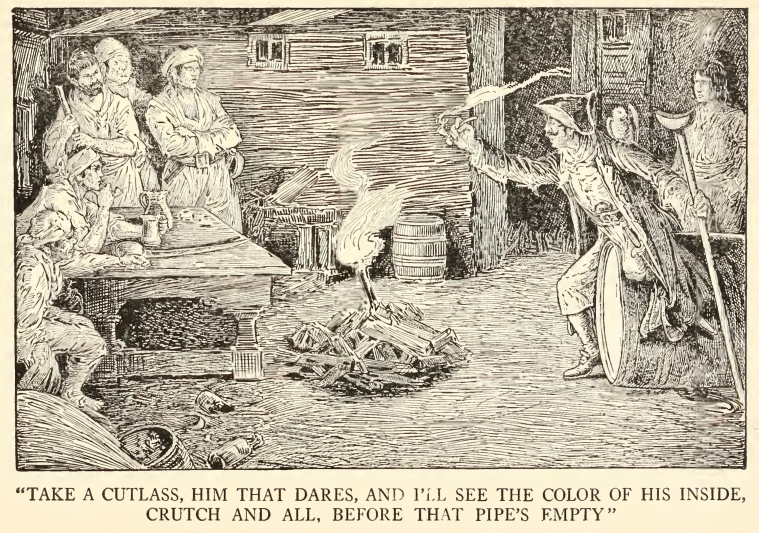
Not a man stirred; not a man answered.
“That’s your sort, is it?” he added, returning his pipe to his mouth. “Well,you’re a gay lot to look at, anyway. Not much worth to fight, you ain’t.P’r’aps you can understand King George’s English. I’m cap’n here by ’lection.I’m cap’n here because I’m the best man by a long sea-mile. You won’t fight, asgentlemen o’ fortune should; then, by thunder, you’ll obey, and you may lay toit! I like that boy, now; I never seen a better boy than that. He’s more a manthan any pair of rats of you in this here house, and what I say is this: let mesee him that’ll lay a hand on him—that’s what I say, and you may lay to it.”
There was a long pause after this. I stood straight up against the wall, myheart still going like a sledge-hammer, but with a ray of hope now shining inmy bosom. Silver leant back against the wall, his arms crossed, his pipe in thecorner of his mouth, as calm as though he had been in church; yet his eye keptwandering furtively, and he kept the tail of it on his unruly followers. They,on their part, drew gradually together towards the far end of the block house,and the low hiss of their whispering sounded in my ear continuously, like astream. One after another, they would look up, and the red light of the torchwould fall for a second on their nervous faces; but it was not towards me, itwas towards Silver that they turned their eyes.
“You seem to have a lot to say,” remarked Silver, spitting far into the air.“Pipe up and let me hear it, or lay to.”
“Ax your pardon, sir,” returned one of the men; “you’re pretty free with someof the rules; maybe you’ll kindly keep an eye upon the rest. This crew’sdissatisfied; this crew don’t vally bullying a marlin-spike; this crew has itsrights like other crews, I’ll make so free as that; and by your own rules, Itake it we can talk together. I ax your pardon, sir, acknowledging you for tobe capting at this present; but I claim my right, and steps outside for acouncil.”
And with an elaborate sea-salute, this fellow, a long, ill-looking, yellow-eyedman of five and thirty, stepped coolly towards the door and disappeared out ofthe house. One after another the rest followed his example, each making asalute as he passed, each adding some apology. “According to rules,” said one.“Forecastle council,” said Morgan. And so with one remark or another allmarched out and left Silver and me alone with the torch.
The sea-cook instantly removed his pipe.
“Now, look you here, Jim Hawkins,” he said in a steady whisper that was no morethan audible, “you’re within half a plank of death, and what’s a long sightworse, of torture. They’re going to throw me off. But, you mark, I stand by youthrough thick and thin. I didn’t mean to; no, not till you spoke up. I wasabout desperate to lose that much blunt, and be hanged into the bargain. But Isee you was the right sort. I says to myself, you stand by Hawkins, John, andHawkins’ll stand by you. You’re his last card, and by the living thunder, John,he’s yours! Back to back, says I. You save your witness, and he’ll save yourneck!”
I began dimly to understand.
“You mean all’s lost?” I asked.
“Aye, by gum, I do!” he answered. “Ship gone, neck gone—that’s the size of it.Once I looked into that bay, Jim Hawkins, and seen no schooner—well, I’m tough,but I gave out. As for that lot and their council, mark me, they’re outrightfools and cowards. I’ll save your life—if so be as I can—from them. But, seehere, Jim—tit for tat—you save Long John from swinging.”
I was bewildered; it seemed a thing so hopeless he was asking—he, the oldbuccaneer, the ringleader throughout.
“What I can do, that I’ll do,” I said.
“It’s a bargain!” cried Long John. “You speak up plucky, and by thunder, I’ve achance!”
He hobbled to the torch, where it stood propped among the firewood, and took afresh light to his pipe.
“Understand me, Jim,” he said, returning. “I’ve a head on my shoulders, I have.I’m on squire’s side now. I know you’ve got that ship safe somewheres. How youdone it, I don’t know, but safe it is. I guess Hands and O’Brien turned soft. Inever much believed in neither of them. Now you mark me. I ask noquestions, nor I won’t let others. I know when a game’s up, I do; and I know alad that’s staunch. Ah, you that’s young—you and me might have done a power ofgood together!”
He drew some cognac from the cask into a tin cannikin.
“Will you taste, messmate?” he asked; and when I had refused: “Well, I’ll takea dram myself, Jim,” said he. “I need a caulker, for there’s trouble on hand.And talking o’ trouble, why did that doctor give me the chart, Jim?”
My face expressed a wonder so unaffected that he saw the needlessness offurther questions.
“Ah, well, he did, though,” said he. “And there’s something under that, nodoubt—something, surely, under that, Jim—bad or good.”
And he took another swallow of the brandy, shaking his great fair head like aman who looks forward to the worst.
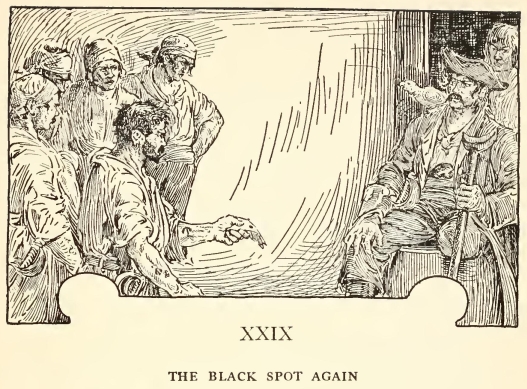
XXIX
The Black Spot Again
he council of buccaneers had lasted some time, when one of them re-entered thehouse, and with a repetition of the same salute, which had in my eyes anironical air, begged for a moment’s loan of the torch. Silver briefly agreed,and this emissary retired again, leaving us together in the dark.
“There’s a breeze coming, Jim,” said Silver, who had by this time adopted quitea friendly and familiar tone.
I turned to the loophole nearest me and looked out. The embers of the greatfire had so far burned themselves out and now glowed so low and duskily that Iunderstood why these conspirators desired a torch. About half-way down theslope to the stockade, they were collected in a group; one held the light,another was on his knees in their midst, and I saw the blade of an open knifeshine in his hand with varying colours in the moon and torchlight. The restwere all somewhat stooping, as though watching the manoeuvres of this last. Icould just make out that he had a book as well as a knife in his hand, and wasstill wondering how anything so incongruous had come in their possession whenthe kneeling figure rose once more to his feet and the whole party began tomove together towards the house.
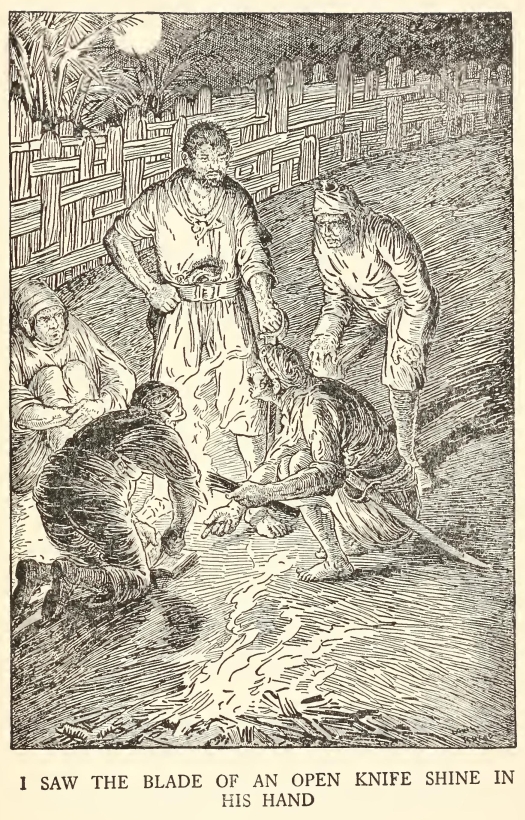
“Here they come,” said I; and I returned to my former position, for it seemedbeneath my dignity that they should find me watching them.
“Well, let ’em come, lad—let ’em come,” said Silver cheerily. “I’ve still ashot in my locker.”
The door opened, and the five men, standing huddled together just inside,pushed one of their number forward. In any other circumstances it would havebeen comical to see his slow advance, hesitating as he set down each foot, butholding his closed right hand in front of him.
“Step up, lad,” cried Silver. “I won’t eat you. Hand it over, lubber. I knowthe rules, I do; I won’t hurt a depytation.”
Thus encouraged, the buccaneer stepped forth more briskly, and having passedsomething to Silver, from hand to hand, slipped yet more smartly back again tohis companions.
The sea-cook looked at what had been given him.
“The black spot! I thought so,” he observed. “Where might you have got thepaper? Why, hillo! Look here, now; this ain’t lucky! You’ve gone and cut thisout of a Bible. What fool’s cut a Bible?”
“Ah, there!” said Morgan. “There! Wot did I say? No good’ll come o’ that, Isaid.”
“Well, you’ve about fixed it now, among you,” continued Silver. “You’ll allswing now, I reckon. What soft-headed lubber had a Bible?”
“It was Dick,” said one.
“Dick, was it? Then Dick can get to prayers,” said Silver. “He’s seen his sliceof luck, has Dick, and you may lay to that.”
But here the long man with the yellow eyes struck in.
“Belay that talk, John Silver,” he said. “This crew has tipped you the blackspot in full council, as in dooty bound; just you turn it over, as in dootybound, and see what’s wrote there. Then you can talk.”
“Thanky, George,” replied the sea-cook. “You always was brisk for business, andhas the rules by heart, George, as I’m pleased to see. Well, what is it,anyway? Ah! ‘Deposed’—that’s it, is it? Very pretty wrote, to be sure; likeprint, I swear. Your hand o’ write, George? Why, you was gettin’ quite aleadin’ man in this here crew. You’ll be cap’n next, I shouldn’t wonder. Justoblige me with that torch again, will you? This pipe don’t draw.”
“Come, now,” said George, “you don’t fool this crew no more. You’re a funnyman, by your account; but you’re over now, and you’ll maybe step down off thatbarrel and help vote.”
“I thought you said you knowed the rules,” returned Silver contemptuously.“Leastways, if you don’t, I do; and I wait here—and I’m still your cap’n,mind—till you outs with your grievances and I reply; in the meantime, yourblack spot ain’t worth a biscuit. After that, we’ll see.”
“Oh,” replied George, “you don’t be under no kind of apprehension; we’reall square, we are. First, you’ve made a hash of this cruise—you’ll be a boldman to say no to that. Second, you let the enemy out o’ this here trap fornothing. Why did they want out? I dunno, but it’s pretty plain they wanted it.Third, you wouldn’t let us go at them upon the march. Oh, we see through you,John Silver; you want to play booty, that’s what’s wrong with you. And then,fourth, there’s this here boy.”
“Is that all?” asked Silver quietly.
“Enough, too,” retorted George. “We’ll all swing and sun-dry for yourbungling.”
“Well now, look here, I’ll answer these four p’ints; one after another I’llanswer ’em. I made a hash o’ this cruise, did I? Well now, you all know what Iwanted, and you all know if that had been done that we’d ’a been aboard theHispaniolathis night as ever was, every man of us alive, and fit, andfull of good plum-duff, and the treasure in the hold of her, by thunder! Well,who crossed me? Who forced my hand, as was the lawful cap’n? Who tipped me theblack spot the day we landed and began this dance? Ah, it’s a fine dance—I’mwith you there—and looks mighty like a hornpipe in a rope’s end at ExecutionDock by London town, it does. But who done it? Why, it was Anderson, and Hands,and you, George Merry! And you’re the last above board of that same meddlingcrew; and you have the Davy Jones’s insolence to up and stand for cap’n overme—you, that sank the lot of us! By the powers! But this tops the stiffest yarnto nothing.”
Silver paused, and I could see by the faces of George and his late comradesthat these words had not been said in vain.
“That’s for number one,” cried the accused, wiping the sweat from his brow, forhe had been talking with a vehemence that shook the house. “Why, I give you myword, I’m sick to speak to you. You’ve neither sense nor memory, and I leave itto fancy where your mothers was that let you come to sea. Sea! Gentlemen o’fortune! I reckon tailors is your trade.”
“Go on, John,” said Morgan. “Speak up to the others.”
“Ah, the others!” returned John. “They’re a nice lot, ain’t they? You say thiscruise is bungled. Ah! By gum, if you could understand how bad it’s bungled,you would see! We’re that near the gibbet that my neck’s stiff with thinking onit. You’ve seen ’em, maybe, hanged in chains, birds about ’em, seamen p’inting’em out as they go down with the tide. ‘Who’s that?’ says one. ‘That! Why,that’s John Silver. I knowed him well,’ says another. And you can hear thechains a-jangle as you go about and reach for the other buoy. Now, that’s aboutwhere we are, every mother’s son of us, thanks to him, and Hands, and Anderson,and other ruination fools of you. And if you want to know about number four,and that boy, why, shiver my timbers, isn’t he a hostage? Are we a-going towaste a hostage? No, not us; he might be our last chance, and I shouldn’twonder. Kill that boy? Not me, mates! And number three? Ah, well, there’s adeal to say to number three. Maybe you don’t count it nothing to have a realcollege doctor to see you every day—you, John, with your head broke—or you,George Merry, that had the ague shakes upon you not six hours agone, and hasyour eyes the colour of lemon peel to this same moment on the clock? And maybe,perhaps, you didn’t know there was a consort coming either? But there is, andnot so long till then; and we’ll see who’ll be glad to have a hostage when itcomes to that. And as for number two, and why I made a bargain—well, you camecrawling on your knees to me to make it—on your knees you came, you was thatdownhearted—and you’d have starved too if I hadn’t—but that’s a trifle! Youlook there—that’s why!”
And he cast down upon the floor a paper that I instantly recognized—none otherthan the chart on yellow paper, with the three red crosses, that I had found inthe oilcloth at the bottom of the captain’s chest. Why the doctor had given itto him was more than I could fancy.
But if it were inexplicable to me, the appearance of the chart was incredibleto the surviving mutineers. They leaped upon it like cats upon a mouse. It wentfrom hand to hand, one tearing it from another; and by the oaths and the criesand the childish laughter with which they accompanied their examination, youwould have thought, not only they were fingering the very gold, but were at seawith it, besides, in safety.
“Yes,” said one, “that’s Flint, sure enough. J. F., and a score below, with aclove hitch to it; so he done ever.”
“Mighty pretty,” said George. “But how are we to get away with it, and us noship.”
Silver suddenly sprang up, and supporting himself with a hand against the wall:“Now I give you warning, George,” he cried. “One more word of your sauce, andI’ll call you down and fight you. How? Why, how do I know? You had ought totell me that—you and the rest, that lost me my schooner, with yourinterference, burn you! But not you, you can’t; you hain’t got the invention ofa cockroach. But civil you can speak, and shall, George Merry, you may lay tothat.”
“That’s fair enow,” said the old man Morgan.
“Fair! I reckon so,” said the sea-cook. “You lost the ship; I found thetreasure. Who’s the better man at that? And now I resign, by thunder! Electwhom you please to be your cap’n now; I’m done with it.”
“Silver!” they cried. “Barbecue forever! Barbecue for cap’n!”
“So that’s the toon, is it?” cried the cook. “George, I reckon you’ll have towait another turn, friend; and lucky for you as I’m not a revengeful man. Butthat was never my way. And now, shipmates, this black spot? ’Tain’t much goodnow, is it? Dick’s crossed his luck and spoiled his Bible, and that’s aboutall.”
“It’ll do to kiss the book on still, won’t it?” growled Dick, who was evidentlyuneasy at the curse he had brought upon himself.
“A Bible with a bit cut out!” returned Silver derisively. “Not it. It don’tbind no more’n a ballad-book.”
“Don’t it, though?” cried Dick with a sort of joy. “Well, I reckon that’s worthhaving too.”
“Here, Jim—here’s a cur’osity for you,” said Silver, and he tossed me thepaper.
It was around about the size of a crown piece. One side was blank, for it hadbeen the last leaf; the other contained a verse or two of Revelation—thesewords among the rest, which struck sharply home upon my mind: “Without are dogsand murderers.” The printed side had been blackened with wood ash, whichalready began to come off and soil my fingers; on the blank side had beenwritten with the same material the one word “Depposed.” I have that curiositybeside me at this moment, but not a trace of writing now remains beyond asingle scratch, such as a man might make with his thumb-nail.
That was the end of the night’s business. Soon after, with a drink all round,we lay down to sleep, and the outside of Silver’s vengeance was to put GeorgeMerry up for sentinel and threaten him with death if he should proveunfaithful.
It was long ere I could close an eye, and heaven knows I had matter enough forthought in the man whom I had slain that afternoon, in my own most perilousposition, and above all, in the remarkable game that I saw Silver now engagedupon—keeping the mutineers together with one hand and grasping with the otherafter every means, possible and impossible, to make his peace and save hismiserable life. He himself slept peacefully and snored aloud, yet my heart wassore for him, wicked as he was, to think on the dark perils that environed andthe shameful gibbet that awaited him.
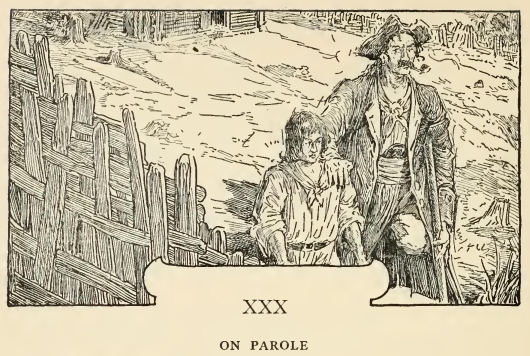
XXX
On Parole
was wakened—indeed, we were all wakened, for I could see even the sentinelshake himself together from where he had fallen against the door-post—by aclear, hearty voice hailing us from the margin of the wood:
“Block house, ahoy!” it cried. “Here’s the doctor.”
And the doctor it was. Although I was glad to hear the sound, yet my gladnesswas not without admixture. I remembered with confusion my insubordinate andstealthy conduct, and when I saw where it had brought me—among what companionsand surrounded by what dangers—I felt ashamed to look him in the face.
He must have risen in the dark, for the day had hardly come; and when I ran toa loophole and looked out, I saw him standing, like Silver once before, up tothe mid-leg in creeping vapour.
“You, doctor! Top o’ the morning to you, sir!” cried Silver, broad awake andbeaming with good nature in a moment. “Bright and early, to be sure; and it’sthe early bird, as the saying goes, that gets the rations. George, shake upyour timbers, son, and help Dr. Livesey over the ship’s side. All a-doin’ well,your patients was—all well and merry.”
So he pattered on, standing on the hilltop with his crutch under his elbow andone hand upon the side of the log-house—quite the old John in voice, manner,and expression.
“We’ve quite a surprise for you too, sir,” he continued. “We’ve a littlestranger here—he! he! A noo boarder and lodger, sir, and looking fit and tautas a fiddle; slep’ like a supercargo, he did, right alongside of John—stem tostem we was, all night.”
Dr. Livesey was by this time across the stockade and pretty near the cook, andI could hear the alteration in his voice as he said, “Not Jim?”
“The very same Jim as ever was,” says Silver.
The doctor stopped outright, although he did not speak, and it was some secondsbefore he seemed able to move on.
“Well, well,” he said at last, “duty first and pleasure afterwards, as youmight have said yourself, Silver. Let us overhaul these patients of yours.”
A moment afterwards he had entered the block house and with one grim nod to meproceeded with his work among the sick. He seemed under no apprehension, thoughhe must have known that his life, among these treacherous demons, depended on ahair; and he rattled on to his patients as if he were paying an ordinaryprofessional visit in a quiet English family. His manner, I suppose, reacted onthe men, for they behaved to him as if nothing had occurred, as if he werestill ship’s doctor and they still faithful hands before the mast.
“You’re doing well, my friend,” he said to the fellow with the bandaged head,“and if ever any person had a close shave, it was you; your head must be ashard as iron. Well, George, how goes it? You’re a pretty colour, certainly;why, your liver, man, is upside down. Did you take that medicine? Did he takethat medicine, men?”
“Aye, aye, sir, he took it, sure enough,” returned Morgan.
“Because, you see, since I am mutineers’ doctor, or prison doctor as I preferto call it,” says Doctor Livesey in his pleasantest way, “I make it a point ofhonour not to lose a man for King George (God bless him!) and the gallows.”
The rogues looked at each other but swallowed the home-thrust in silence.
“Dick don’t feel well, sir,” said one.
“Don’t he?” replied the doctor. “Well, step up here, Dick, and let me see yourtongue. No, I should be surprised if he did! The man’s tongue is fit tofrighten the French. Another fever.”
“Ah, there,” said Morgan, “that comed of sp’iling Bibles.”
“That comes—as you call it—of being arrant asses,” retorted the doctor, “andnot having sense enough to know honest air from poison, and the dry land from avile, pestiferous slough. I think it most probable—though of course it’s onlyan opinion—that you’ll all have the deuce to pay before you get that malariaout of your systems. Camp in a bog, would you? Silver, I’m surprised at you.You’re less of a fool than many, take you all round; but you don’t appear to meto have the rudiments of a notion of the rules of health.
“Well,” he added after he had dosed them round and they had taken hisprescriptions, with really laughable humility, more like charity schoolchildrenthan blood-guilty mutineers and pirates—“well, that’s done for today. And now Ishould wish to have a talk with that boy, please.”
And he nodded his head in my direction carelessly.
George Merry was at the door, spitting and spluttering over some bad-tastedmedicine; but at the first word of the doctor’s proposal he swung round with adeep flush and cried “No!” and swore.
Silver struck the barrel with his open hand.
“Si-lence!” he roared and looked about him positively like a lion. “Doctor,” hewent on in his usual tones, “I was a-thinking of that, knowing as how you had afancy for the boy. We’re all humbly grateful for your kindness, and as you see,puts faith in you and takes the drugs down like that much grog. And I take itI’ve found a way as’ll suit all. Hawkins, will you give me your word of honouras a young gentleman—for a young gentleman you are, although poor born—yourword of honour not to slip your cable?”
I readily gave the pledge required.
“Then, doctor,” said Silver, “you just step outside o’ that stockade, and onceyou’re there I’ll bring the boy down on the inside, and I reckon you can yarnthrough the spars. Good day to you, sir, and all our dooties to the squire andCap’n Smollett.”
The explosion of disapproval, which nothing but Silver’s black looks hadrestrained, broke out immediately the doctor had left the house. Silver wasroundly accused of playing double—of trying to make a separate peace forhimself, of sacrificing the interests of his accomplices and victims, and, inone word, of the identical, exact thing that he was doing. It seemed to me soobvious, in this case, that I could not imagine how he was to turn their anger.But he was twice the man the rest were, and his last night’s victory had givenhim a huge preponderance on their minds. He called them all the fools and doltsyou can imagine, said it was necessary I should talk to the doctor, flutteredthe chart in their faces, asked them if they could afford to break the treatythe very day they were bound a-treasure-hunting.
“No, by thunder!” he cried. “It’s us must break the treaty when the time comes;and till then I’ll gammon that doctor, if I have to ile his boots with brandy.”
And then he bade them get the fire lit, and stalked out upon his crutch, withhis hand on my shoulder, leaving them in a disarray, and silenced by hisvolubility rather than convinced.
“Slow, lad, slow,” he said. “They might round upon us in a twinkle of an eye ifwe was seen to hurry.”
Very deliberately, then, did we advance across the sand to where the doctorawaited us on the other side of the stockade, and as soon as we were withineasy speaking distance Silver stopped.
“You’ll make a note of this here also, doctor,” says he, “and the boy’ll tellyou how I saved his life, and were deposed for it too, and you may lay to that.Doctor, when a man’s steering as near the wind as me—playing chuck-farthingwith the last breath in his body, like—you wouldn’t think it too much, mayhap,to give him one good word? You’ll please bear in mind it’s not my life onlynow—it’s that boy’s into the bargain; and you’ll speak me fair, doctor, andgive me a bit o’ hope to go on, for the sake of mercy.”
Silver was a changed man once he was out there and had his back to his friendsand the block house; his cheeks seemed to have fallen in, his voice trembled;never was a soul more dead in earnest.
“Why, John, you’re not afraid?” asked Dr. Livesey.
“Doctor, I’m no coward; no, not I—not somuch!” and he snapped hisfingers. “If I was I wouldn’t say it. But I’ll own up fairly, I’ve the shakesupon me for the gallows. You’re a good man and a true; I never seen a betterman! And you’ll not forget what I done good, not any more than you’ll forgetthe bad, I know. And I step aside—see here—and leave you and Jim alone. Andyou’ll put that down for me too, for it’s a long stretch, is that!”
So saying, he stepped back a little way, till he was out of earshot, and theresat down upon a tree-stump and began to whistle, spinning round now and againupon his seat so as to command a sight, sometimes of me and the doctor andsometimes of his unruly ruffians as they went to and fro in the sand betweenthe fire—which they were busy rekindling—and the house, from which they broughtforth pork and bread to make the breakfast.
“So, Jim,” said the doctor sadly, “here you are. As you have brewed, so shallyou drink, my boy. Heaven knows, I cannot find it in my heart to blame you, butthis much I will say, be it kind or unkind: when Captain Smollett was well, youdared not have gone off; and when he was ill and couldn’t help it, by George,it was downright cowardly!”
I will own that I here began to weep. “Doctor,” I said, “you might spare me. Ihave blamed myself enough; my life’s forfeit anyway, and I should have beendead by now if Silver hadn’t stood for me; and doctor, believe this, I candie—and I dare say I deserve it—but what I fear is torture. If they come totorture me—”
“Jim,” the doctor interrupted, and his voice was quite changed, “Jim, I can’thave this. Whip over, and we’ll run for it.”
“Doctor,” said I, “I passed my word.”
“I know, I know,” he cried. “We can’t help that, Jim, now. I’ll take it on myshoulders, holus bolus, blame and shame, my boy; but stay here, I cannot letyou. Jump! One jump, and you’re out, and we’ll run for it like antelopes.”
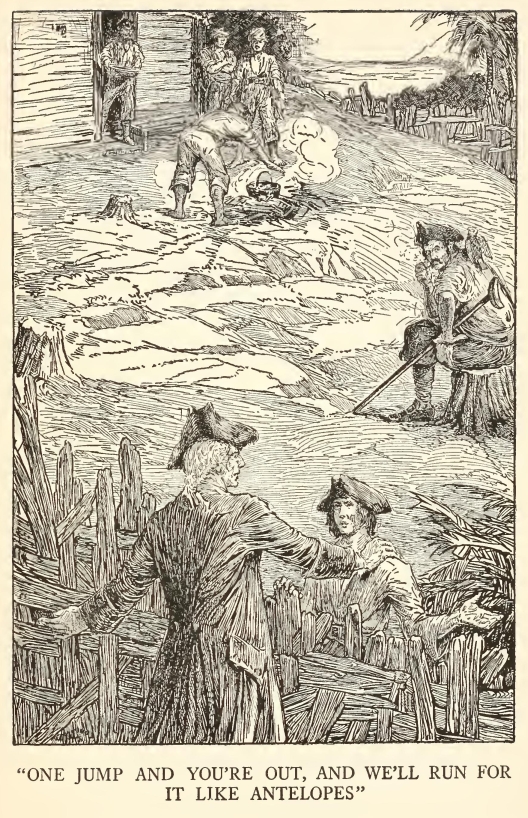
“No,” I replied; “you know right well you wouldn’t do the thingyourself—neither you nor squire nor captain; and no more will I. Silver trustedme; I passed my word, and back I go. But, doctor, you did not let me finish. Ifthey come to torture me, I might let slip a word of where the ship is, for Igot the ship, part by luck and part by risking, and she lies in North Inlet, onthe southern beach, and just below high water. At half tide she must be highand dry.”
“The ship!” exclaimed the doctor.
Rapidly I described to him my adventures, and he heard me out in silence.
“There is a kind of fate in this,” he observed when I had done. “Every step,it’s you that saves our lives; and do you suppose by any chance that we aregoing to let you lose yours? That would be a poor return, my boy. You found outthe plot; you found Ben Gunn—the best deed that ever you did, or will do,though you live to ninety. Oh, by Jupiter, and talking of Ben Gunn! Why, thisis the mischief in person. Silver!” he cried. “Silver! I’ll give you a piece ofadvice,” he continued as the cook drew near again; “don’t you be in any greathurry after that treasure.”
“Why, sir, I do my possible, which that ain’t,” said Silver. “I can only,asking your pardon, save my life and the boy’s by seeking for that treasure;and you may lay to that.”
“Well, Silver,” replied the doctor, “if that is so, I’ll go one step further:look out for squalls when you find it.”
“Sir,” said Silver, “as between man and man, that’s too much and too little.What you’re after, why you left the block house, why you given me that therechart, I don’t know, now, do I? And yet I done your bidding with my eyes shutand never a word of hope! But no, this here’s too much. If you won’t tell mewhat you mean plain out, just say so and I’ll leave the helm.”
“No,” said the doctor musingly; “I’ve no right to say more; it’s not my secret,you see, Silver, or, I give you my word, I’d tell it you. But I’ll go as farwith you as I dare go, and a step beyond, for I’ll have my wig sorted by thecaptain or I’m mistaken! And first, I’ll give you a bit of hope; Silver, if weboth get alive out of this wolf-trap, I’ll do my best to save you, short ofperjury.”
Silver’s face was radiant. “You couldn’t say more, I’m sure, sir, not if youwas my mother,” he cried.
“Well, that’s my first concession,” added the doctor. “My second is a piece ofadvice: keep the boy close beside you, and when you need help, halloo. I’m offto seek it for you, and that itself will show you if I speak at random.Good-bye, Jim.”
And Dr. Livesey shook hands with me through the stockade, nodded to Silver, andset off at a brisk pace into the wood.
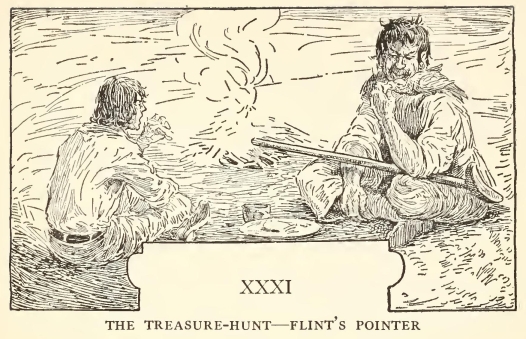
XXXI
The Treasure-hunt—Flint’s Pointer
im,” said Silver when we were alone, “if I saved your life, you saved mine; andI’ll not forget it. I seen the doctor waving you to run for it—with the tail ofmy eye, I did; and I seen you say no, as plain as hearing. Jim, that’s one toyou. This is the first glint of hope I had since the attack failed, and I oweit you. And now, Jim, we’re to go in for this here treasure-hunting, withsealed orders too, and I don’t like it; and you and me must stick close, backto back like, and we’ll save our necks in spite o’ fate and fortune.”
Just then a man hailed us from the fire that breakfast was ready, and we weresoon seated here and there about the sand over biscuit and fried junk. They hadlit a fire fit to roast an ox, and it was now grown so hot that they could onlyapproach it from the windward, and even there not without precaution. In thesame wasteful spirit, they had cooked, I suppose, three times more than wecould eat; and one of them, with an empty laugh, threw what was left into thefire, which blazed and roared again over this unusual fuel. I never in my lifesaw men so careless of the morrow; hand to mouth is the only word that candescribe their way of doing; and what with wasted food and sleeping sentries,though they were bold enough for a brush and be done with it, I could see theirentire unfitness for anything like a prolonged campaign.
Even Silver, eating away, with Captain Flint upon his shoulder, had not a wordof blame for their recklessness. And this the more surprised me, for I thoughthe had never shown himself so cunning as he did then.
“Aye, mates,” said he, “it’s lucky you have Barbecue to think for you with thishere head. I got what I wanted, I did. Sure enough, they have the ship. Wherethey have it, I don’t know yet; but once we hit the treasure, we’ll have tojump about and find out. And then, mates, us that has the boats, I reckon, hasthe upper hand.”
Thus he kept running on, with his mouth full of the hot bacon; thus he restoredtheir hope and confidence, and, I more than suspect, repaired his own at thesame time.
“As for hostage,” he continued, “that’s his last talk, I guess, with them heloves so dear. I’ve got my piece o’ news, and thanky to him for that; but it’sover and done. I’ll take him in a line when we go treasure-hunting, for we’llkeep him like so much gold, in case of accidents, you mark, and in themeantime. Once we got the ship and treasure both and off to sea like jollycompanions, why then we’ll talk Mr. Hawkins over, we will, and we’ll give himhis share, to be sure, for all his kindness.”
It was no wonder the men were in a good humour now. For my part, I was horriblycast down. Should the scheme he had now sketched prove feasible, Silver,already doubly a traitor, would not hesitate to adopt it. He had still a footin either camp, and there was no doubt he would prefer wealth and freedom withthe pirates to a bare escape from hanging, which was the best he had to hope onour side.
Nay, and even if things so fell out that he was forced to keep his faith withDr. Livesey, even then what danger lay before us! What a moment that would bewhen the suspicions of his followers turned to certainty and he and I shouldhave to fight for dear life—he a cripple and I a boy—against five strong andactive seamen!
Add to this double apprehension the mystery that still hung over the behaviourof my friends, their unexplained desertion of the stockade, their inexplicablecession of the chart, or harder still to understand, the doctor’s last warningto Silver, “Look out for squalls when you find it,” and you will readilybelieve how little taste I found in my breakfast and with how uneasy a heart Iset forth behind my captors on the quest for treasure.
We made a curious figure, had anyone been there to see us—all in soiled sailorclothes and all but me armed to the teeth. Silver had two guns slung abouthim—one before and one behind—besides the great cutlass at his waist and apistol in each pocket of his square-tailed coat. To complete his strangeappearance, Captain Flint sat perched upon his shoulder and gabbling odds andends of purposeless sea-talk. I had a line about my waist and followedobediently after the sea-cook, who held the loose end of the rope, now in hisfree hand, now between his powerful teeth. For all the world, I was led like adancing bear.
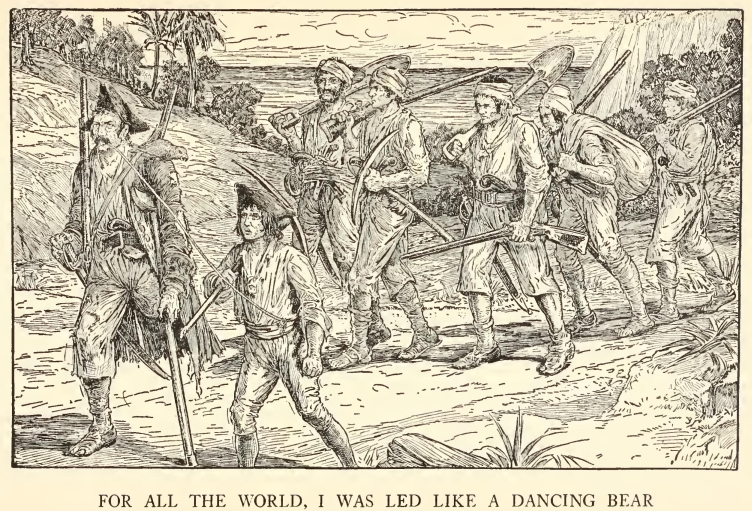
The other men were variously burthened, some carrying picks and shovels—forthat had been the very first necessary they brought ashore from theHispaniola—others laden with pork, bread, and brandy for the middaymeal. All the stores, I observed, came from our stock, and I could see thetruth of Silver’s words the night before. Had he not struck a bargain with thedoctor, he and his mutineers, deserted by the ship, must have been driven tosubsist on clear water and the proceeds of their hunting. Water would have beenlittle to their taste; a sailor is not usually a good shot; and besides allthat, when they were so short of eatables, it was not likely they would be veryflush of powder.
Well, thus equipped, we all set out—even the fellow with the broken head, whoshould certainly have kept in shadow—and straggled, one after another, to thebeach, where the two gigs awaited us. Even these bore trace of the drunkenfolly of the pirates, one in a broken thwart, and both in their muddy andunbailed condition. Both were to be carried along with us for the sake ofsafety; and so, with our numbers divided between them, we set forth upon thebosom of the anchorage.
As we pulled over, there was some discussion on the chart. The red cross was,of course, far too large to be a guide; and the terms of the note on the back,as you will hear, admitted of some ambiguity. They ran, the reader mayremember, thus:
Tall tree, Spy-glass shoulder, bearing a point to the N. of N.N.E.
Skeleton Island E.S.E. and by E.
Ten feet.
A tall tree was thus the principal mark. Now, right before us the anchorage wasbounded by a plateau from two to three hundred feet high, adjoining on thenorth the sloping southern shoulder of the Spy-glass and rising again towardsthe south into the rough, cliffy eminence called the Mizzenmast Hill. The topof the plateau was dotted thickly with pine-trees of varying height. Every hereand there, one of a different species rose forty or fifty feet clear above itsneighbours, and which of these was the particular “tall tree” of Captain Flintcould only be decided on the spot, and by the readings of the compass.
Yet, although that was the case, every man on board the boats had picked afavourite of his own ere we were half-way over, Long John alone shrugging hisshoulders and bidding them wait till they were there.
We pulled easily, by Silver’s directions, not to weary the hands prematurely,and after quite a long passage, landed at the mouth of the second river—thatwhich runs down a woody cleft of the Spy-glass. Thence, bending to our left, webegan to ascend the slope towards the plateau.
At the first outset, heavy, miry ground and a matted, marish vegetation greatlydelayed our progress; but by little and little the hill began to steepen andbecome stony under foot, and the wood to change its character and to grow in amore open order. It was, indeed, a most pleasant portion of the island that wewere now approaching. A heavy-scented broom and many flowering shrubs hadalmost taken the place of grass. Thickets of green nutmeg-trees were dottedhere and there with the red columns and the broad shadow of the pines; and thefirst mingled their spice with the aroma of the others. The air, besides, wasfresh and stirring, and this, under the sheer sunbeams, was a wonderfulrefreshment to our senses.
The party spread itself abroad, in a fan shape, shouting and leaping to andfro. About the centre, and a good way behind the rest, Silver and I followed—Itethered by my rope, he ploughing, with deep pants, among the sliding gravel.From time to time, indeed, I had to lend him a hand, or he must have missed hisfooting and fallen backward down the hill.
We had thus proceeded for about half a mile and were approaching the brow ofthe plateau when the man upon the farthest left began to cry aloud, as if interror. Shout after shout came from him, and the others began to run in hisdirection.
“He can’t ’a found the treasure,” said old Morgan, hurrying past us from theright, “for that’s clean a-top.”
Indeed, as we found when we also reached the spot, it was something verydifferent. At the foot of a pretty big pine and involved in a green creeper,which had even partly lifted some of the smaller bones, a human skeleton lay,with a few shreds of clothing, on the ground. I believe a chill struck for amoment to every heart.
“He was a seaman,” said George Merry, who, bolder than the rest, had gone upclose and was examining the rags of clothing. “Leastways, this is goodsea-cloth.”
“Aye, aye,” said Silver; “like enough; you wouldn’t look to find a bishop here,I reckon. But what sort of a way is that for bones to lie? ’Tain’t in natur’.”
Indeed, on a second glance, it seemed impossible to fancy that the body was ina natural position. But for some disarray (the work, perhaps, of the birds thathad fed upon him or of the slow-growing creeper that had gradually envelopedhis remains) the man lay perfectly straight—his feet pointing in one direction,his hands, raised above his head like a diver’s, pointing directly in theopposite.
“I’ve taken a notion into my old numbskull,” observed Silver. “Here’s thecompass; there’s the tip-top p’int o’ Skeleton Island, stickin’ out like atooth. Just take a bearing, will you, along the line of them bones.”
It was done. The body pointed straight in the direction of the island, and thecompass read duly E.S.E. and by E.
“I thought so,” cried the cook; “this here is a p’inter. Right up there is ourline for the Pole Star and the jolly dollars. But, by thunder! If it don’t makeme cold inside to think of Flint. This is one of hisjokes, and nomistake. Him and these six was alone here; he killed ’em, every man; and thisone he hauled here and laid down by compass, shiver my timbers! They’re longbones, and the hair’s been yellow. Aye, that would be Allardyce. You mindAllardyce, Tom Morgan?”
“Aye, aye,” returned Morgan; “I mind him; he owed me money, he did, and took myknife ashore with him.”
“Speaking of knives,” said another, “why don’t we find his’n lying round? Flintwarn’t the man to pick a seaman’s pocket; and the birds, I guess, would leaveit be.”
“By the powers, and that’s true!” cried Silver.
“There ain’t a thing left here,” said Merry, still feeling round among thebones; “not a copper doit nor a baccy box. It don’t look nat’ral to me.”
“No, by gum, it don’t,” agreed Silver; “not nat’ral, nor not nice, says you.Great guns! Messmates, but if Flint was living, this would be a hot spot foryou and me. Six they were, and six are we; and bones is what they are now.”
“I saw him dead with these here deadlights,” said Morgan. “Billy took me in.There he laid, with penny-pieces on his eyes.”
“Dead—aye, sure enough he’s dead and gone below,” said the fellow with thebandage; “but if ever sperrit walked, it would be Flint’s. Dear heart, but hedied bad, did Flint!”
“Aye, that he did,” observed another; “now he raged, and now he hollered forthe rum, and now he sang. ‘Fifteen Men’ were his only song, mates; and I tellyou true, I never rightly liked to hear it since. It was main hot, and thewindy was open, and I hear that old song comin’ out as clear as clear—and thedeath-haul on the man already.”
“Come, come,” said Silver; “stow this talk. He’s dead, and he don’t walk, thatI know; leastways, he won’t walk by day, and you may lay to that. Care killed acat. Fetch ahead for the doubloons.”
We started, certainly; but in spite of the hot sun and the staring daylight,the pirates no longer ran separate and shouting through the wood, but kept sideby side and spoke with bated breath. The terror of the dead buccaneer hadfallen on their spirits.
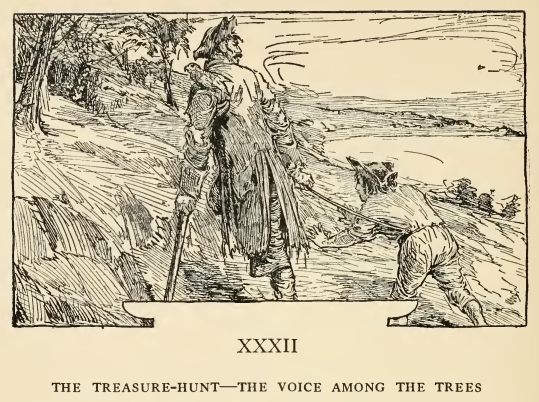
XXXII
The Treasure-hunt—The Voice Among the Trees

artly from the damping influence of this alarm, partly to rest Silver and thesick folk, the whole party sat down as soon as they had gained the brow of theascent.
The plateau being somewhat tilted towards the west, this spot on which we hadpaused commanded a wide prospect on either hand. Before us, over the tree-tops,we beheld the Cape of the Woods fringed with surf; behind, we not only lookeddown upon the anchorage and Skeleton Island, but saw—clear across the spit andthe eastern lowlands—a great field of open sea upon the east. Sheer above usrose the Spy-glass, here dotted with single pines, there black with precipices.There was no sound but that of the distant breakers, mounting from all round,and the chirp of countless insects in the brush. Not a man, not a sail, uponthe sea; the very largeness of the view increased the sense of solitude.
Silver, as he sat, took certain bearings with his compass.
“There are three ‘tall trees,’” said he, “about in the right line from SkeletonIsland. ‘Spy-glass shoulder,’ I take it, means that lower p’int there. It’schild’s play to find the stuff now. I’ve half a mind to dine first.”
“I don’t feel sharp,” growled Morgan. “Thinkin’ o’ Flint—I think it were—asdone me.”
“Ah, well, my son, you praise your stars he’s dead,” said Silver.
“He were an ugly devil,” cried a third pirate with a shudder; “that blue in theface too!”
“That was how the rum took him,” added Merry. “Blue! Well, I reckon he wasblue. That’s a true word.”
Ever since they had found the skeleton and got upon this train of thought, theyhad spoken lower and lower, and they had almost got to whispering by now, sothat the sound of their talk hardly interrupted the silence of the wood. All ofa sudden, out of the middle of the trees in front of us, a thin, high,trembling voice struck up the well-known air and words:
“Fifteen men on the dead man’s chest—
Yo-ho-ho, and a bottle of rum!”
I never have seen men more dreadfully affected than the pirates. The colourwent from their six faces like enchantment; some leaped to their feet, someclawed hold of others; Morgan grovelled on the ground.
“It’s Flint, by ——!” cried Merry.
The song had stopped as suddenly as it began—broken off, you would have said,in the middle of a note, as though someone had laid his hand upon the singer’smouth. Coming through the clear, sunny atmosphere among the green tree-tops, Ithought it had sounded airily and sweetly; and the effect on my companions wasthe stranger.
“Come,” said Silver, struggling with his ashen lips to get the word out; “thiswon’t do. Stand by to go about. This is a rum start, and I can’t name thevoice, but it’s someone skylarking—someone that’s flesh and blood, and you maylay to that.”
His courage had come back as he spoke, and some of the colour to his face alongwith it. Already the others had begun to lend an ear to this encouragement andwere coming a little to themselves, when the same voice broke out again—notthis time singing, but in a faint distant hail that echoed yet fainter amongthe clefts of the Spy-glass.
“Darby M’Graw,” it wailed—for that is the word that best describes thesound—“Darby M’Graw! Darby M’Graw!” again and again and again; and then risinga little higher, and with an oath that I leave out: “Fetch aft the rum, Darby!”
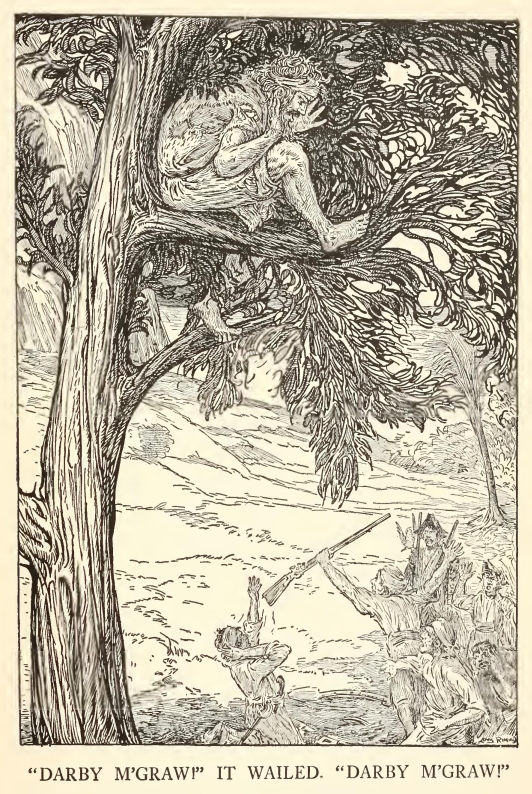
The buccaneers remained rooted to the ground, their eyes starting from theirheads. Long after the voice had died away they still stared in silence,dreadfully, before them.
“That fixes it!” gasped one. “Let’s go.”
“They was his last words,” moaned Morgan, “his last words above board.”
Dick had his Bible out and was praying volubly. He had been well brought up,had Dick, before he came to sea and fell among bad companions.
Still Silver was unconquered. I could hear his teeth rattle in his head, but hehad not yet surrendered.
“Nobody in this here island ever heard of Darby,” he muttered; “not one but usthat’s here.” And then, making a great effort: “Shipmates,” he cried, “I’m hereto get that stuff, and I’ll not be beat by man or devil. I never was feared ofFlint in his life, and, by the powers, I’ll face him dead. There’s sevenhundred thousand pound not a quarter of a mile from here. When did ever agentleman o’ fortune show his stern to that much dollars for a boozy old seamanwith a blue mug—and him dead too?”
But there was no sign of reawakening courage in his followers, rather, indeed,of growing terror at the irreverence of his words.
“Belay there, John!” said Merry. “Don’t you cross a sperrit.”
And the rest were all too terrified to reply. They would have run awayseverally had they dared; but fear kept them together, and kept them close byJohn, as if his daring helped them. He, on his part, had pretty well fought hisweakness down.
“Sperrit? Well, maybe,” he said. “But there’s one thing not clear to me. Therewas an echo. Now, no man ever seen a sperrit with a shadow; well then, what’she doing with an echo to him, I should like to know? That ain’t in natur’,surely?”
This argument seemed weak enough to me. But you can never tell what will affectthe superstitious, and to my wonder, George Merry was greatly relieved.
“Well, that’s so,” he said. “You’ve a head upon your shoulders, John, and nomistake. ’Bout ship, mates! This here crew is on a wrong tack, I do believe.And come to think on it, it was like Flint’s voice, I grant you, but not justso clear-away like it, after all. It was liker somebody else’s voice now—it wasliker—”
“By the powers, Ben Gunn!” roared Silver.
“Aye, and so it were,” cried Morgan, springing on his knees. “Ben Gunn itwere!”
“It don’t make much odds, do it, now?” asked Dick. “Ben Gunn’s not here in thebody any more’n Flint.”
But the older hands greeted this remark with scorn.
“Why, nobody minds Ben Gunn,” cried Merry; “dead or alive, nobody minds him.”
It was extraordinary how their spirits had returned and how the natural colourhad revived in their faces. Soon they were chatting together, with intervals oflistening; and not long after, hearing no further sound, they shouldered thetools and set forth again, Merry walking first with Silver’s compass to keepthem on the right line with Skeleton Island. He had said the truth: dead oralive, nobody minded Ben Gunn.
Dick alone still held his Bible, and looked around him as he went, with fearfulglances; but he found no sympathy, and Silver even joked him on hisprecautions.
“I told you,” said he—“I told you you had sp’iled your Bible. If it ain’t nogood to swear by, what do you suppose a sperrit would give for it? Not that!”and he snapped his big fingers, halting a moment on his crutch.
But Dick was not to be comforted; indeed, it was soon plain to me that the ladwas falling sick; hastened by heat, exhaustion, and the shock of his alarm, thefever, predicted by Dr. Livesey, was evidently growing swiftly higher.
It was fine open walking here, upon the summit; our way lay a little downhill,for, as I have said, the plateau tilted towards the west. The pines, great andsmall, grew wide apart; and even between the clumps of nutmeg and azalea, wideopen spaces baked in the hot sunshine. Striking, as we did, pretty nearnorth-west across the island, we drew, on the one hand, ever nearer under theshoulders of the Spy-glass, and on the other, looked ever wider over thatwestern bay where I had once tossed and trembled in the coracle.
The first of the tall trees was reached, and by the bearings proved the wrongone. So with the second. The third rose nearly two hundred feet into the airabove a clump of underwood—a giant of a vegetable, with a red column as big asa cottage, and a wide shadow around in which a company could have manoeuvred.It was conspicuous far to sea both on the east and west and might have beenentered as a sailing mark upon the chart.
But it was not its size that now impressed my companions; it was the knowledgethat seven hundred thousand pounds in gold lay somewhere buried below itsspreading shadow. The thought of the money, as they drew nearer, swallowed uptheir previous terrors. Their eyes burned in their heads; their feet grewspeedier and lighter; their whole soul was bound up in that fortune, that wholelifetime of extravagance and pleasure, that lay waiting there for each of them.
Silver hobbled, grunting, on his crutch; his nostrils stood out and quivered;he cursed like a madman when the flies settled on his hot and shinycountenance; he plucked furiously at the line that held me to him and from timeto time turned his eyes upon me with a deadly look. Certainly he took no painsto hide his thoughts, and certainly I read them like print. In the immediatenearness of the gold, all else had been forgotten: his promise and the doctor’swarning were both things of the past, and I could not doubt that he hoped toseize upon the treasure, find and board the Hispaniolaunder cover ofnight, cut every honest throat about that island, and sail away as he had atfirst intended, laden with crimes and riches.
Shaken as I was with these alarms, it was hard for me to keep up with the rapidpace of the treasure-hunters. Now and again I stumbled, and it was then thatSilver plucked so roughly at the rope and launched at me his murderous glances.Dick, who had dropped behind us and now brought up the rear, was babbling tohimself both prayers and curses as his fever kept rising. This also added to mywretchedness, and to crown all, I was haunted by the thought of the tragedythat had once been acted on that plateau, when that ungodly buccaneer with theblue face—he who died at Savannah, singing and shouting for drink—had there,with his own hand, cut down his six accomplices. This grove that was now sopeaceful must then have rung with cries, I thought; and even with the thought Icould believe I heard it ringing still.
We were now at the margin of the thicket.
“Huzza, mates, all together!” shouted Merry; and the foremost broke into a run.
And suddenly, not ten yards further, we beheld them stop. A low cry arose.Silver doubled his pace, digging away with the foot of his crutch like onepossessed; and next moment he and I had come also to a dead halt.
Before us was a great excavation, not very recent, for the sides had fallen inand grass had sprouted on the bottom. In this were the shaft of a pick brokenin two and the boards of several packing-cases strewn around. On one of theseboards I saw, branded with a hot iron, the name Walrus—the name ofFlint’s ship.
All was clear to probation. The cachehad been found and rifled; theseven hundred thousand pounds were gone!
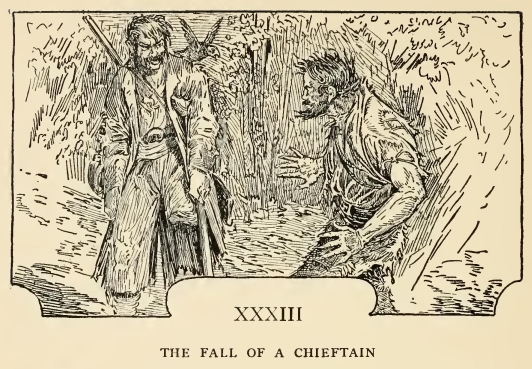
XXXIII
The Fall of a Chieftain
here never was such an overturn in this world. Each of these six men was asthough he had been struck. But with Silver the blow passed almost instantly.Every thought of his soul had been set full-stretch, like a racer, on thatmoney; well, he was brought up, in a single second, dead; and he kept his head,found his temper, and changed his plan before the others had had time torealize the disappointment.
“Jim,” he whispered, “take that, and stand by for trouble.”
And he passed me a double-barrelled pistol.
At the same time, he began quietly moving northward, and in a few steps had putthe hollow between us two and the other five. Then he looked at me and nodded,as much as to say, “Here is a narrow corner,” as, indeed, I thought it was. Hislooks were not quite friendly, and I was so revolted at these constant changesthat I could not forbear whispering, “So you’ve changed sides again.”
There was no time left for him to answer in. The buccaneers, with oaths andcries, began to leap, one after another, into the pit and to dig with theirfingers, throwing the boards aside as they did so. Morgan found a piece ofgold. He held it up with a perfect spout of oaths. It was a two-guinea piece,and it went from hand to hand among them for a quarter of a minute.
“Two guineas!” roared Merry, shaking it at Silver. “That’s your seven hundredthousand pounds, is it? You’re the man for bargains, ain’t you? You’re him thatnever bungled nothing, you wooden-headed lubber!”
“Dig away, boys,” said Silver with the coolest insolence; “you’ll find somepig-nuts and I shouldn’t wonder.”
“Pig-nuts!” repeated Merry, in a scream. “Mates, do you hear that? I tell younow, that man there knew it all along. Look in the face of him and you’ll seeit wrote there.”
“Ah, Merry,” remarked Silver, “standing for cap’n again? You’re a pushing lad,to be sure.”
But this time everyone was entirely in Merry’s favour. They began to scrambleout of the excavation, darting furious glances behind them. One thing Iobserved, which looked well for us: they all got out upon the opposite sidefrom Silver.
Well, there we stood, two on one side, five on the other, the pit between us,and nobody screwed up high enough to offer the first blow. Silver never moved;he watched them, very upright on his crutch, and looked as cool as ever I sawhim. He was brave, and no mistake.
At last Merry seemed to think a speech might help matters.
“Mates,” says he, “there’s two of them alone there; one’s the old cripple thatbrought us all here and blundered us down to this; the other’s that cub that Imean to have the heart of. Now, mates—”
He was raising his arm and his voice, and plainly meant to lead a charge. Butjust then—crack! crack! crack!—three musket-shots flashed out of the thicket.Merry tumbled head foremost into the excavation; the man with the bandage spunround like a teetotum and fell all his length upon his side, where he lay dead,but still twitching; and the other three turned and ran for it with all theirmight.
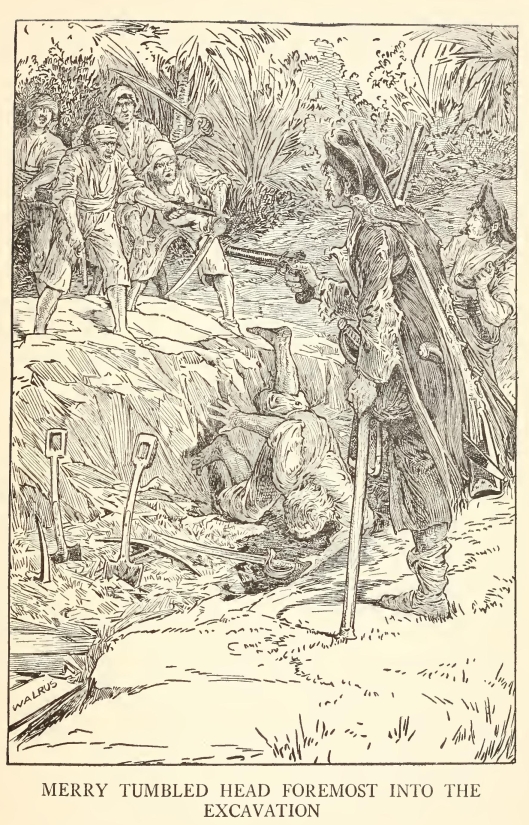
Before you could wink, Long John had fired two barrels of a pistol into thestruggling Merry, and as the man rolled up his eyes at him in the last agony,“George,” said he, “I reckon I settled you.”
At the same moment, the doctor, Gray, and Ben Gunn joined us, with smokingmuskets, from among the nutmeg-trees.
“Forward!” cried the doctor. “Double quick, my lads. We must head ’em off theboats.”
And we set off at a great pace, sometimes plunging through the bushes to thechest.
I tell you, but Silver was anxious to keep up with us. The work that man wentthrough, leaping on his crutch till the muscles of his chest were fit to burst,was work no sound man ever equalled; and so thinks the doctor. As it was, hewas already thirty yards behind us and on the verge of strangling when wereached the brow of the slope.
“Doctor,” he hailed, “see there! No hurry!”
Sure enough there was no hurry. In a more open part of the plateau, we couldsee the three survivors still running in the same direction as they hadstarted, right for Mizzenmast Hill. We were already between them and the boats;and so we four sat down to breathe, while Long John, mopping his face, cameslowly up with us.
“Thank ye kindly, doctor,” says he. “You came in in about the nick, I guess,for me and Hawkins. And so it’s you, Ben Gunn!” he added. “Well, you’re a niceone, to be sure.”
“I’m Ben Gunn, I am,” replied the maroon, wriggling like an eel in hisembarrassment. “And,” he added, after a long pause, “how do, Mr. Silver? Prettywell, I thank ye, says you.”
“Ben, Ben,” murmured Silver, “to think as you’ve done me!”
The doctor sent back Gray for one of the pick-axes deserted, in their flight,by the mutineers, and then as we proceeded leisurely downhill to where theboats were lying, related in a few words what had taken place. It was a storythat profoundly interested Silver; and Ben Gunn, the half-idiot maroon, was thehero from beginning to end.
Ben, in his long, lonely wanderings about the island, had found the skeleton—itwas he that had rifled it; he had found the treasure; he had dug it up (it wasthe haft of his pick-axe that lay broken in the excavation); he had carried iton his back, in many weary journeys, from the foot of the tall pine to a cavehe had on the two-pointed hill at the north-east angle of the island, and thereit had lain stored in safety since two months before the arrival of theHispaniola.
When the doctor had wormed this secret from him on the afternoon of the attack,and when next morning he saw the anchorage deserted, he had gone to Silver,given him the chart, which was now useless—given him the stores, for Ben Gunn’scave was well supplied with goats’ meat salted by himself—given anything andeverything to get a chance of moving in safety from the stockade to thetwo-pointed hill, there to be clear of malaria and keep a guard upon the money.
“As for you, Jim,” he said, “it went against my heart, but I did what I thoughtbest for those who had stood by their duty; and if you were not one of these,whose fault was it?”
That morning, finding that I was to be involved in the horrid disappointment hehad prepared for the mutineers, he had run all the way to the cave, and leavingthe squire to guard the captain, had taken Gray and the maroon and started,making the diagonal across the island to be at hand beside the pine. Soon,however, he saw that our party had the start of him; and Ben Gunn, being fleetof foot, had been dispatched in front to do his best alone. Then it hadoccurred to him to work upon the superstitions of his former shipmates, and hewas so far successful that Gray and the doctor had come up and were alreadyambushed before the arrival of the treasure-hunters.
“Ah,” said Silver, “it were fortunate for me that I had Hawkins here. You wouldhave let old John be cut to bits, and never given it a thought, doctor.”
“Not a thought,” replied Dr. Livesey cheerily.
And by this time we had reached the gigs. The doctor, with the pick-axe,demolished one of them, and then we all got aboard the other and set out to goround by sea for North Inlet.
This was a run of eight or nine miles. Silver, though he was almost killedalready with fatigue, was set to an oar, like the rest of us, and we were soonskimming swiftly over a smooth sea. Soon we passed out of the straits anddoubled the south-east corner of the island, round which, four days ago, we hadtowed the Hispaniola.
As we passed the two-pointed hill, we could see the black mouth of Ben Gunn’scave and a figure standing by it, leaning on a musket. It was the squire, andwe waved a handkerchief and gave him three cheers, in which the voice of Silverjoined as heartily as any.
Three miles farther, just inside the mouth of North Inlet, what should we meetbut the Hispaniola, cruising by herself? The last flood had lifted her,and had there been much wind or a strong tide current, as in the southernanchorage, we should never have found her more, or found her stranded beyondhelp. As it was, there was little amiss beyond the wreck of the main-sail.Another anchor was got ready and dropped in a fathom and a half of water. Weall pulled round again to Rum Cove, the nearest point for Ben Gunn’streasure-house; and then Gray, single-handed, returned with the gig to theHispaniola, where he was to pass the night on guard.
A gentle slope ran up from the beach to the entrance of the cave. At the top,the squire met us. To me he was cordial and kind, saying nothing of my escapadeeither in the way of blame or praise. At Silver’s polite salute he somewhatflushed.
“John Silver,” he said, “you’re a prodigious villain and imposter—a monstrousimposter, sir. I am told I am not to prosecute you. Well, then, I will not. Butthe dead men, sir, hang about your neck like mill-stones.”
“Thank you kindly, sir,” replied Long John, again saluting.
“I dare you to thank me!” cried the squire. “It is a gross dereliction of myduty. Stand back.”
And thereupon we all entered the cave. It was a large, airy place, with alittle spring and a pool of clear water, overhung with ferns. The floor wassand. Before a big fire lay Captain Smollett; and in a far corner, only duskilyflickered over by the blaze, I beheld great heaps of coin and quadrilateralsbuilt of bars of gold. That was Flint’s treasure that we had come so far toseek and that had cost already the lives of seventeen men from theHispaniola. How many it had cost in the amassing, what blood and sorrow,what good ships scuttled on the deep, what brave men walking the plankblindfold, what shot of cannon, what shame and lies and cruelty, perhaps no manalive could tell. Yet there were still three upon that island—Silver, and oldMorgan, and Ben Gunn—who had each taken his share in these crimes, as each hadhoped in vain to share in the reward.
“Come in, Jim,” said the captain. “You’re a good boy in your line, Jim, but Idon’t think you and me’ll go to sea again. You’re too much of the bornfavourite for me. Is that you, John Silver? What brings you here, man?”
“Come back to my dooty, sir,” returned Silver.
“Ah!” said the captain, and that was all he said.
What a supper I had of it that night, with all my friends around me; and what ameal it was, with Ben Gunn’s salted goat and some delicacies and a bottle ofold wine from the Hispaniola. Never, I am sure, were people gayer orhappier. And there was Silver, sitting back almost out of the firelight, buteating heartily, prompt to spring forward when anything was wanted, evenjoining quietly in our laughter—the same bland, polite, obsequious seaman ofthe voyage out.
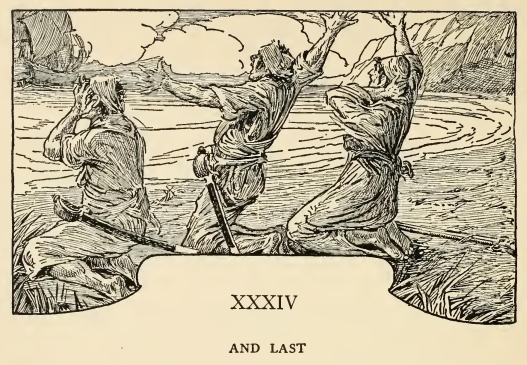
XXXIV
And Last
he next morning we fell early to work, for the transportation of this greatmass of gold near a mile by land to the beach, and thence three miles by boatto the Hispaniola, was a considerable task for so small a number ofworkmen. The three fellows still abroad upon the island did not greatly troubleus; a single sentry on the shoulder of the hill was sufficient to ensure usagainst any sudden onslaught, and we thought, besides, they had had more thanenough of fighting.
Therefore the work was pushed on briskly. Gray and Ben Gunn came and went withthe boat, while the rest during their absences piled treasure on the beach. Twoof the bars, slung in a rope’s end, made a good load for a grown man—one thathe was glad to walk slowly with. For my part, as I was not much use atcarrying, I was kept busy all day in the cave packing the minted money intobread-bags.
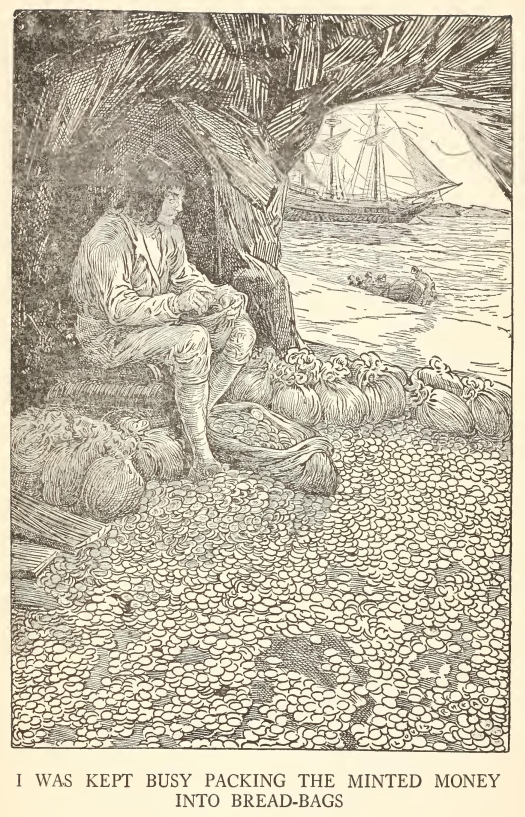
It was a strange collection, like Billy Bones’s hoard for the diversity ofcoinage, but so much larger and so much more varied that I think I never hadmore pleasure than in sorting them. English, French, Spanish, Portuguese,Georges, and Louises, doubloons and double guineas and moidores and sequins,the pictures of all the kings of Europe for the last hundred years, strangeOriental pieces stamped with what looked like wisps of string or bits ofspider’s web, round pieces and square pieces, and pieces bored through themiddle, as if to wear them round your neck—nearly every variety of money in theworld must, I think, have found a place in that collection; and for number, Iam sure they were like autumn leaves, so that my back ached with stooping andmy fingers with sorting them out.
Day after day this work went on; by every evening a fortune had been stowedaboard, but there was another fortune waiting for the morrow; and all this timewe heard nothing of the three surviving mutineers.
At last—I think it was on the third night—the doctor and I were strolling onthe shoulder of the hill where it overlooks the lowlands of the isle, when,from out the thick darkness below, the wind brought us a noise betweenshrieking and singing. It was only a snatch that reached our ears, followed bythe former silence.
“Heaven forgive them,” said the doctor; “’tis the mutineers!”
“All drunk, sir,” struck in the voice of Silver from behind us.
Silver, I should say, was allowed his entire liberty, and in spite of dailyrebuffs, seemed to regard himself once more as quite a privileged and friendlydependent. Indeed, it was remarkable how well he bore these slights and withwhat unwearying politeness he kept on trying to ingratiate himself with all.Yet, I think, none treated him better than a dog, unless it was Ben Gunn, whowas still terribly afraid of his old quartermaster, or myself, who had reallysomething to thank him for; although for that matter, I suppose, I had reasonto think even worse of him than anybody else, for I had seen him meditating afresh treachery upon the plateau. Accordingly, it was pretty gruffly that thedoctor answered him.
“Drunk or raving,” said he.
“Right you were, sir,” replied Silver; “and precious little odds which, to youand me.”
“I suppose you would hardly ask me to call you a humane man,” returned thedoctor with a sneer, “and so my feelings may surprise you, Master Silver. Butif I were sure they were raving—as I am morally certain one, at least, of themis down with fever—I should leave this camp, and at whatever risk to my owncarcass, take them the assistance of my skill.”
“Ask your pardon, sir, you would be very wrong,” quoth Silver. “You would loseyour precious life, and you may lay to that. I’m on your side now, hand andglove; and I shouldn’t wish for to see the party weakened, let alone yourself,seeing as I know what I owes you. But these men down there, they couldn’t keeptheir word—no, not supposing they wished to; and what’s more, they couldn’tbelieve as you could.”
“No,” said the doctor. “You’re the man to keep your word, we know that.”
Well, that was about the last news we had of the three pirates. Only once weheard a gunshot a great way off and supposed them to be hunting. A council washeld, and it was decided that we must desert them on the island—to the hugeglee, I must say, of Ben Gunn, and with the strong approval of Gray. We left agood stock of powder and shot, the bulk of the salt goat, a few medicines, andsome other necessaries, tools, clothing, a spare sail, a fathom or two of rope,and by the particular desire of the doctor, a handsome present of tobacco.
That was about our last doing on the island. Before that, we had got thetreasure stowed and had shipped enough water and the remainder of the goat meatin case of any distress; and at last, one fine morning, we weighed anchor,which was about all that we could manage, and stood out of North Inlet, thesame colours flying that the captain had flown and fought under at thepalisade.
The three fellows must have been watching us closer than we thought for, as wesoon had proved. For coming through the narrows, we had to lie very near thesouthern point, and there we saw all three of them kneeling together on a spitof sand, with their arms raised in supplication. It went to all our hearts, Ithink, to leave them in that wretched state; but we could not risk anothermutiny; and to take them home for the gibbet would have been a cruel sort ofkindness. The doctor hailed them and told them of the stores we had left, andwhere they were to find them. But they continued to call us by name and appealto us, for God’s sake, to be merciful and not leave them to die in such aplace.
At last, seeing the ship still bore on her course and was now swiftly drawingout of earshot, one of them—I know not which it was—leapt to his feet with ahoarse cry, whipped his musket to his shoulder, and sent a shot whistling overSilver’s head and through the main-sail.
After that, we kept under cover of the bulwarks, and when next I looked outthey had disappeared from the spit, and the spit itself had almost melted outof sight in the growing distance. That was, at least, the end of that; andbefore noon, to my inexpressible joy, the highest rock of Treasure Island hadsunk into the blue round of sea.
We were so short of men that everyone on board had to bear a hand—only thecaptain lying on a mattress in the stern and giving his orders, for thoughgreatly recovered he was still in want of quiet. We laid her head for thenearest port in Spanish America, for we could not risk the voyage home withoutfresh hands; and as it was, what with baffling winds and a couple of freshgales, we were all worn out before we reached it.
It was just at sundown when we cast anchor in a most beautiful land-lockedgulf, and were immediately surrounded by shore boats full of Negroes andMexican Indians and half-bloods selling fruits and vegetables and offering todive for bits of money. The sight of so many good-humoured faces (especiallythe blacks), the taste of the tropical fruits, and above all the lights thatbegan to shine in the town made a most charming contrast to our dark and bloodysojourn on the island; and the doctor and the squire, taking me along withthem, went ashore to pass the early part of the night. Here they met thecaptain of an English man-of-war, fell in talk with him, went on board hisship, and, in short, had so agreeable a time that day was breaking when we camealongside the Hispaniola.
Ben Gunn was on deck alone, and as soon as we came on board he began, withwonderful contortions, to make us a confession. Silver was gone. The maroon hadconnived at his escape in a shore boat some hours ago, and he now assured us hehad only done so to preserve our lives, which would certainly have been forfeitif “that man with the one leg had stayed aboard.” But this was not all. Thesea-cook had not gone empty-handed. He had cut through a bulkhead unobservedand had removed one of the sacks of coin, worth perhaps three or four hundredguineas, to help him on his further wanderings.
I think we were all pleased to be so cheaply quit of him.
Well, to make a long story short, we got a few hands on board, made a goodcruise home, and the Hispaniolareached Bristol just as Mr. Blandly wasbeginning to think of fitting out her consort. Five men only of those who hadsailed returned with her. “Drink and the devil had done for the rest,” with avengeance, although, to be sure, we were not quite in so bad a case as thatother ship they sang about:
With one man of her crew alive,
What put to sea with seventy-five.
All of us had an ample share of the treasure and used it wisely or foolishly,according to our natures. Captain Smollett is now retired from the sea. Graynot only saved his money, but being suddenly smit with the desire to rise, alsostudied his profession, and he is now mate and part owner of a fine full-riggedship, married besides, and the father of a family. As for Ben Gunn, he got athousand pounds, which he spent or lost in three weeks, or to be more exact, innineteen days, for he was back begging on the twentieth. Then he was given alodge to keep, exactly as he had feared upon the island; and he still lives, agreat favourite, though something of a butt, with the country boys, and anotable singer in church on Sundays and saints’ days.
Of Silver we have heard no more. That formidable seafaring man with one leg hasat last gone clean out of my life; but I dare say he met his old Negress, andperhaps still lives in comfort with her and Captain Flint. It is to be hopedso, I suppose, for his chances of comfort in another world are very small.
The bar silver and the arms still lie, for all that I know, where Flint buriedthem; and certainly they shall lie there for me. Oxen and wain-ropes would notbring me back again to that accursed island; and the worst dreams that ever Ihave are when I hear the surf booming about its coasts or start upright in bedwith the sharp voice of Captain Flint still ringing in my ears: “Pieces ofeight! Pieces of eight!”
- Previous: The Great Stone Face and Other Tales of the White Mountains, by Nathaniel Hawthorne
- Next: God the Invisible King, by H. G. Wells
- The Project Gutenberg eBook of The Taming of the Shrew, by William Shakespeare
- The Project Gutenberg eBook of Measure for Measure, by William Shakespeare
- The Polity of the Athenians and The Lacedaemonians, by Xenophon
- The Light of Western Stars
- The Bickerstaff
- A Modest Proposal
- The Project Gutenberg eBook of King Henry IV, Part 2, by William Shakespeare
- The Project Gutenberg eBook of King Henry VI, Part 2, by William Shakespeare
- Rupert of Hentzau, by Anthony Hope
- Step by Step, by The American Tract Society
Related articles
- The Project Gutenberg eBook of The Tempest, by William Shakespeare
- A Wasted Day, by Richard Harding Davis
- A Question of Latitude, by Richard Harding Davis
- Philebus, by Plato
- Uncle Vanya, by Anton Checkov
- The Project Gutenberg eBook of Extracts From Adam’s Diary by Mark Twain
- The Project Gutenberg eBook of King Lear, by William Shakespeare
- New Collected Rhymes, by Andrew Lang
- The Prince
- The Nature Faker, by Richard Harding Davis
- The Project Gutenberg eBook of The Chignecto Isthmus and Its First Settlers, by Howard Trueman
- Secrets of the Woods, by William J. Long
- The Project Gutenberg eBook of The Ballad of the White Horse, by G.K. Chesterton
- A Question of Latitude, by Richard Harding Davis
- Albert Savarus, by Honore de Balzac
- Peace Manoeuvres, by Richard Harding Davis
- A History of Science, Vol. IV by Henry Smith Williams
- The Human Drift
- Eryxias, by A Platonic Imitator
- Michael Strogoff, by Jules Verne
Browse randomly
- Copyright © 2026 Powered by Treasure Island,engineering kits for 11 year olds under 30 dollars sitemap